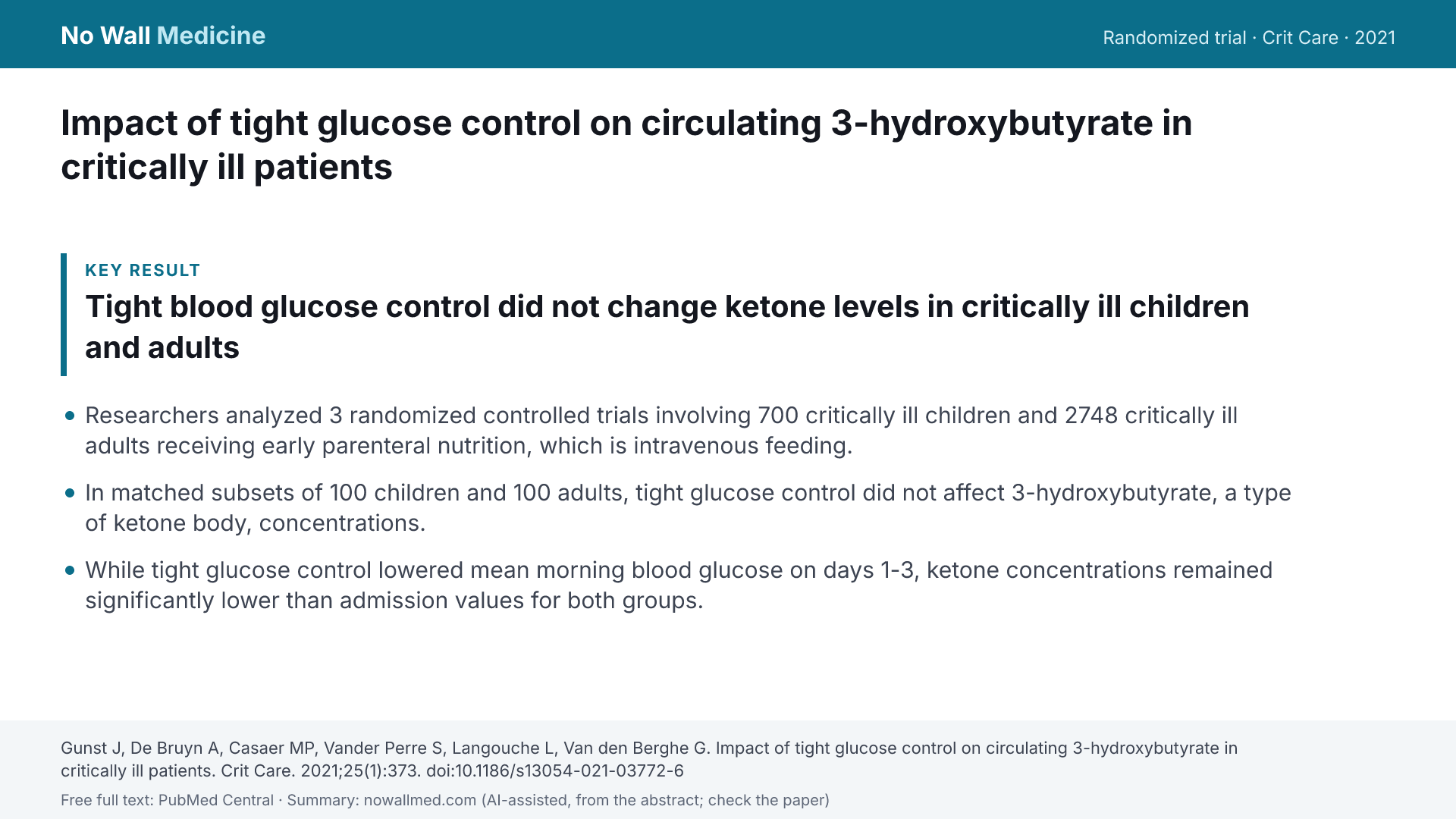
Tight blood glucose control did not change ketone levels in critically ill children and adults
Impact of tight glucose control on circulating 3-hydroxybutyrate in critically ill patients
Key points
- Researchers analyzed 3 randomized controlled trials involving 700 critically ill children and 2748 critically ill adults receiving early parenteral nutrition, which is intravenous feeding.
- In matched subsets of 100 children and 100 adults, tight glucose control did not affect 3-hydroxybutyrate, a type of ketone body, concentrations.
- While tight glucose control lowered mean morning blood glucose on days 1-3, ketone concentrations remained significantly lower than admission values for both groups.
Headline and key points written with AI from the paper’s abstract, with every number checked against it. Read the paper before relying on them.
Was this summary helpful?
Abstract
Background
Recent evidence suggests a potentially protective effect of increasing ketone body availability via accepting low macronutrient intake early after onset of critical illness. The impact of blood glucose control with insulin on circulating ketones is unclear. Whereas lowering blood glucose may activate ketogenesis, high insulin concentrations may have the opposite effect. We hypothesized that the previously reported protective effects of tight glucose control in critically ill patients receiving early parenteral nutrition may have been mediated in part by activation of ketogenesis. Methods
This is a secondary analysis of 3 randomized controlled trials on tight versus liberal blood glucose control in the intensive care unit, including 700 critically ill children and 2748 critically ill adults. All patients received early parenteral nutrition as part of the contemporary standard of care. Before studying a potential mediator role of circulating ketones in improving outcome, we performed a time course analysis to investigate whether tight glucose control significantly affected ketogenesis and to identify a day of maximal effect, if any. We quantified plasma/serum 3-hydroxybutyrate concentrations from intensive care unit admission until day 3 in 2 matched subsets of 100 critically ill children and 100 critically ill adults. Univariable differences between groups were investigated by Kruskal-Wallis test. Differences in 3-hydroxybutyrate concentrations between study days were investigated by Wilcoxon signed-rank test. Results
In critically ill children and adults receiving early parenteral nutrition, tight glucose control, as compared with liberal glucose control, lowered mean morning blood glucose on days 1-3 (P < 0.0001) via infusing insulin at a higher dose (P < 0.0001). Throughout the study period, caloric intake was not different between groups. In both children and adults, tight glucose control did not affect 3-hydroxybutyrate concentrations, which were suppressed on ICU days 1-3 and significantly lower than the ICU admission values for both groups (P < 0.0001). Conclusion
Tight versus liberal glucose control in the context of early parenteral nutrition did not affect 3-hydroxybutyrate concentrations in critically ill patients. Hence, the protective effects of tight glucose control in this context cannot be attributed to increased ketone body availability.
Abstract reproduced under the article’s CC BY licence.
Subject terms
Headline, design, result, key points, caveat and citation as plain text.
Cite this article
Gunst J, De Bruyn A, Casaer MP, Vander Perre S, Langouche L, Van den Berghe G. Impact of tight glucose control on circulating 3-hydroxybutyrate in critically ill patients. Crit Care. 2021;25(1):373. doi:10.1186/s13054-021-03772-6
Spotted a mistake? Suggest a correction