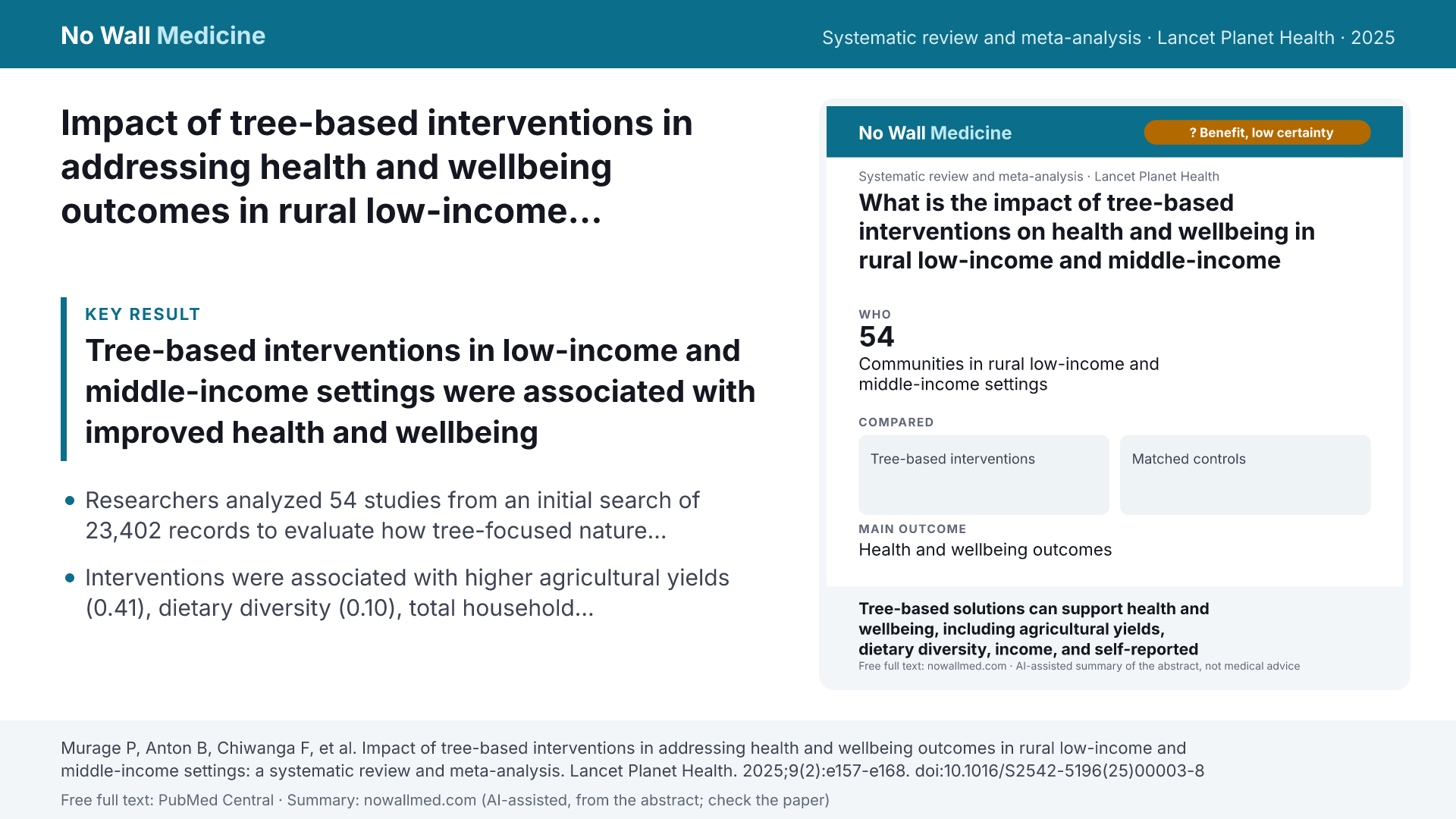
Tree-based interventions in low-income and middle-income settings were associated with improved health and wellbeing
Impact of tree-based interventions in addressing health and wellbeing outcomes in rural low-income and middle-income settings: a systematic review and meta-analysis
Systematic review and meta-analysisBenefit, low certainty
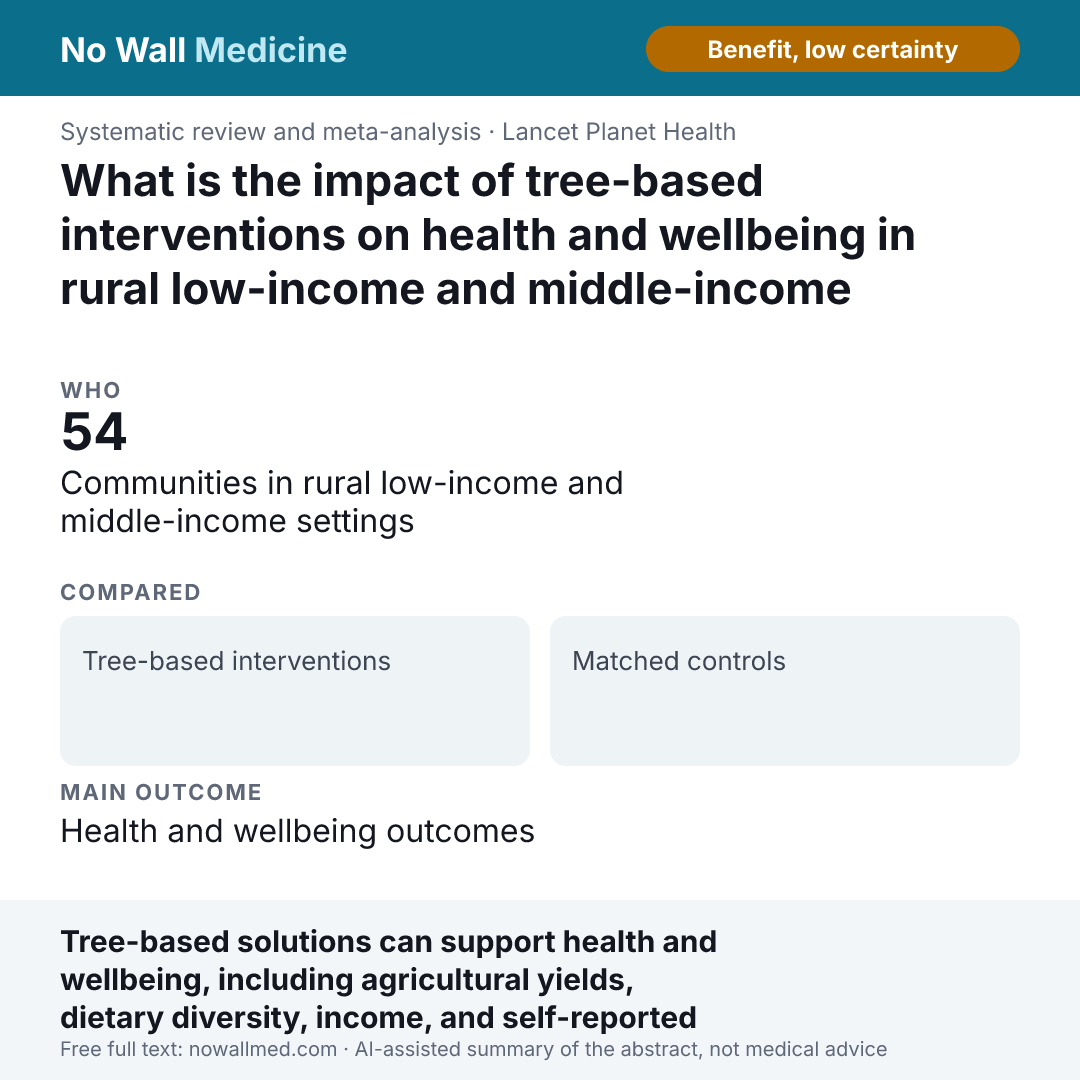
What is the impact of tree-based interventions on health and wellbeing in rural low-income and middle-income settings?
Who
54
Communities in rural low-income and middle-income settings
Compared
Tree-based interventions
Matched controls
Main outcome
Health and wellbeing outcomes
Result: standardised mean difference 0.41 (95% CI 0.11 to 0.70) for agricultural yields
Bottom line: Tree-based solutions can support health and wellbeing, including agricultural yields, dietary diversity, income, and self-reported wellbeing.
Limitation: Cautious interpretation is urged owing to the low certainty of the evidence.
Lancet Planet Health · 2025-02-23 · Save PNG
Clinical question: What is the impact of tree-based interventions on health and wellbeing in rural low-income and middle-income settings?
Why it matters: The strength of evidence and the extent to which nature-based solutions support policy and practice in low-income and middle-income settings are currently insufficient.
Key points
- Researchers analyzed 54 studies from an initial search of 23,402 records to evaluate how tree-focused nature solutions affect people in rural, low-income, and middle-income areas.
- Interventions were associated with higher agricultural yields (0.41), dietary diversity (0.10), total household income (0.21), poverty reduction (0.17), child growth (0.11), and self-reported wellbeing (0.21).
- While timber production income loss was associated with -0.13, increased income from non-timber forest products was associated with 0.32.
Limitation the authors note: The authors urge cautious interpretation of the results owing to the low certainty of the evidence.
Headline and key points written with AI from the paper’s abstract, with every number checked against it. Read the paper before relying on them.
Was this summary helpful?
Abstract
The impact of nature-based solutions on human health is increasingly recognised; however, our understanding of the strength of evidence and the extent to which it supports policy and practice is insufficient. We aimed to assess the health and wellbeing impacts of solutions in low-income and middle-income settings in which trees are a central feature in the protection, restoration, and sustainable management of landscapes. For this systematic review and meta-analysis, we searched Web of Science, Embase, APA PsycInfo, MEDLINE ALL, Global Health, Global Index Medicus, GreenFILE, SciELO, EconLit, and Africa-Wide Information for studies that evaluated the impacts of relevant interventions on health and wellbeing. Searches were limited to records published from Jan 1, 2000, to the search date; an initial search was conducted on Nov 23, 2021, and was updated on Feb 27-28, 2023. We extracted data from studies comparing interventions with matched controls, calculated standardised mean differences, and pooled the effects using random-effects meta-analysis with adjustments for potential effect dependence. Studies were assessed for quality using seven risk-of-bias domains. Our search identified 23 402 studies, of which 54 were included in the meta-analysis. We found significant positive pooled effects for agricultural yields (standardised mean difference 0·41 [95% CI 0·11 to 0·70]), dietary diversity (0·10 [0·02 to 0·18]), total household income (0·21 [0·09 to 0·33]), poverty reduction (0·17 [0·07 to 0·27]), child growth (0·11 [0·00 to 0·22]), and self-reported wellbeing (0·21 [0·00 to 0·43]). Loss of income from timber production could be a negative outcome (-0·13 [-0·29 to 0·02]); however, these effects might be partially offset by increased income from non-timber forest products (0·32 [0·04 to 0·61]). Effects varied substantially by intervention type, with more positive effects associated with interventions in which the primary target was livelihood improvement than with interventions that targeted biodiversity or carbon mitigation. However, cautious interpretation is urged owing to the low certainty of the evidence. In conclusion, evidence suggests that tree-based solutions can support the health and wellbeing of the implementing communities. Such evidence strengthens the case for aligning health objectives with the goals of nature-based solutions by making community wellbeing an integral component of conservation programmes. Future studies should examine a wider range of outcomes that have direct relevance for health.
Abstract reproduced under the article’s CC BY licence.
Subject terms
Headline, design, result, key points, caveat and citation as plain text.
Cite this article
Murage P, Anton B, Chiwanga F, et al. Impact of tree-based interventions in addressing health and wellbeing outcomes in rural low-income and middle-income settings: a systematic review and meta-analysis. Lancet Planet Health. 2025;9(2):e157-e168. doi:10.1016/S2542-5196(25)00003-8
Spotted a mistake? Suggest a correction