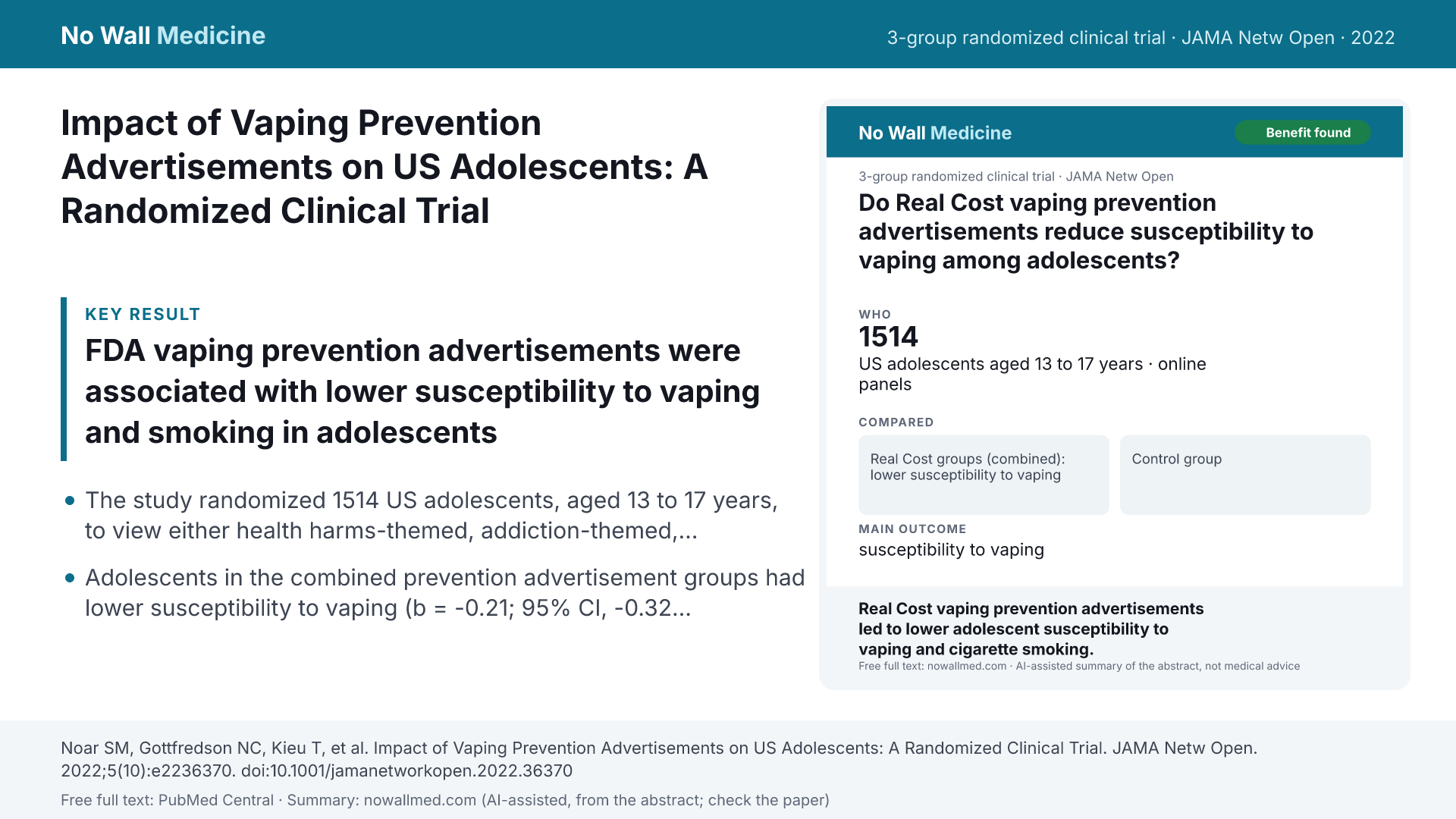
FDA vaping prevention advertisements were associated with lower susceptibility to vaping and smoking in adolescents
Impact of Vaping Prevention Advertisements on US Adolescents: A Randomized Clinical Trial
3-group randomized clinical trialBenefit found
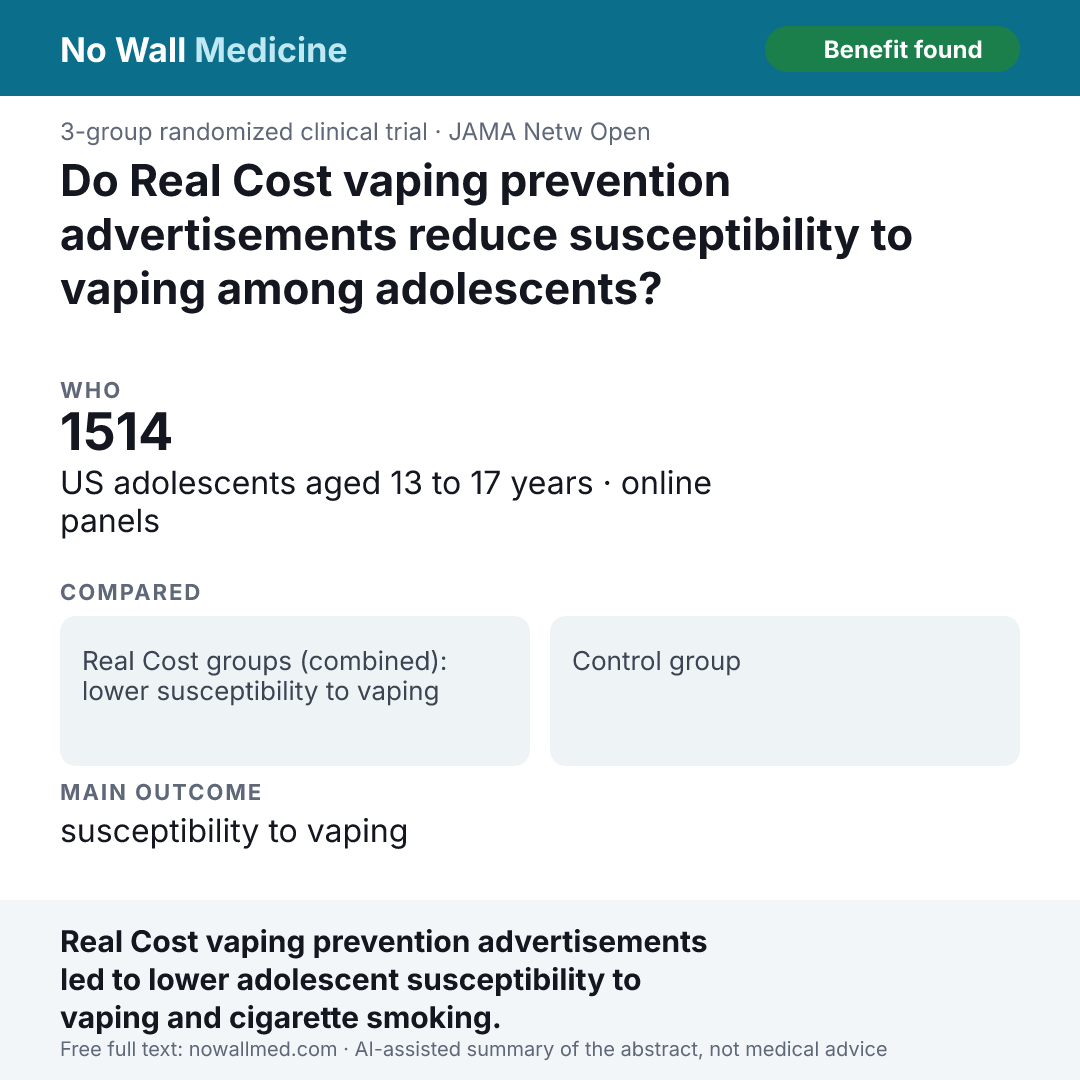
Do Real Cost vaping prevention advertisements reduce susceptibility to vaping among adolescents?
Who
1514
US adolescents aged 13 to 17 years · online panels
Compared
Real Cost groups (combined): lower susceptibility to vaping
Control group
Main outcome
susceptibility to vaping
Result: b = -0.21 (95% CI, -0.32 to -0.10)
Bottom line: Real Cost vaping prevention advertisements led to lower adolescent susceptibility to vaping and cigarette smoking.
JAMA Netw Open · 2022-10-03 · Save PNG
Clinical question: Do Real Cost vaping prevention advertisements reduce susceptibility to vaping among adolescents?
Key points
- The study randomized 1514 US adolescents, aged 13 to 17 years, to view either health harms-themed, addiction-themed, or neutral videos about vaping.
- Adolescents in the combined prevention advertisement groups had lower susceptibility to vaping (b = -0.21; 95% CI, -0.32 to -0.10) and smoking (b = -0.21; 95% CI, -0.32 to -0.10) than the control group.
- There was no significant difference between the health harms-themed and addiction-themed advertisement groups regarding susceptibility to vaping (b = -0.05; 95% CI, -0.17 to 0.07).
Headline and key points written with AI from the paper’s abstract, with every number checked against it. Read the paper before relying on them.
Was this summary helpful?
Subject terms
Headline, design, result, key points, caveat and citation as plain text.
Cite this article
Noar SM, Gottfredson NC, Kieu T, et al. Impact of Vaping Prevention Advertisements on US Adolescents: A Randomized Clinical Trial. JAMA Netw Open. 2022;5(10):e2236370. doi:10.1001/jamanetworkopen.2022.36370
Spotted a mistake? Suggest a correction