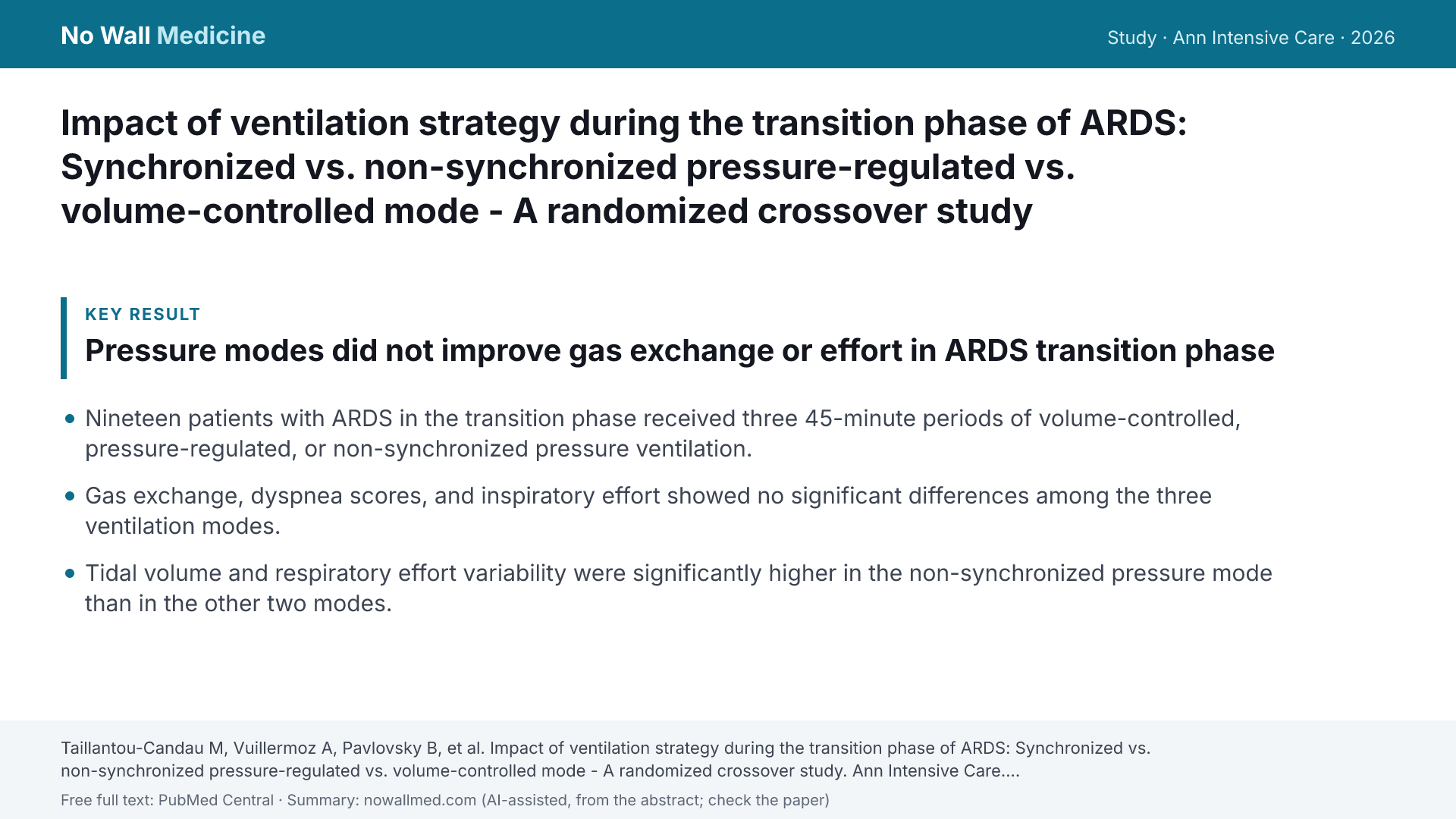
Pressure modes did not improve gas exchange or effort in ARDS transition phase
Impact of ventilation strategy during the transition phase of ARDS: Synchronized vs. non-synchronized pressure-regulated vs. volume-controlled mode - A randomized crossover study
Why it matters: Limited data exist on the optimal ventilation strategy during the ARDS transition phase when spontaneous breathing resumes and lung recovery is ongoing.
Key points
- Nineteen patients with ARDS in the transition phase received three 45-minute periods of volume-controlled, pressure-regulated, or non-synchronized pressure ventilation.
- Gas exchange, dyspnea scores, and inspiratory effort showed no significant differences among the three ventilation modes.
- Tidal volume and respiratory effort variability were significantly higher in the non-synchronized pressure mode than in the other two modes.
Limitation the authors note: The study involved only 19 patients who completed the crossover design.
Headline and key points written with AI from the paper’s abstract, with every number checked against it. Read the paper before relying on them.
Was this summary helpful?
Headline, design, result, key points, caveat and citation as plain text.
Cite this article
Taillantou-Candau M, Vuillermoz A, Pavlovsky B, et al. Impact of ventilation strategy during the transition phase of ARDS: Synchronized vs. non-synchronized pressure-regulated vs. volume-controlled mode - A randomized crossover study. Ann Intensive Care. 2026;16:100200. doi:10.1016/j.aicoj.2026.100200
Spotted a mistake? Suggest a correction