Releasing Wolbachia-infected male mosquitoes reduced dengue incidence in a large Singapore trial
Impact of Wolbachia-mediated incompatible and sterile insect techniques on dengue incidence: a large-scale cluster randomised controlled trial
Large-scale cluster-randomised controlled trialBenefit found
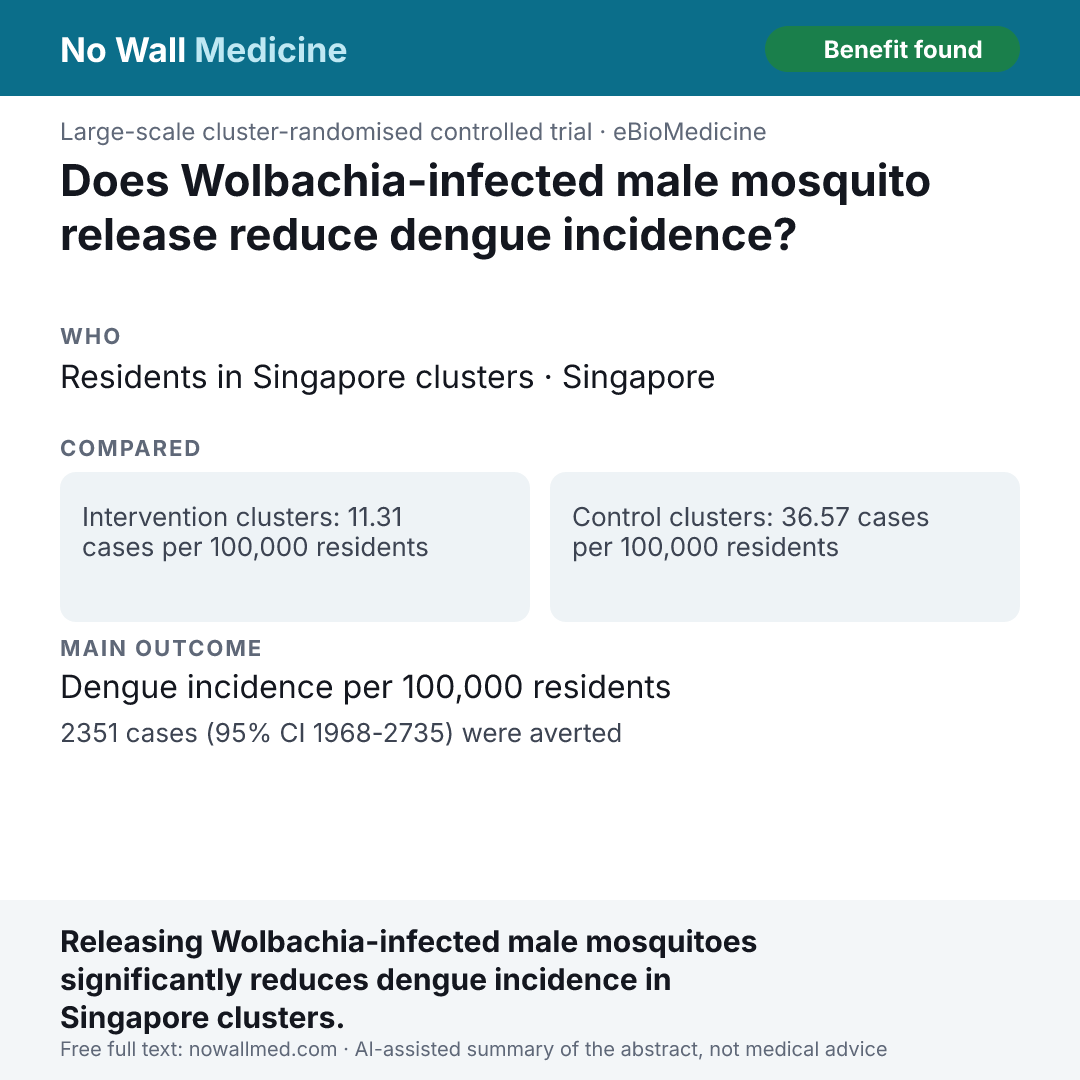
Does Wolbachia-infected male mosquito release reduce dengue incidence?
Who
Residents in Singapore clusters · Singapore
Compared
Intervention clusters: 11.31 cases per 100,000 residents
Control clusters: 36.57 cases per 100,000 residents
Main outcome
Dengue incidence per 100,000 residents
Result: 2351 cases (95% CI 1968-2735) were averted
Bottom line: Releasing Wolbachia-infected male mosquitoes significantly reduces dengue incidence in Singapore clusters.
Funded by: Ministry of Finance, Singapore
eBioMedicine · 2026-09-10 · Save PNG
Clinical question: Does Wolbachia-infected male mosquito release reduce dengue incidence?
Why it matters: Robust evidence was needed to determine if releasing Wolbachia-infected male mosquitoes could effectively reduce the incidence of dengue fever.
Key points
- Researchers conducted a cluster-randomised controlled trial in Singapore involving 393,236 mosquitoes released in 8 intervention clusters and 331,192 mosquitoes in 7 control clusters.
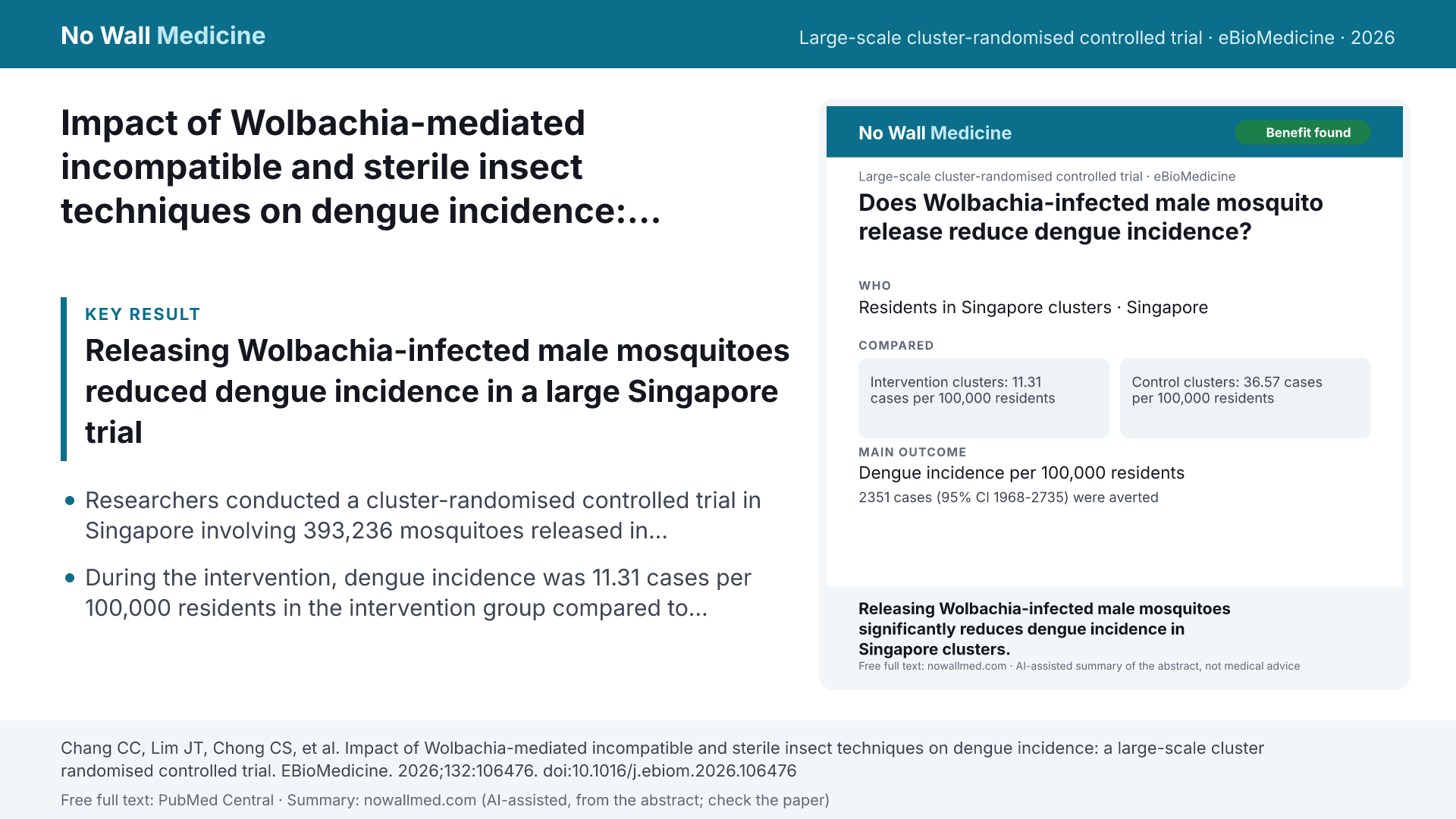
- During the intervention, dengue incidence was 11.31 cases per 100,000 residents in the intervention group compared to 36.57 cases per 100,000 in the control group.
- The study estimated that 2351 cases were averted during the trial period relative to the 1037 cases reported in the intervention arm.
Headline and key points written with AI from the paper’s abstract, with every number checked against it. Read the paper before relying on them.
Was this summary helpful?
Subject terms
Headline, design, result, key points, caveat and citation as plain text.
Cite this article
Chang CC, Lim JT, Chong CS, et al. Impact of Wolbachia-mediated incompatible and sterile insect techniques on dengue incidence: a large-scale cluster randomised controlled trial. EBioMedicine. 2026;132:106476. doi:10.1016/j.ebiom.2026.106476
Spotted a mistake? Suggest a correction