Impacts of ischemic preconditioning in liver resection: systematic review with meta-analysis
Systematic review with meta-analysisBenefit found
Does ischemic preconditioning benefit patients undergoing liver resection?
Who
1052
Patients undergoing liver resection
Compared
Ischemic preconditioning
No preconditioning
Main outcome
Bleeding, blood product transfusion, and postoperative ascites
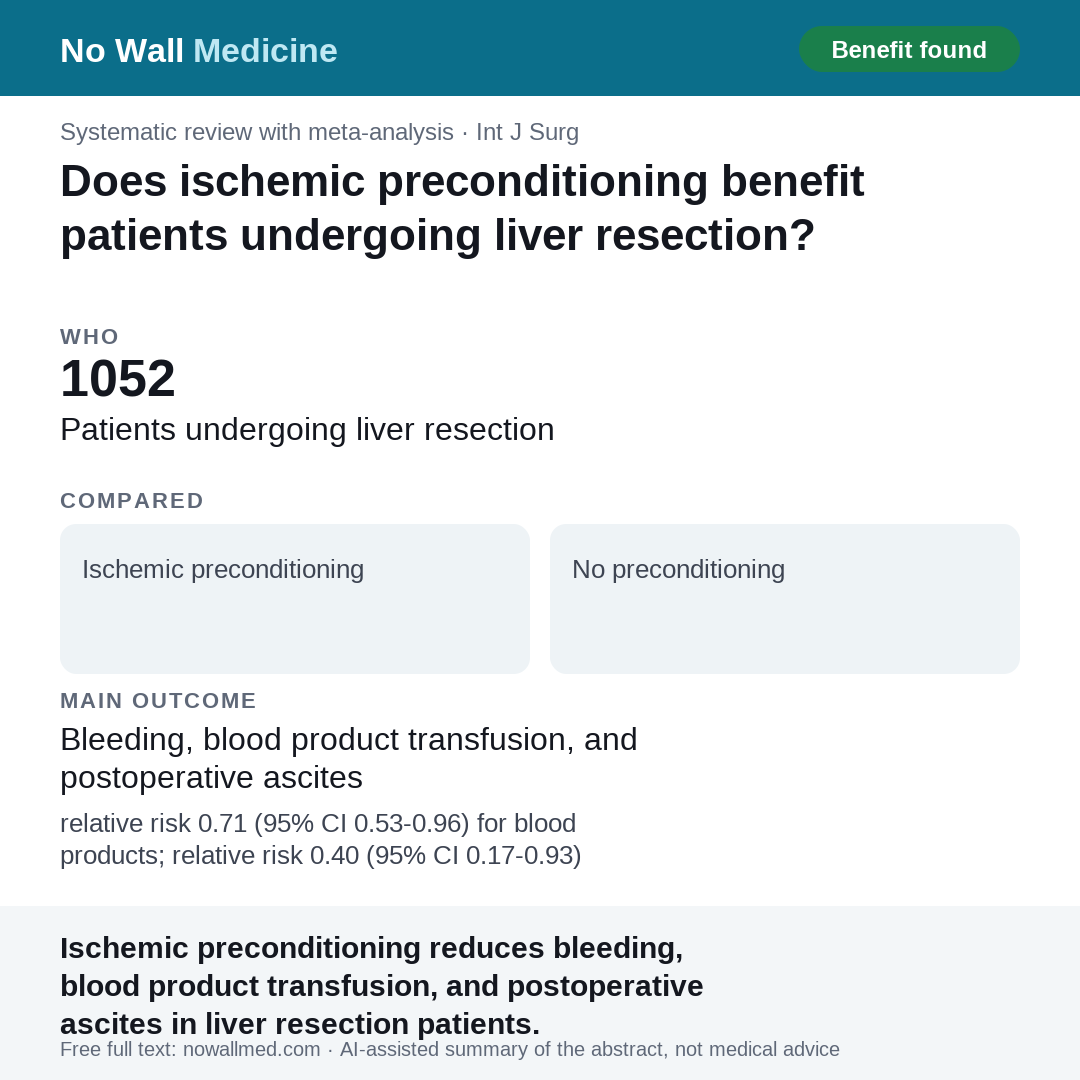
Result: relative risk 0.71 (95% CI 0.53-0.96) for blood products; relative risk 0.40 (95% CI 0.17-0.93) for ascites
Bottom line: Ischemic preconditioning reduces bleeding, blood product transfusion, and postoperative ascites in liver resection patients.
Limitation: Not enough evidence to encourage routine use due to high heterogeneity in some outcomes.
Int J Surg · 2023-06-01Download image
Clinical question: Does ischemic preconditioning benefit patients undergoing liver resection?
Abstract
Objective
To assess the beneficial effects of ischemic preconditioning (IPC) in liver resection and evaluate its applicability in clinical practice. Summary background data
Liver surgeries are usually associated with intentional transient ischemia for hemostatic control. IPC is a surgical step that intends to reduce the effects of ischemia-reperfusion; however, there is no strong evidence about the real impact of the IPC, and it is necessary to effectively clarify what its effects are. Methods
Randomized clinical trials were selected, comparing IPC with no preconditioning in patients undergoing liver resection. Data were extracted by three independent researchers according to the PRISMA (Preferred Reporting Items for Systematic Reviews and Meta-Analyses) guidelines, Supplemental Digital Content 1, http://links.lww.com/JS9/A79 . Several outcomes were evaluated, including postoperative peaks of transaminases and bilirubin, mortality, length of hospital stay, length of stay in the ICU, bleeding, and transfusion of blood products, among others. Bias risks were assessed using the Cochrane collaboration tool. Results
Seventeen articles were selected, with a total of 1052 patients. IPC did not change the surgical time of the liver resections while these patients bled less (Mean Difference: -49.97 ml; 95% CI: -86.32 to -13.6; I2 : 64%), needed less blood products [relative risk (RR): 0.71; 95% CI: 0.53-0.96; I2 =0%], and had a lower risk of postoperative ascites (RR: 0.40; 95% CI: 0.17-0.93; I2 =0%). The other outcomes had no statistical differences or could not have their meta-analyses conducted due to high heterogeneity. Conclusions
IPC is applicable in clinical practice, and it has some beneficial effects. However, there is not enough evidence to encourage its routine use.
Subject terms
Cite this article
de Oliveira GC, de Oliveira WK, Yoshida WB, Sobreira ML. Impacts of ischemic preconditioning in liver resection: systematic review with meta-analysis. Int J Surg. 2023. doi:10.1097/JS9.0000000000000243
Spotted a mistake? Suggest a correction
Top studies every Monday
The week’s key trials and guidelines in your specialties, plus any topics you follow. By email, free.
Get the weekly digest