Effective antirheumatic therapy restored blood clotting and clot breakdown balance in early rheumatoid arthritis
Impaired coagulation parameters in early RA are restored by effective antirheumatic therapy: a prospective pilot study
Randomized prospective pilot studyBenefit found
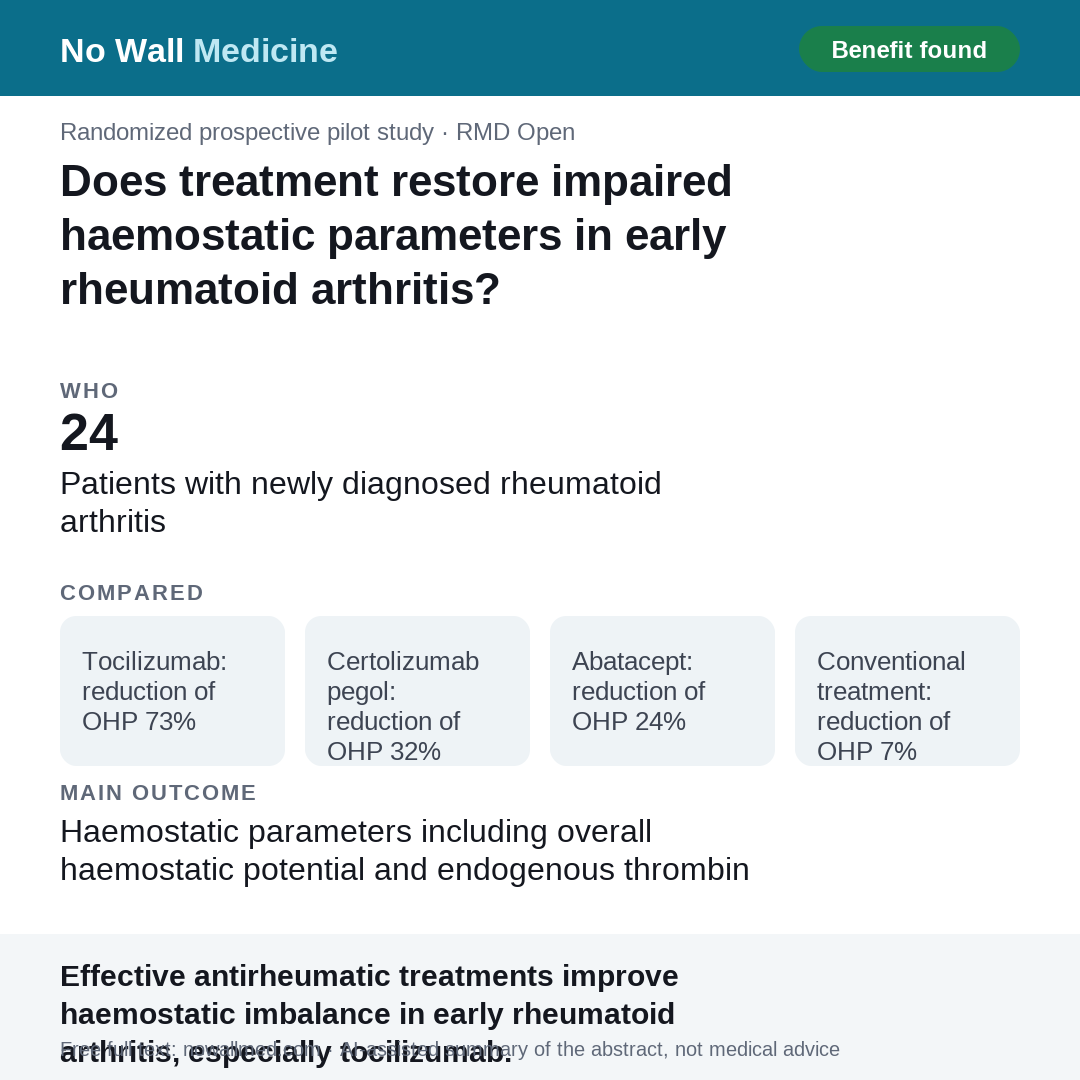
Does treatment restore impaired haemostatic parameters in early rheumatoid arthritis?
Who
24
Patients with newly diagnosed rheumatoid arthritis
Compared
Tocilizumab: reduction of OHP 73%
Certolizumab pegol: reduction of OHP 32%
Abatacept: reduction of OHP 24%
Conventional treatment: reduction of OHP 7%
Main outcome
Haemostatic parameters including overall haemostatic potential and endogenous thrombin potential
Bottom line: Effective antirheumatic treatments improve haemostatic imbalance in early rheumatoid arthritis, especially tocilizumab.
RMD Open · 2024-12-31Download image
Clinical question: Does treatment restore impaired haemostatic parameters in early rheumatoid arthritis?
Why it matters: It was unknown how effective antirheumatic treatments affect the balance of blood clotting and clot breakdown in patients with newly diagnosed rheumatoid arthritis.
Key points
- Researchers studied 24 patients with newly diagnosed rheumatoid arthritis randomized to receive methotrexate plus either conventional treatment, certolizumab pegol, abatacept, or tocilizumab.
- After 24 weeks, patients showed significant changes in biomarkers including fibrinogen, D-dimer, and global clotting assays like overall haemostatic potential and endogenous thrombin potential.
- Tocilizumab resulted in a 73% reduction in overall haemostatic potential compared to 32% for certolizumab pegol, 24% for abatacept, and 7% for conventional treatment.
Headline and key points written with AI from the paper’s abstract, with every number checked against it. Read the paper before relying on them.
Was this summary helpful?
Abstract
Objectives
To assess the effect of treatment on haemostatic parameters in patients with early rheumatoid arthritis (RA). Methods
Patients with newly diagnosed RA started methotrexate and were randomised to additional conventional treatment, certolizumab pegol, abatacept or tocilizumab. Several biomarkers for haemostasis were analysed including parameters of the two global haemostatic assays-overall haemostatic potential (OHP) and endogenous thrombin potential (ETP), as well as single haemostatic factors-fibrinogen, prothrombin fragment 1+2 (F1+2), D-dimer, thrombin activatable fibrinolysis inhibitor (TAFI) and clot lysis time (CLT) in 24 patients at baseline, 12 and 24 weeks after the start of the treatment. Results
At baseline, patients had elevated levels of the following biomarkers compared with reference values: fibrinogen, F1+2, D-dimer and parameters of the two global haemostatic assays, that is, ETP and OHP. After 24 weeks we observed a significant reduction in F1+2 (p<0.01), fibrinogen (p<0.01), D-dimer (p<0.01), OHP (p<0.01), ETP (p<0.01), CLT (p<0.01), TAFI (p<0.01) and an increase of OFP (p<0.01). Tocilizumab treatment resulted in the most significant reduction of global haemostatic assays after 24 weeks, that is, a reduction of OHP 73% (p<0.01) compared with certolizumab pegol arm 32% (p<0.01), abatacept arm 24% (p=0.25) or conventional treatment arm 7% (p=0.66). Conclusion
Newly diagnosed RA patients have enhanced coagulation activation and impaired fibrinolysis as demonstrated by our results. Effective antirheumatic treatments during the first 24 weeks after diagnosis improved this haemostatic imbalance, with prominent effects of biological drugs and especially tocilizumab, compared with conventional treatment.
Abstract reproduced under the article’s CC BY NC licence.
Subject terms
Cite this article
Dijkshoorn B, Hansildaar R, Vedder D, Soutari N, Rudin A, Nordström D. Impaired coagulation parameters in early RA are restored by effective antirheumatic therapy: a prospective pilot study. RMD Open. 2024. doi:10.1136/rmdopen-2024-004838
Spotted a mistake? Suggest a correction
Top studies every Monday
The week’s key trials and guidelines in your specialties, plus any topics you follow. By email, free.
Get the weekly digest