Low GLP-2 response after meals was associated with kidney disease in MASH patients
Impaired postprandial GLP-2 response enhances endotoxemia, systemic inflammation, and kidney injury in metabolic dysfunction-associated steatohepatitis (MASH): effect of phospholipid curcumin meriva
Randomized trialUnclear result
Does phospholipid curcumin Meriva affect postprandial GLP-2, endotoxemia, and inflammation in MASH?
Who
52
52 biopsy proven metabolic dysfunction-associated steatohepatitis patients
Compared
curcumin Meriva
placebo
Main outcome
postprandial GLP-2 response, endotoxin, and systemic inflammation
Bottom line: Impaired GLP-2 response in MASH is associated with intestinal barrier dysfunction and may promote renal dysfunction.
Gut Microbes · 2024-12-02Download image
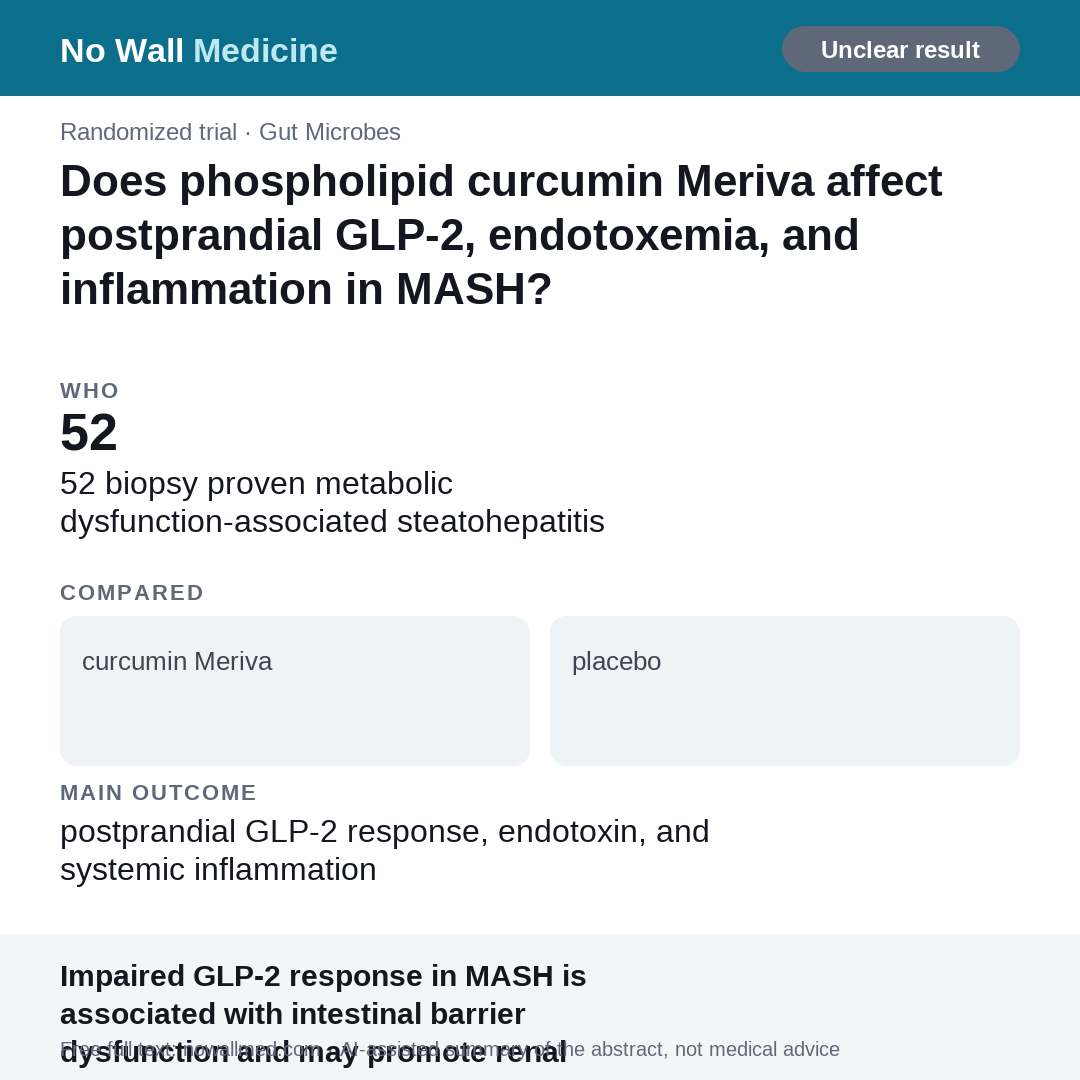
Clinical question: Does phospholipid curcumin Meriva affect postprandial GLP-2, endotoxemia, and inflammation in MASH?
Why it matters: It was unknown how postprandial GLP-2, a hormone that supports intestinal health, relates to intestinal barrier dysfunction and kidney disease in patients with MASH.
Key points
- Researchers studied 52 patients with biopsy-proven metabolic dysfunction-associated steatohepatitis (MASH) randomized to curcumin Meriva or placebo and 26 matched controls.
- A lower GLP-2 response after eating was associated with the presence of chronic kidney disease (OR = 0.43, 95%CI: 0.32-0.80, p = 0.008) in MASH patients.
- MASH patients with chronic kidney disease had a 2-fold higher postprandial endotoxin (LPS) and NF-kB activation in circulating mononuclear cells than MASH patients without kidney disease.
Headline and key points written with AI from the paper’s abstract, with every number checked against it. Read the paper before relying on them.
Topics
Cite this article
Musso G, Alberto M, Mariano F, Cassader M, De Michieli F, Riva A. Impaired postprandial GLP-2 response enhances endotoxemia, systemic inflammation, and kidney injury in metabolic dysfunction-associated steatohepatitis (MASH): effect of phospholipid curcumin meriva. Gut Microbes. 2024. doi:10.1080/19490976.2024.2424907
Spotted a mistake? Suggest a correction
Top studies every Monday
The week’s key trials and guidelines in your specialties, plus any topics you follow. By email, free.
Get the weekly digest