Computerized decision tools show variable adoption and mixed results for antibiotic prescribing in primary care
Implementation, adoption and impact of clinical decision support system for antibiotic prescribing in primary care: a systematic review
Systematic review of 40 studiesMixed results
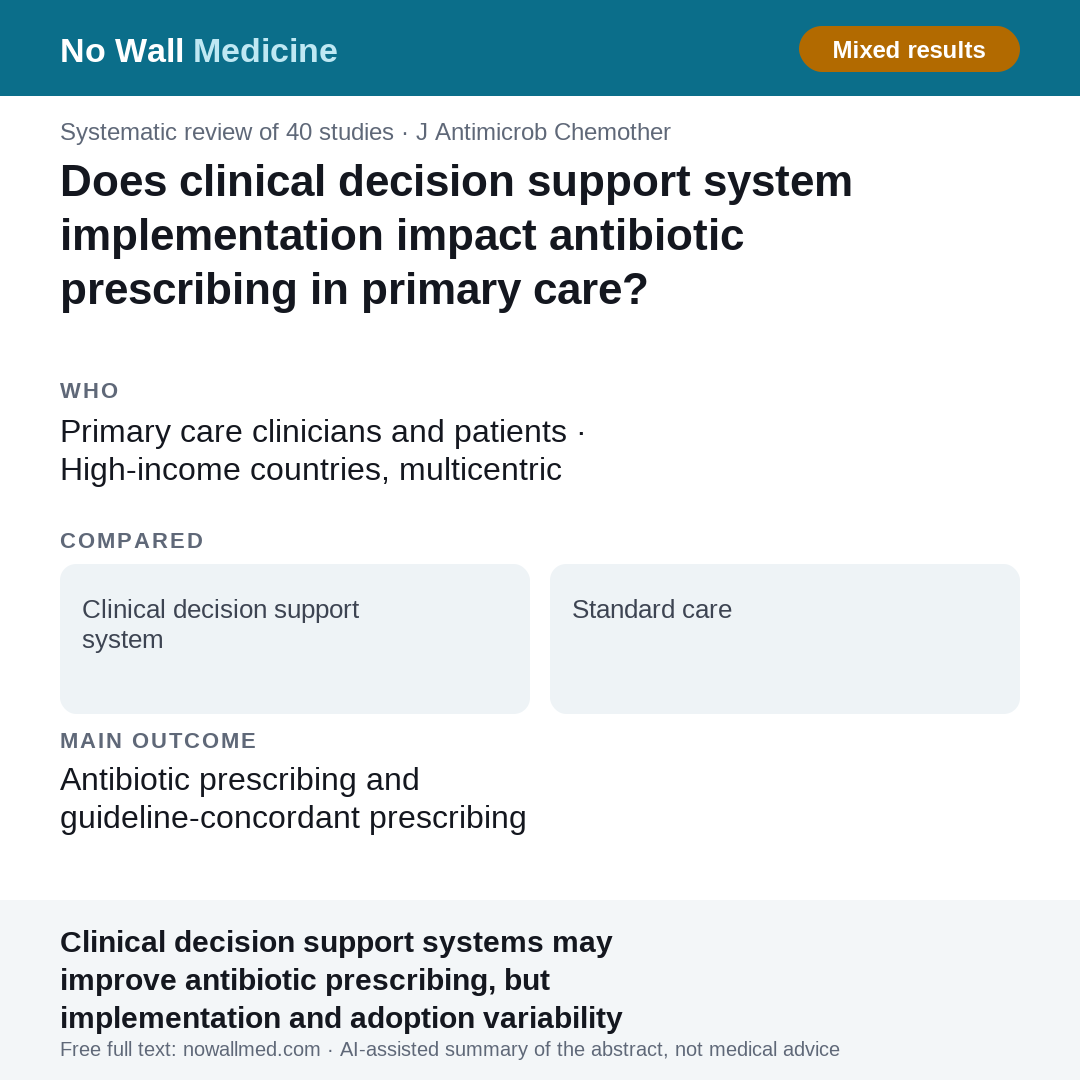
Does clinical decision support system implementation impact antibiotic prescribing in primary care?
Who
Primary care clinicians and patients · High-income countries, multicentric
Compared
Clinical decision support system
Standard care
Main outcome
Antibiotic prescribing and guideline-concordant prescribing
Bottom line: Clinical decision support systems may improve antibiotic prescribing, but implementation and adoption variability limits scalability.
Limitation: Wide variability in implementation and real-world adoption limits generalizability and scalability.
J Antimicrob Chemother · 2026-09-01Download image
Clinical question: Does clinical decision support system implementation impact antibiotic prescribing in primary care?
Why it matters: There is a need to understand how computerized decision tools are implemented and how they impact antibiotic prescribing in primary care settings.
Key points
- Researchers reviewed 40 studies involving clinical decision support systems, which are computerized tools that assist clinicians in making guideline-based decisions.
- Among 32 studies assessing clinical outcomes, 17 reported reduced overall antibiotic prescribing, though adoption rates were highly variable.
- Barriers to using these tools included time consumption, technical issues, alert fatigue, and concerns regarding patient-doctor trust.
Limitation the authors note: Wide variability in implementation and real-world adoption limits the generalizability and scalability of these findings.
Headline and key points written with AI from the paper’s abstract, with every number checked against it. Read the paper before relying on them.
Topics
Spotted a mistake? Suggest a correction