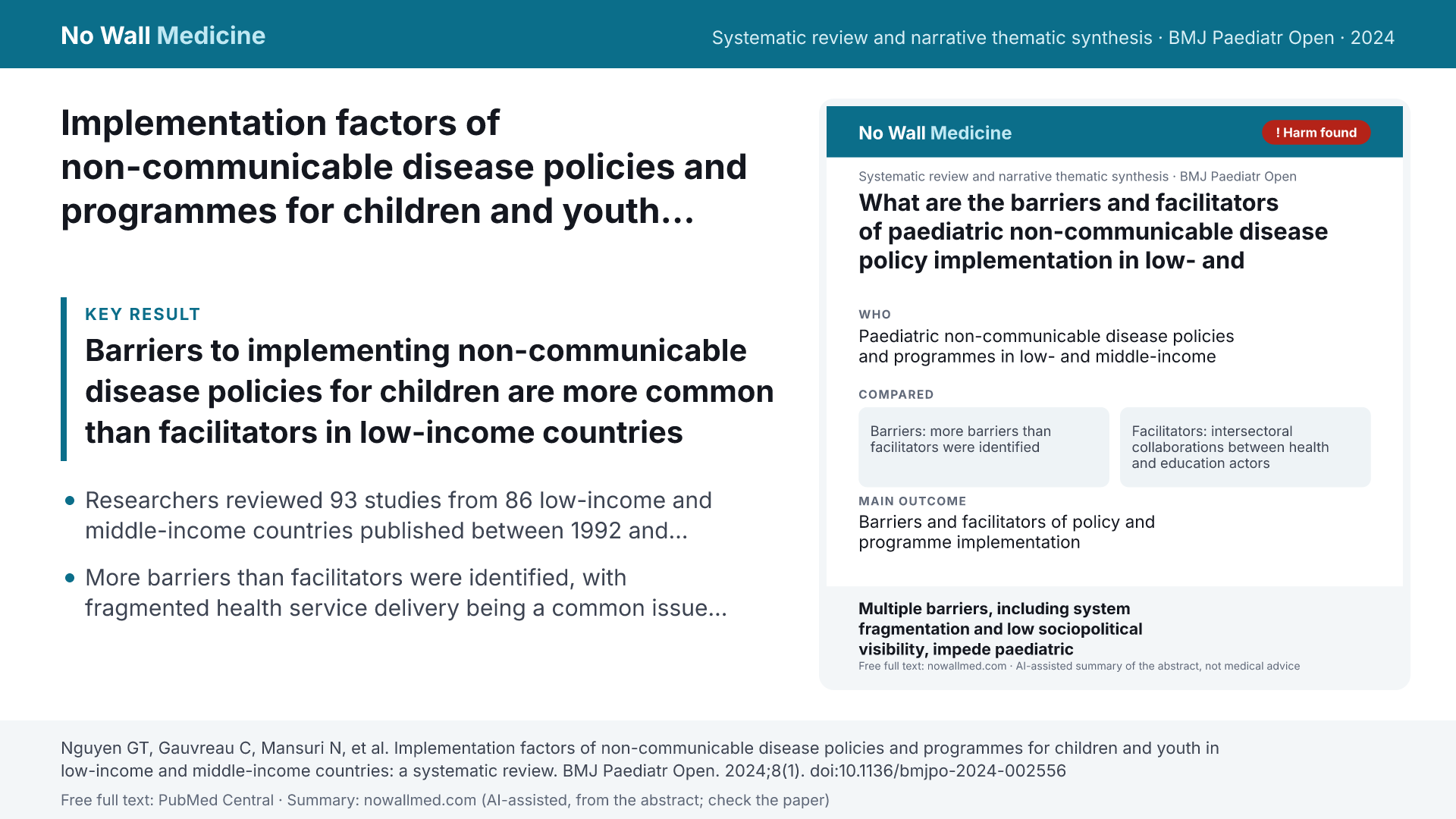
Barriers to implementing non-communicable disease policies for children are more common than facilitators in low-income countries
Implementation factors of non-communicable disease policies and programmes for children and youth in low-income and middle-income countries: a systematic review
Systematic review and narrative thematic synthesisHarm found
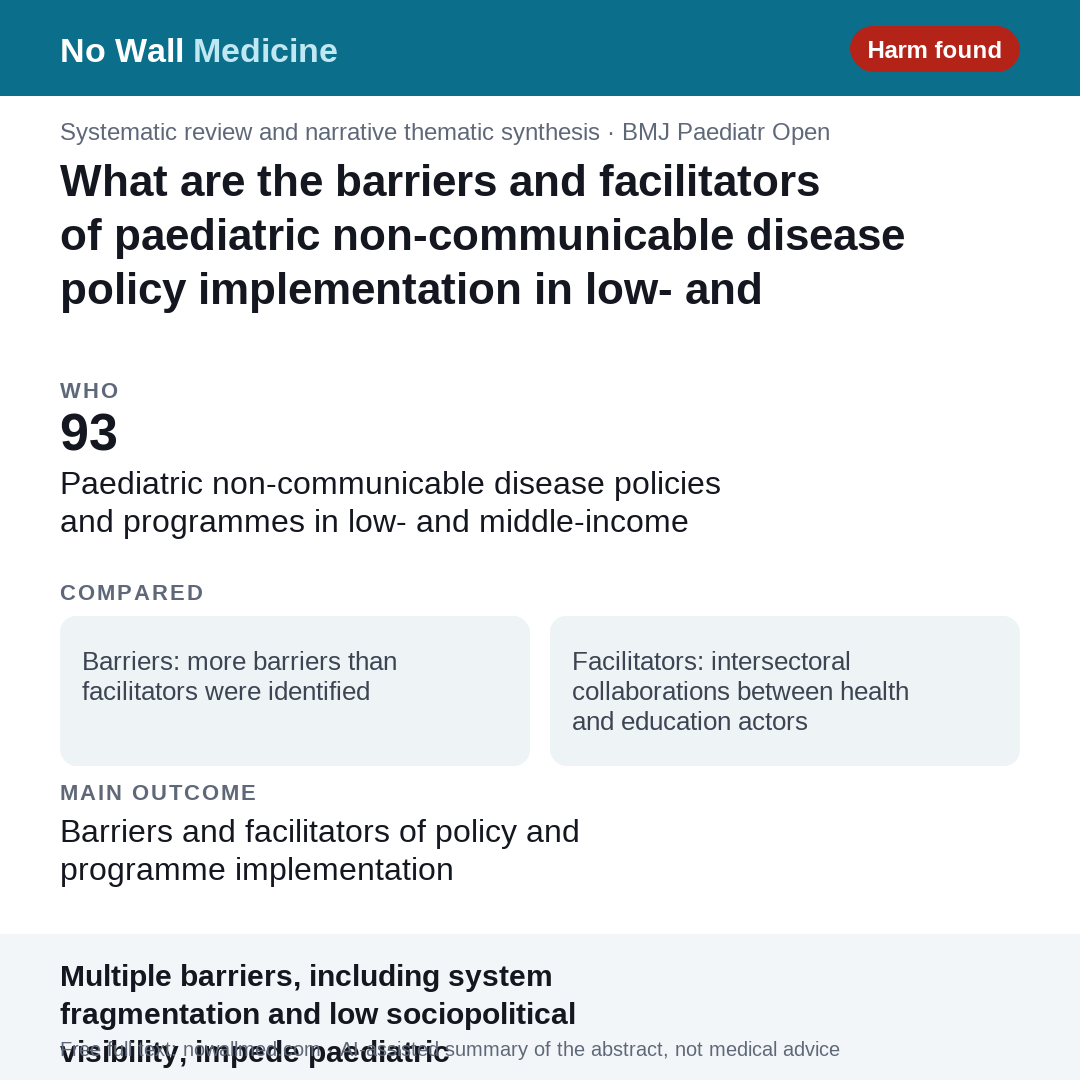
What are the barriers and facilitators of paediatric non-communicable disease policy implementation in low- and middle-income countries?
Who
93
Paediatric non-communicable disease policies and programmes in low- and middle-income countries · 86 low-income and middle-income countries
Compared
Barriers: more barriers than facilitators were identified
Facilitators: intersectoral collaborations between health and education actors
Main outcome
Barriers and facilitators of policy and programme implementation
Bottom line: Multiple barriers, including system fragmentation and low sociopolitical visibility, impede paediatric non-communicable disease policy implementation in low- and middle-income countries.
BMJ Paediatr Open · 2024-06-03Download image
Clinical question: What are the barriers and facilitators of paediatric non-communicable disease policy implementation in low- and middle-income countries?
Why it matters: It is unknown what specific barriers and facilitators affect the implementation of policies for non-communicable diseases in children and youth within low-income and middle-income countries.
Key points
- Researchers reviewed 93 studies from 86 low-income and middle-income countries published between 1992 and 2020 regarding pediatric non-communicable disease programs.
- More barriers than facilitators were identified, with fragmented health service delivery being a common issue for age-specific care.
- Collaborations between health and education sectors were identified as a significant facilitator for delivering care in community settings.
Headline and key points written with AI from the paper’s abstract, with every number checked against it. Read the paper before relying on them.
Was this summary helpful?
Abstract
Introduction
Despite declared life-course principles in non-communicable disease (NCD) prevention and management, worldwide focus has been on older rather than younger populations. However, the burden from childhood NCDs has mounted; particularly in low-income and middle-income countries (LMICs). There is limited knowledge regarding the implementation of paediatric NCD policies and programmes in LMICs, despite their disproportionate burden of morbidity and mortality. We aimed to understand the barriers to and facilitators of paediatric NCD policy and programme implementation in LMICs. Methods
We systematically searched medical databases, Web of Science and WHOLIS for studies on paediatric NCD policy and programme implementation in LMICs. Screening and quality assessment were performed independently by researchers, using consensus to resolve differences. Data extraction was conducted within the WHO health system building-blocks framework. Narrative thematic synthesis was conducted. Results
93 studies (1992-2020) were included, spanning 86 LMICs. Most were of moderate or high quality. 78% reported on paediatric NCDs outside the four major NCD categories contributing to the adult burden. Across the framework, more barriers than facilitators were identified. The most prevalently reported factors were related to health service delivery, with system fragmentation impeding the continuity of age-specific NCD care. A significant facilitator was intersectoral collaborations between health and education actors to deliver care in trusted community settings. Non-health factors were also important to paediatric NCD policies and programmes, such as community stakeholders, sociocultural support to caregivers and school disruptions. Conclusions
Multiple barriers prevent the optimal implementation of paediatric NCD policies and programmes in LMIC health systems. The low sociopolitical visibility of paediatric NCDs limits their prioritisation, resulting in fragmented service delivery and constraining the integration of programmes across key sectors impacting children, including health, education and social services. Implementation research is needed to understand specific contextual solutions to improve access to paediatric NCD services in diverse LMIC settings.
Abstract reproduced under the article’s CC BY NC licence.
Subject terms
Cite this article
Nguyen GT, Gauvreau C, Mansuri N, et al. Implementation factors of non-communicable disease policies and programmes for children and youth in low-income and middle-income countries: a systematic review. BMJ Paediatr Open. 2024. doi:10.1136/bmjpo-2024-002556
Spotted a mistake? Suggest a correction