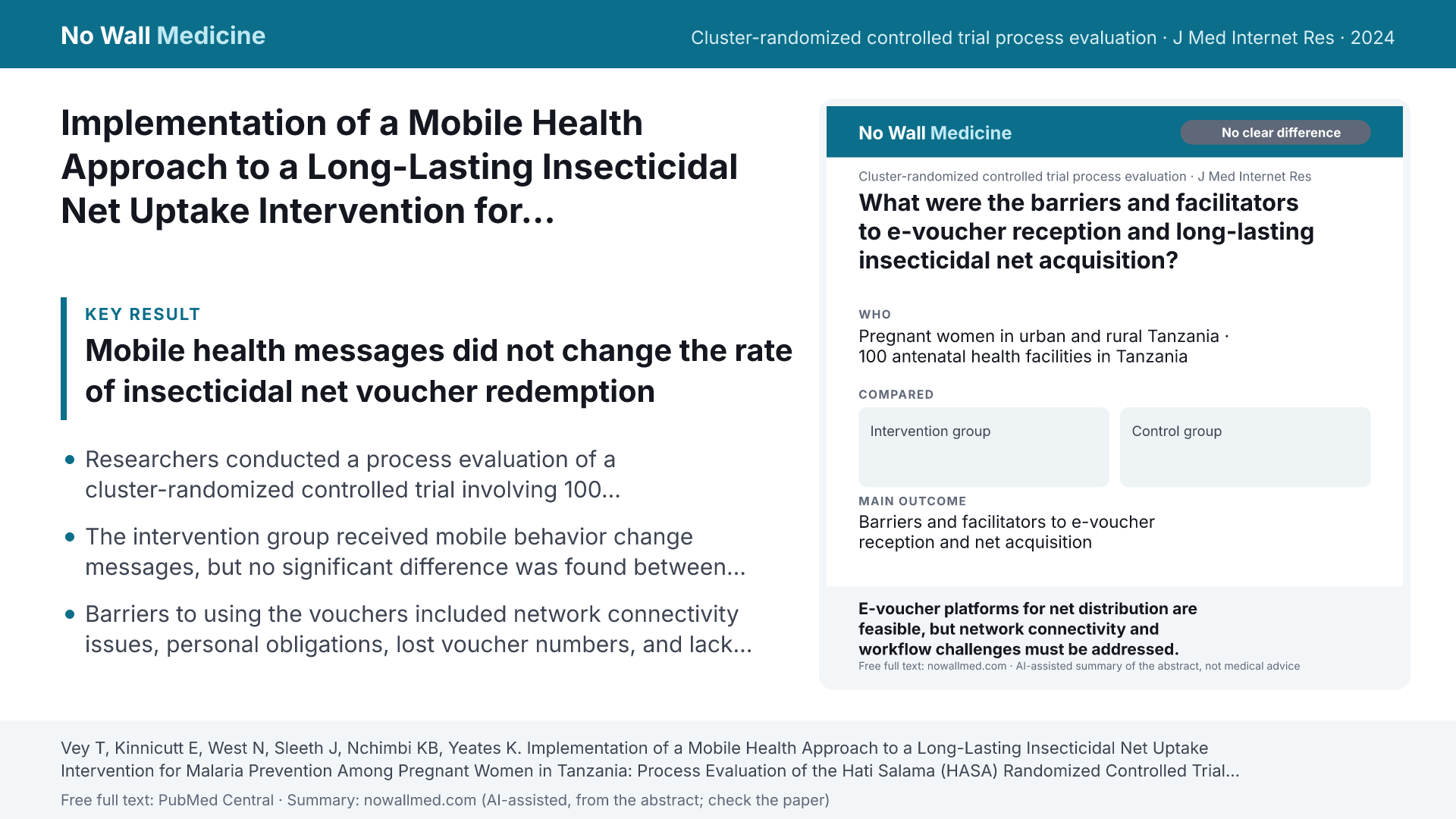
Mobile health messages did not change the rate of insecticidal net voucher redemption
Implementation of a Mobile Health Approach to a Long-Lasting Insecticidal Net Uptake Intervention for Malaria Prevention Among Pregnant Women in Tanzania: Process Evaluation of the Hati Salama (HASA) Randomized Controlled Trial Study
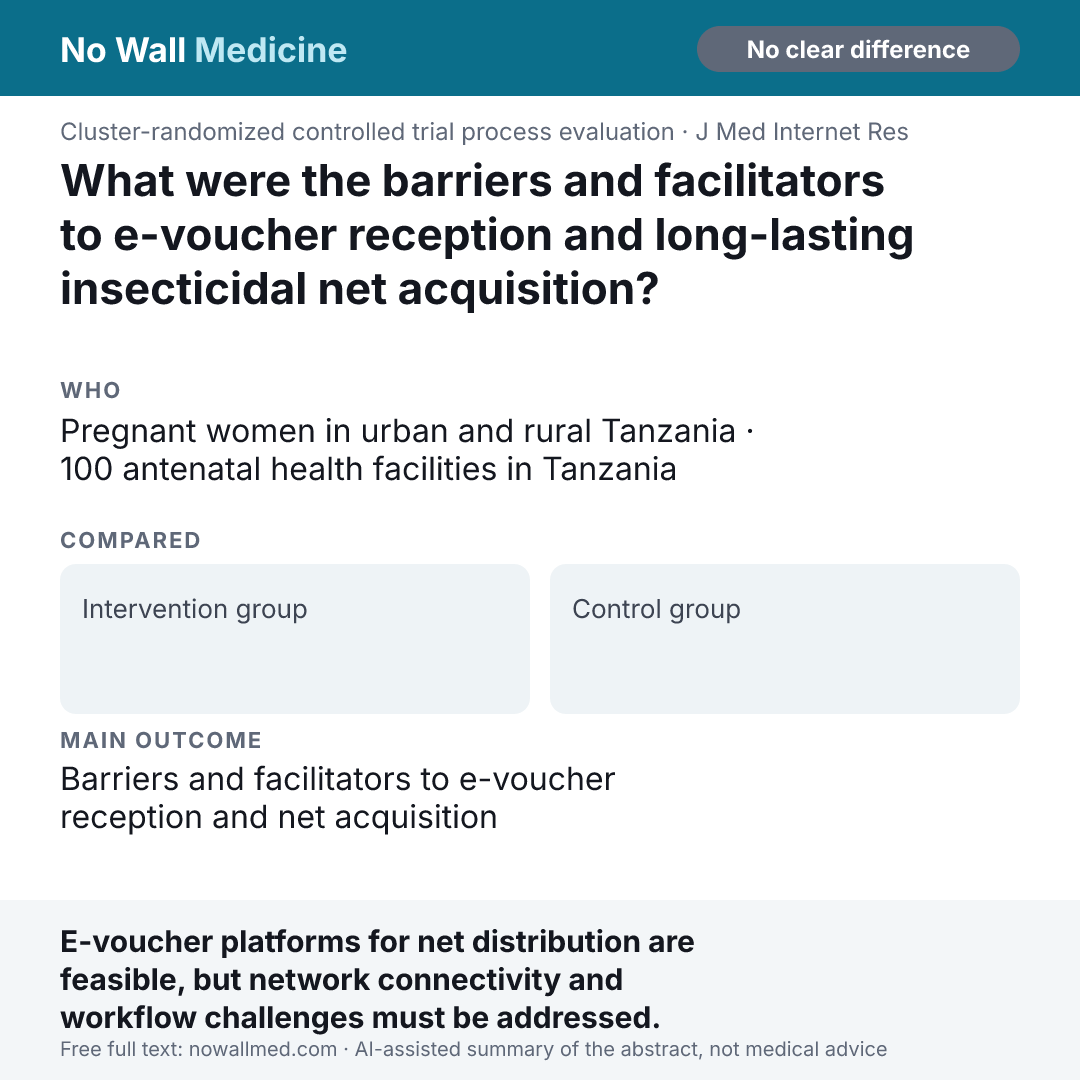
Cluster-randomized controlled trial process evaluationNo clear difference
What were the barriers and facilitators to e-voucher reception and long-lasting insecticidal net acquisition?
Who
Pregnant women in urban and rural Tanzania · 100 antenatal health facilities in Tanzania
Compared
Intervention group
Control group
Main outcome
Barriers and facilitators to e-voucher reception and net acquisition
Bottom line: E-voucher platforms for net distribution are feasible, but network connectivity and workflow challenges must be addressed.
J Med Internet Res · 2024-11-05 · Save PNG
Same trial (NCT02561624)
Papers we list that report this registered trial, oldest first. Read a secondary analysis alongside the main results.
- Main results No clear difference
This paper J Med Internet Res 2024-11 - Related analysis No clear difference
Mobile health messages did not significantly increase insecticidal net voucher use among pregnant women J Med Internet Res 2025-03
Clinical question: What were the barriers and facilitators to e-voucher reception and long-lasting insecticidal net acquisition?
Key points
- Researchers conducted a process evaluation of a cluster-randomized controlled trial involving 100 antenatal health facilities in Tanzania to study e-voucher use for malaria prevention nets.
- The intervention group received mobile behavior change messages, but no significant difference was found between the two groups regarding the rates of e-voucher redemption.
- Barriers to using the vouchers included network connectivity issues, personal obligations, lost voucher numbers, and lack of net stock at retailers.
Headline and key points written with AI from the paper’s abstract, with every number checked against it. Read the paper before relying on them.
Was this summary helpful?
Subject terms
Headline, design, result, key points, caveat and citation as plain text.
Cite this article
Vey T, Kinnicutt E, West N, Sleeth J, Nchimbi KB, Yeates K. Implementation of a Mobile Health Approach to a Long-Lasting Insecticidal Net Uptake Intervention for Malaria Prevention Among Pregnant Women in Tanzania: Process Evaluation of the Hati Salama (HASA) Randomized Controlled Trial Study. J Med Internet Res. 2024;26:e51527. doi:10.2196/51527
Spotted a mistake? Suggest a correction