Implementation of a Secure Firearm Storage Program in Pediatric Primary Care: A Cluster Randomized Trial
Cluster randomized trialBenefit found
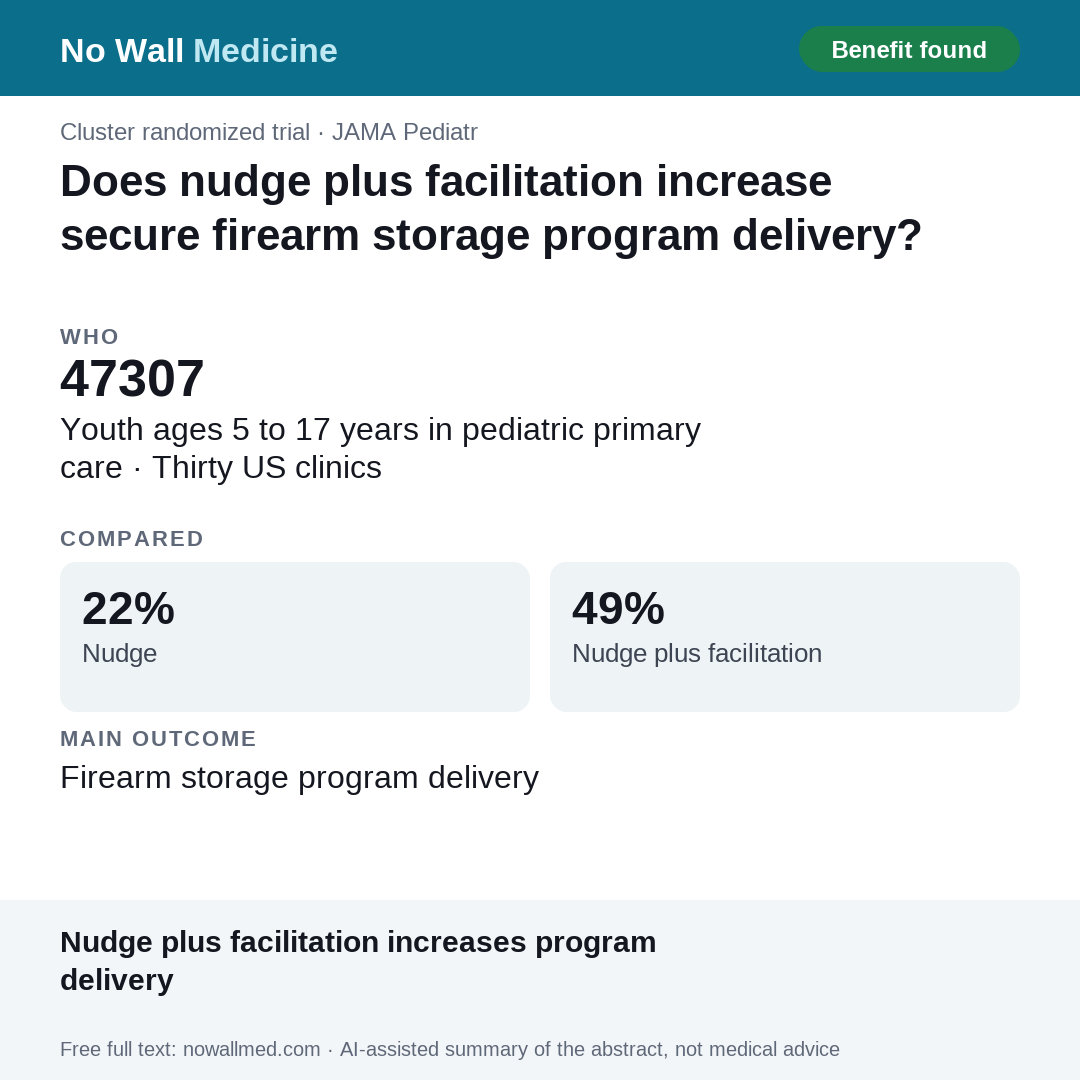
Does nudge plus facilitation increase secure firearm storage program delivery?
Who
47307
Youth ages 5 to 17 years in pediatric primary care · Thirty US clinics
Compared
22%Nudge (95% CI 13-31)
49%Nudge plus facilitation (95% CI 37-61)
Main outcome
Firearm storage program delivery
Bottom line: Nudge plus facilitation increases program delivery
JAMA Pediatr · 2024-09-03Download image
Clinical question: Does nudge plus facilitation increase secure firearm storage program delivery?
Abstract
Importance
Increased secure firearm storage can reduce youth firearm injury and mortality, a leading cause of death for children and adolescents in the US. Despite the availability of evidence-based secure firearm storage programs and recommendations from the American Academy of Pediatrics, few pediatric clinicians report routinely implementing these programs. Objective
To compare the effectiveness of an electronic health record (EHR) documentation template (nudge) and the nudge plus facilitation (ie, clinic support to implement the program; nudge+) at promoting delivery of a brief evidence-based secure firearm storage program (SAFE Firearm) that includes counseling about secure firearm storage and free cable locks during all pediatric well visits. Design, setting, and participants
The Adolescent and Child Suicide Prevention in Routine Clinical Encounters (ASPIRE) unblinded parallel cluster randomized effectiveness-implementation trial was conducted from March 14, 2022, to March 20, 2023, to test the hypothesis that, relative to nudge, nudge+ would result in delivery of the firearm storage program to an additional 10% or more of the eligible population, and that this difference would be statistically significant. Thirty pediatric primary care clinics in 2 US health care systems (in Michigan and Colorado) were included, excluding clinics that were not the primary site for participating health care professionals and a subset selected at random due to resource limitations. All pediatric well visits at participating clinics for youth ages 5 to 17 years were analyzed. Interventions
Clinics were randomly assigned in a 1:1 ratio to receive either the nudge or nudge+. Main outcomes and measures
Patient-level outcomes were modeled to estimate the primary outcome, reach, which is a visit-level binary indicator of whether the parent received both components of the firearm storage program (counseling and lock), as documented by the clinician in the EHR. Secondary outcomes explored individual program component delivery. Results
A total of 47 307 well-child visits (median [IQR] age, 11.3 [8.1-14.4] years; 24 210 [51.2%] male and 23 091 [48.8%] female) among 46 597 children and 368 clinicians were eligible to receive the firearm storage program during the trial and were included in analyses. Using the intention-to-treat principle, a higher percentage of well-child visits received the firearm storage program in the nudge+ condition (49%; 95% CI, 37-61) compared to nudge (22%; 95% CI, 13-31). Conclusions and relevance
In this study, the EHR strategy combined with facilitation (nudge+) was more effective at increasing delivery of an evidence-based secure firearm storage program compared to nudge alone. Trial registration
ClinicalTrials.gov Identifier: NCT04844021.
Topics
Cite this article
Beidas RS, Linn KA, Boggs JM, Marcus SC, Hoskins K, Jager-Hyman S. Implementation of a Secure Firearm Storage Program in Pediatric Primary Care: A Cluster Randomized Trial. JAMA Pediatr. 2024. doi:10.1001/jamapediatrics.2024.3274
Spotted a mistake? Suggest a correction
Top studies every Monday
The week’s key trials and guidelines in your specialties, by email. Free.
Get the weekly digest