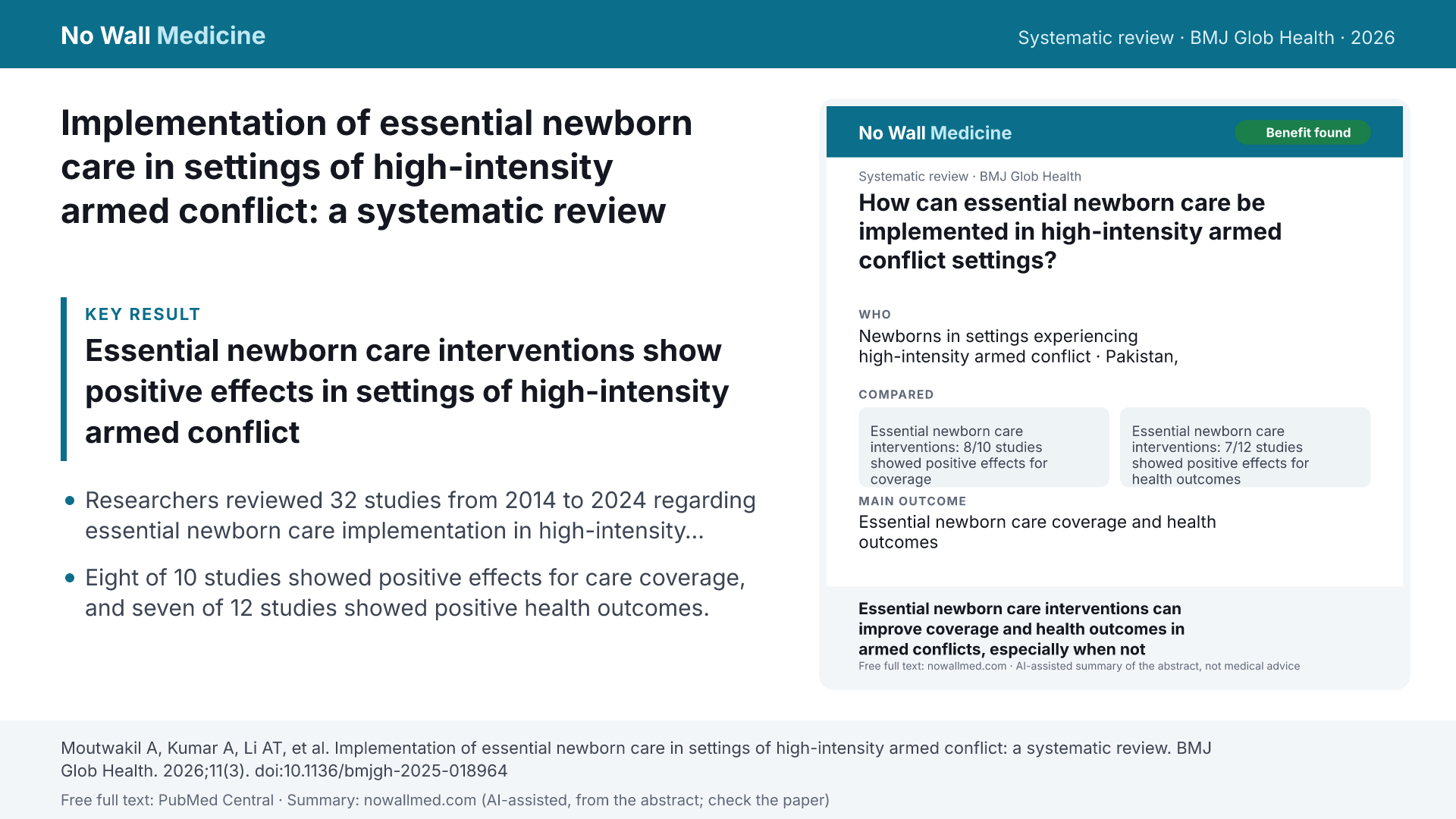
Essential newborn care interventions show positive effects in settings of high-intensity armed conflict
Implementation of essential newborn care in settings of high-intensity armed conflict: a systematic review
Systematic reviewBenefit found
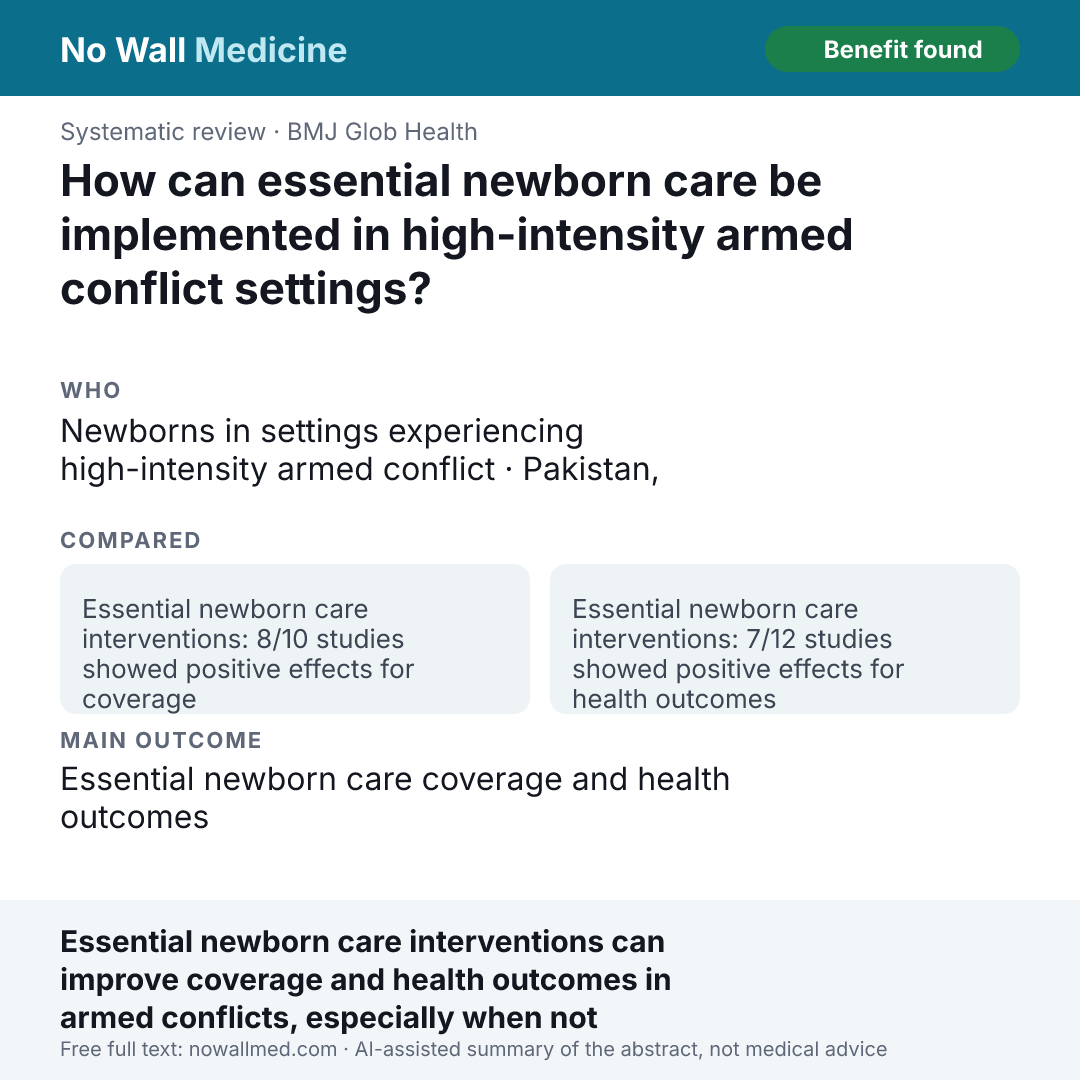
How can essential newborn care be implemented in high-intensity armed conflict settings?
Who
Newborns in settings experiencing high-intensity armed conflict · Pakistan, South Sudan, and other high-intensity armed conflict settings
Compared
Essential newborn care interventions: 8/10 studies showed positive effects for coverage
Essential newborn care interventions: 7/12 studies showed positive effects for health outcomes
Main outcome
Essential newborn care coverage and health outcomes
Bottom line: Essential newborn care interventions can improve coverage and health outcomes in armed conflicts, especially when not dependent on functional health facilities.
Limitation: Lack of grey and non-English literature and studies on sick newborns or comprehensive care packages.
BMJ Glob Health · 2026-03-16 · Save PNG
Clinical question: How can essential newborn care be implemented in high-intensity armed conflict settings?
Why it matters: A disproportionate share of global neonatal deaths occurs in armed-conflict settings where progress in reducing newborn mortality remains slow.
Key points
- Researchers reviewed 32 studies from 2014 to 2024 regarding essential newborn care implementation in high-intensity armed conflict settings.
- Eight of 10 studies showed positive effects for care coverage, and seven of 12 studies showed positive health outcomes.
- Interventions focused on the health workforce and service delivery, with 84% of studies utilizing community health worker training.
Limitation the authors note: The review was limited by a lack of grey and non-English literature and studies on caring for small or sick newborns.
Headline and key points written with AI from the paper’s abstract, with every number checked against it. Read the paper before relying on them.
Was this summary helpful?
Abstract
Introduction
A disproportionate share of global neonatal deaths occurs in armed-conflict settings, where progress in reducing neonatal mortality remains slow. This systematic review aims to synthesise the literature on implementing essential newborn care (ENC) interventions in high-intensity armed conflict settings. Methods
We searched PubMed, CINAHL, Embase and the grey literature from January 2014 to March 2024. Eligible original studies in English implemented at least one component of ENC in settings experiencing high-intensity armed conflict. Data were extracted on study characteristics, ENC implementation and outcomes. Certainty of evidence was assessed using Grading of Recommendations, Assessment, Development and Evaluation (GRADE) for quantitative studies and GRADE-Confidence in the Evidence from Reviews of Qualitative Research for qualitative and mixed-method studies. Results
32 studies were included, primarily from hospital settings (n=15, 47%) in Pakistan (n=6, 19%) and South Sudan (n=5, 16%). Interventions focused on health workforce (n=19, 59%) and service delivery (n=8, 25%), predominantly through community health worker training (n=27, 84%). Positive effects were observed for ENC coverage (8/10 studies) and health outcomes (7/12 studies), particularly for interventions promoting breastfeeding, skin-to-skin contact, chlorhexidine applications to the umbilical cord and quality improvement approaches. Neonatal resuscitation training showed variable effects. Key facilitators included local healthcare workers providing emergency supervision and the use of audio-visual or mobile technologies, while barriers included insecurity, conflict-imposed movement restrictions, violence against health facilities and workers, the inability of supervisors to access facilities and the community, population displacement and degradation of ENC quality. Conclusion
Implementation of ENC interventions, particularly breastfeeding promotion, Kangaroo Mother Care and cord care, that do not depend on functional health facilities can improve coverage and neonatal health outcomes in high-intensity armed conflicts, but requires adaptations to context-specific challenges. Strategies to strengthen the health workforce, leverage community health workers and integrate technology may enhance the delivery of lifesaving newborn care amidst armed conflict. Our review was limited by a lack of grey and non-English literature and studies on caring for small and/or sick newborns, implementation of comprehensive care packages and effectiveness evaluations. Further research is needed on comprehensive ENC packages and innovative approaches to overcome systemic barriers. Prospero registration number
CRD42023388617.
Abstract reproduced under the article’s CC BY NC licence.
Subject terms
Headline, design, result, key points, caveat and citation as plain text.
Cite this article
Moutwakil A, Kumar A, Li AT, et al. Implementation of essential newborn care in settings of high-intensity armed conflict: a systematic review. BMJ Glob Health. 2026;11(3). doi:10.1136/bmjgh-2025-018964
Spotted a mistake? Suggest a correction