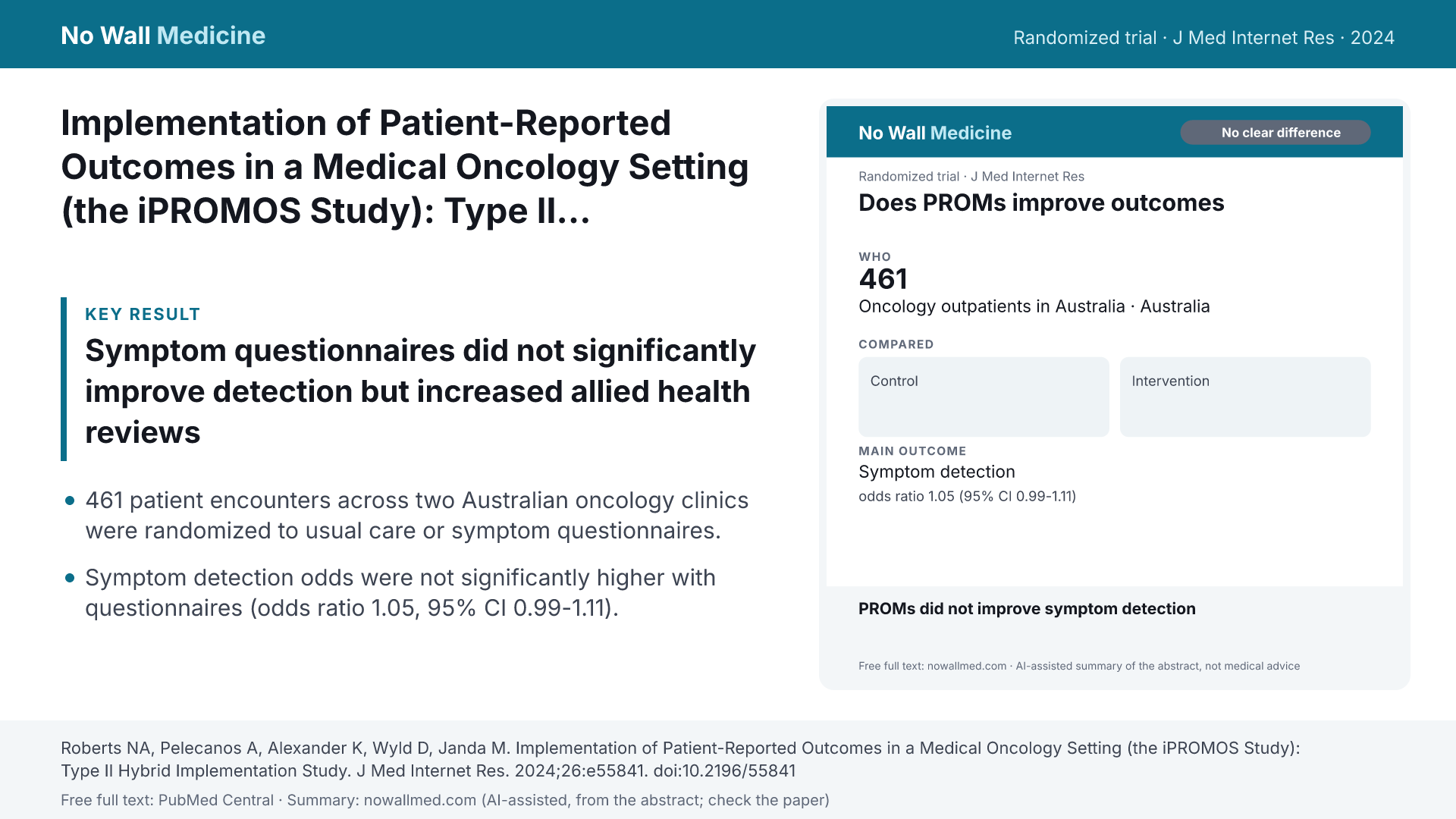
Symptom questionnaires did not significantly improve detection but increased allied health reviews
Implementation of Patient-Reported Outcomes in a Medical Oncology Setting (the iPROMOS Study): Type II Hybrid Implementation Study
Randomized trialNo clear difference
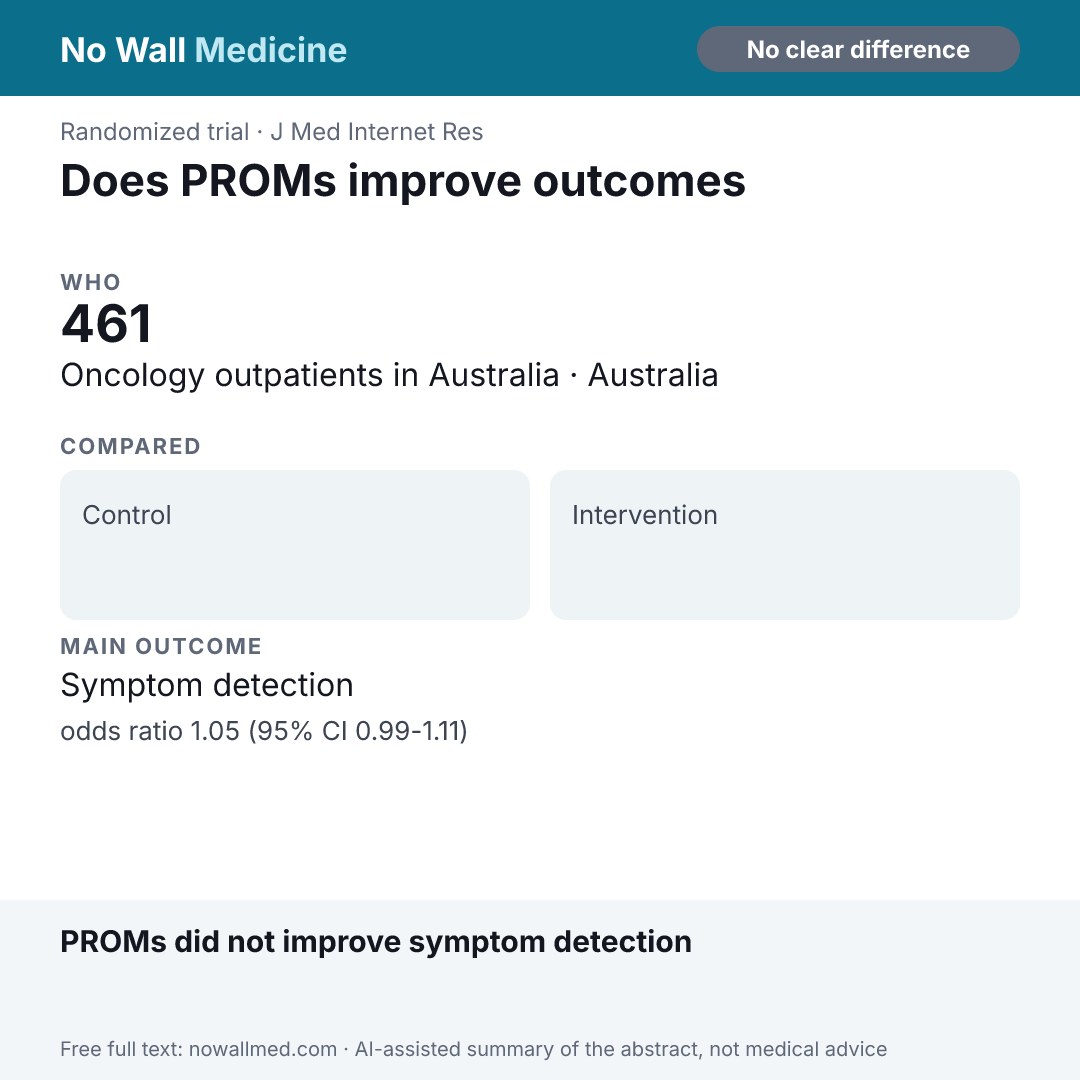
Does PROMs improve outcomes
Who
461
Oncology outpatients in Australia · Australia
Compared
Control
Intervention
Main outcome
Symptom detection
Result: odds ratio 1.05 (95% CI 0.99-1.11)
Bottom line: PROMs did not improve symptom detection
J Med Internet Res · 2024-08-27 · Save PNG
Why it matters: Applies to medical oncology outpatients; suggests symptom questionnaires may increase supportive care referrals without significantly changing symptom detection rates.
Key points
- 461 patient encounters across two Australian oncology clinics were randomized to usual care or symptom questionnaires.
- Symptom detection odds were not significantly higher with questionnaires (odds ratio 1.05, 95% CI 0.99-1.11).
- The odds of receiving nonroutine allied health reviews were significantly higher with questionnaires (odds ratio 3.54, 95% CI 1.26-9.90).
Headline and key points written with AI from the paper’s abstract, with every number checked against it. Read the paper before relying on them.
Was this summary helpful?
Subject terms
Headline, design, result, key points, caveat and citation as plain text.
Cite this article
Roberts NA, Pelecanos A, Alexander K, Wyld D, Janda M. Implementation of Patient-Reported Outcomes in a Medical Oncology Setting (the iPROMOS Study): Type II Hybrid Implementation Study. J Med Internet Res. 2024;26:e55841. doi:10.2196/55841
Spotted a mistake? Suggest a correction