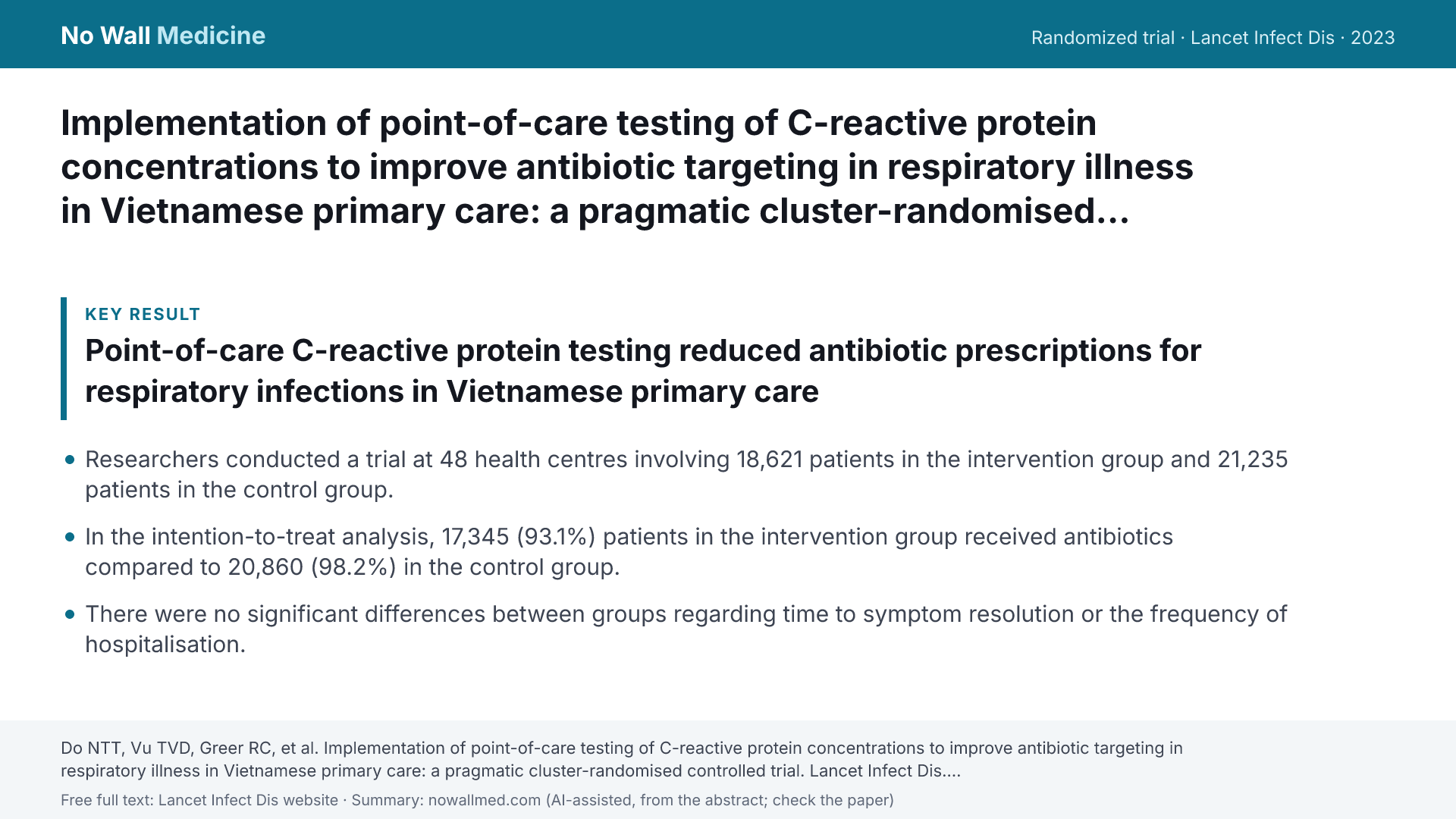
Point-of-care C-reactive protein testing reduced antibiotic prescriptions for respiratory infections in Vietnamese primary care
Implementation of point-of-care testing of C-reactive protein concentrations to improve antibiotic targeting in respiratory illness in Vietnamese primary care: a pragmatic cluster-randomised controlled trial
Key points
- Researchers conducted a trial at 48 health centres involving 18,621 patients in the intervention group and 21,235 patients in the control group.
- In the intention-to-treat analysis, 17,345 (93.1%) patients in the intervention group received antibiotics compared to 20,860 (98.2%) in the control group.
- There were no significant differences between groups regarding time to symptom resolution or the frequency of hospitalisation.
Headline and key points written with AI from the paper’s abstract, with every number checked against it. Read the paper before relying on them.
Was this summary helpful?
Abstract
Background
In previous trials, point-of-care testing of C-reactive protein (CRP) concentrations safely reduced antibiotic use in non-severe acute respiratory infections in primary care. However, these trials were done in a research-oriented context with close support from research staff, which could have influenced prescribing practices. To better inform the potential for scaling up point-of-care testing of CRP in respiratory infections, we aimed to do a pragmatic trial of the intervention in a routine care setting. Methods
We did a pragmatic, cluster-randomised controlled trial at 48 commune health centres in Viet Nam between June 1, 2020, and May 12, 2021. Eligible centres served populations of more than 3000 people, handled 10-40 respiratory infections per week, had licensed prescribers on site, and maintained electronic patient databases. Centres were randomly allocated (1:1) to provide point-of-care CRP testing plus routine care or routine care only. Randomisation was stratified by district and by baseline prescription level (ie, the proportion of patients with suspected acute respiratory infections to whom antibiotics were prescribed in 2019). Eligible patients were aged 1-65 years and visiting the commune health centre for a suspected acute respiratory infection with at least one focal sign or symptom and symptoms lasting less than 7 days. The primary endpoint was the proportion of patients prescribed an antibiotic at first attendance in the intention-to-treat population. The per-protocol analysis included only people who underwent CRP testing. Secondary safety outcomes included time to resolution of symptoms and frequency of hospitalisation. This trial is registered with ClinicalTrials.gov, NCT03855215. Findings
48 commune health centres were enrolled and randomly assigned, 24 to the intervention group (n=18 621 patients) and 24 to the control group (n=21 235). 17 345 (93·1%) patients in the intervention group were prescribed antibiotics, compared with 20 860 (98·2%) in the control group (adjusted relative risk 0·83 [95% CI 0·66-0·93]). Only 2606 (14%) of 18 621 patients in the intervention group underwent CRP testing and were included in the per-protocol analysis. When analyses were restricted to this population, larger reductions in prescribing were noted in the intervention group compared with the control group (adjusted relative risk 0·64 [95% CI 0·60-0·70]). Time to resolution of symptoms (hazard ratio 0·70 [95% CI 0·39-1·27]) and frequency of hospitalisation (nine in the intervention group vs 17 in the control group; adjusted relative risk 0·52 [95% CI 0·23-1·17]) did not differ between groups. Interpretation
Use of point-of-care CRP testing efficaciously reduced prescription of antibiotics in patients with non-severe acute respiratory infections in primary health care in Viet Nam without compromising patient recovery. The low uptake of CRP testing suggests that barriers to implementation and compliance need to be addressed before scale-up of the intervention. Funding
Australian Government, UK Government, and the Foundation for Innovative New Diagnostics.
Abstract reproduced under the article’s CC BY licence.
Subject terms
Headline, design, result, key points, caveat and citation as plain text.
Cite this article
Do NTT, Vu TVD, Greer RC, et al. Implementation of point-of-care testing of C-reactive protein concentrations to improve antibiotic targeting in respiratory illness in Vietnamese primary care: a pragmatic cluster-randomised controlled trial. Lancet Infect Dis. 2023;23(9):1085-1094. doi:10.1016/S1473-3099(23)00125-1
Spotted a mistake? Suggest a correction