Program characteristics and environmental factors influence the implementation of school-based cardiopulmonary resuscitation training
Implementation of school-based CPR training - A systematic review and mixed-methods meta-analysis
Systematic review and mixed-methods meta-analysisMixed results
What are the enablers and barriers to implementing school-based cardiopulmonary resuscitation training?
Who
18
School-based cardiopulmonary resuscitation training programs
Compared
Program characteristics
Environmental factors
Main outcome
Enablers and barriers to implementation
Bottom line: Successful implementation depends on both program characteristics and environmental factors working together.
Resusc Plus · 2025-04-10Download image
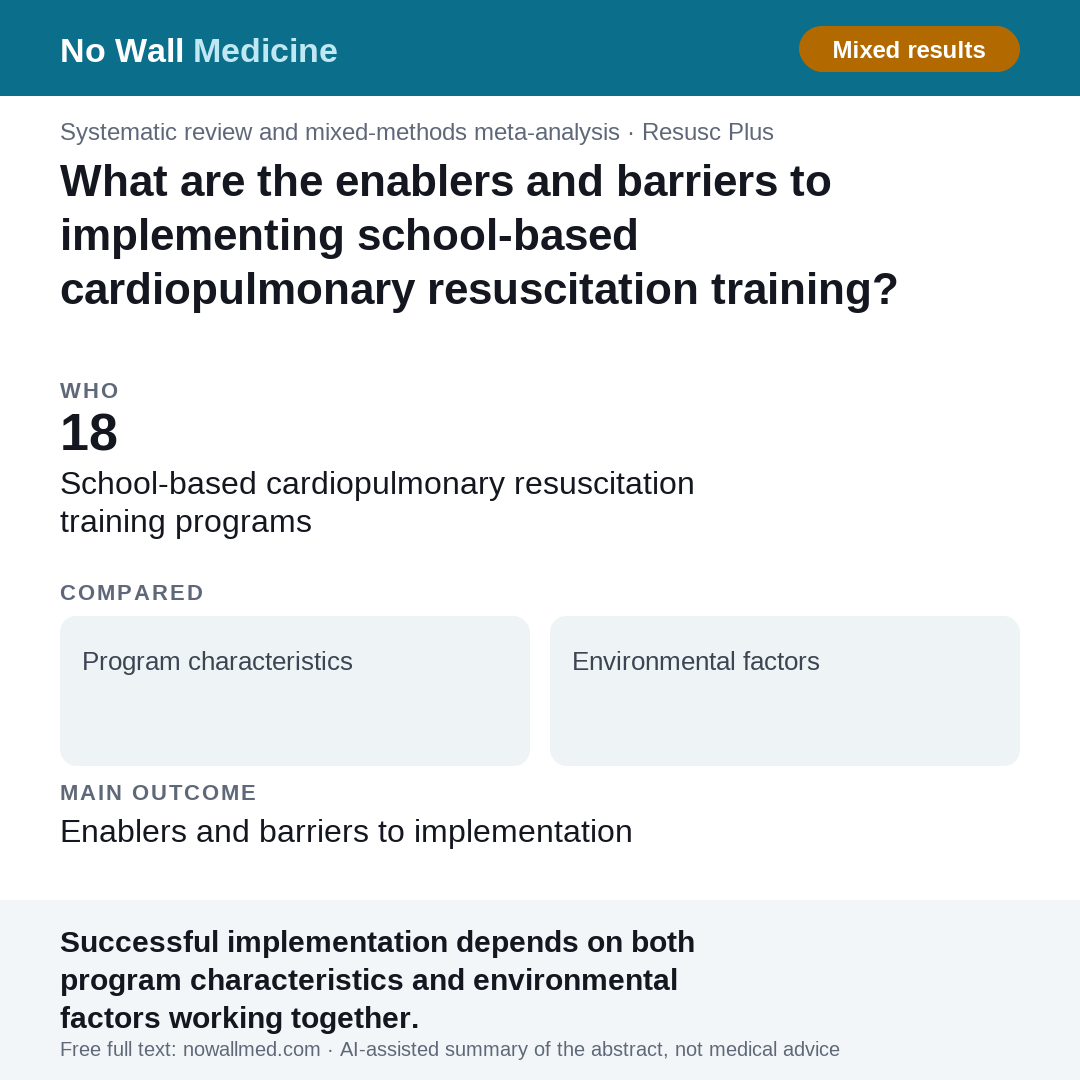
Clinical question: What are the enablers and barriers to implementing school-based cardiopulmonary resuscitation training?
Why it matters: Bystander cardiopulmonary resuscitation rates remain low because school-based training initiatives are often poorly implemented.
Key points
- Researchers analyzed 18 reports, including 7 qualitative and 11 quantitative studies, to identify barriers and enablers for school-based cardiopulmonary resuscitation training.
- Successful implementation was linked to high-quality resources, low costs in time and staffing, and standardized training for teachers.
- Implementation was also associated with support from school leadership, parents, and teachers, alongside mandatory legislation and government endorsement.
Headline and key points written with AI from the paper’s abstract, with every number checked against it. Read the paper before relying on them.
Was this summary helpful?
Cite this article
Sadjadi M, Brülle R, Onbasilar U, Booke H, Strauß C, von Groote T. Implementation of school-based CPR training - A systematic review and mixed-methods meta-analysis. Resusc Plus. 2025. doi:10.1016/j.resplu.2025.100955
Spotted a mistake? Suggest a correction
Top studies every Monday
The week’s key trials and guidelines in your specialties, plus any topics you follow. By email, free.
Get the weekly digest