Implementing an audit and feedback cycle to improve adherence to the Choosing Wisely Canada recommendations: clustered randomized trail
Clustered randomized trialBenefit found
Does audit and feedback reduce unnecessary antibiotic and antipsychotic prescribing?
Who
239
239 primary care providers in Manitoba, Canada · Manitoba, Canada
Compared
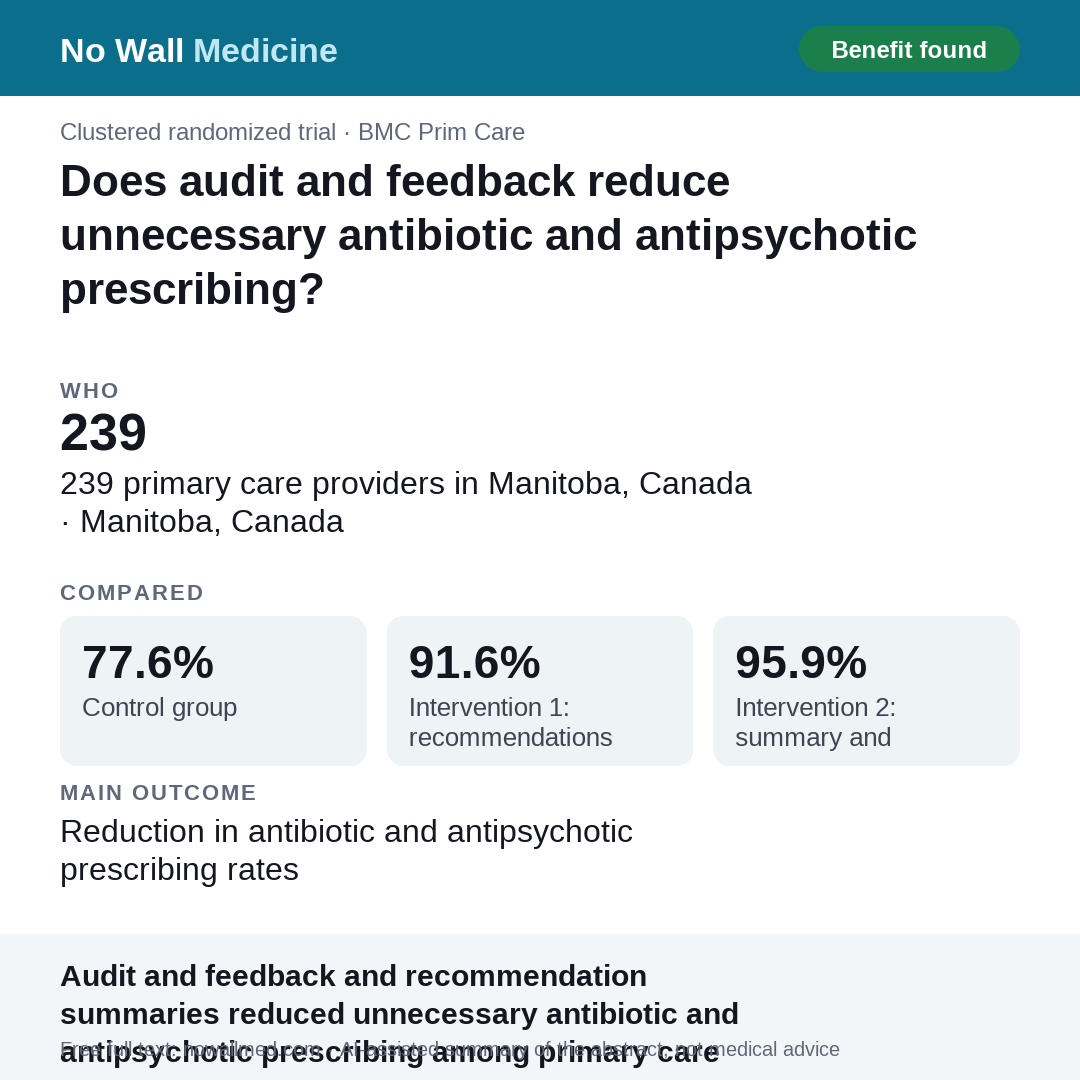
77.6%Control group
91.6%Intervention 1: recommendations summary
95.9%Intervention 2: summary and personalized feedback
Main outcome
Reduction in antibiotic and antipsychotic prescribing rates
Bottom line: Audit and feedback and recommendation summaries reduced unnecessary antibiotic and antipsychotic prescribing among primary care providers.
BMC Prim Care · 2022-11-26Download image
Clinical question: Does audit and feedback reduce unnecessary antibiotic and antipsychotic prescribing?
Abstract
Background
Audit and Feedback (A&F), a strategy aimed at promoting modified practice through performance feedback, is a method to change provider behaviour and reduce unnecessary medical services. This study aims to assess the use of A&F to reduce antibiotic prescribing for viral infections and antipsychotic prescribing to patients with dementia. Methods
Clustered randomized trial of 239 primary care providers in Manitoba, Canada, participating in the Manitoba Primary Care Research Network. Forty-six practices were randomly assigned to one of three groups: control group, intervention 1 (recommendations summary), intervention 2 (recommendations summary and personalized feedback). We assessed prescribing rates prior to the intervention (2014/15), during and immediately after the intervention (2016/17) and following the intervention (2018/19). Physician characteristics were assessed. Results
Between 2014/15-2016/17, 91.6% of providers in intervention group 1 and 95.9% of providers in intervention group 2 reduced their antibiotic and antipsychotic prescribing rate by ≥ 1 compared to the control group (77.6%) (p-value 0.0073). This reduction was maintained into 2018/19 at 91.4%. On multivariate regression alternatively funded providers had 2.4 × higher odds of reducing their antibiotic prescribing rate compared to fee-for-service providers. In quantile regression of providers with a reduction in antibiotic prescribing, alternatively funded (e.g. salaried or locum) providers compared to fee-for-service providers were significant at the 80th quantile. Conclusions
Both A&F and recommendation summaries sent to providers by a trusted source reduced unnecessary prescriptions. Our findings support further scale up of efforts to engage with primary care practices to improve care with A&F. Trial registration
ClinicalTrials.gov NCT05385445, retrospectively registered, 23/05/2022.
Subject terms
Cite this article
Singer A, Kosowan L, Abrams EM, Katz A, Lix L, Leong K. Implementing an audit and feedback cycle to improve adherence to the Choosing Wisely Canada recommendations: clustered randomized trail. BMC Prim Care. 2022. doi:10.1186/s12875-022-01912-7
Spotted a mistake? Suggest a correction
Top studies every Monday
The week’s key trials and guidelines in your specialties, plus any topics you follow. By email, free.
Get the weekly digest