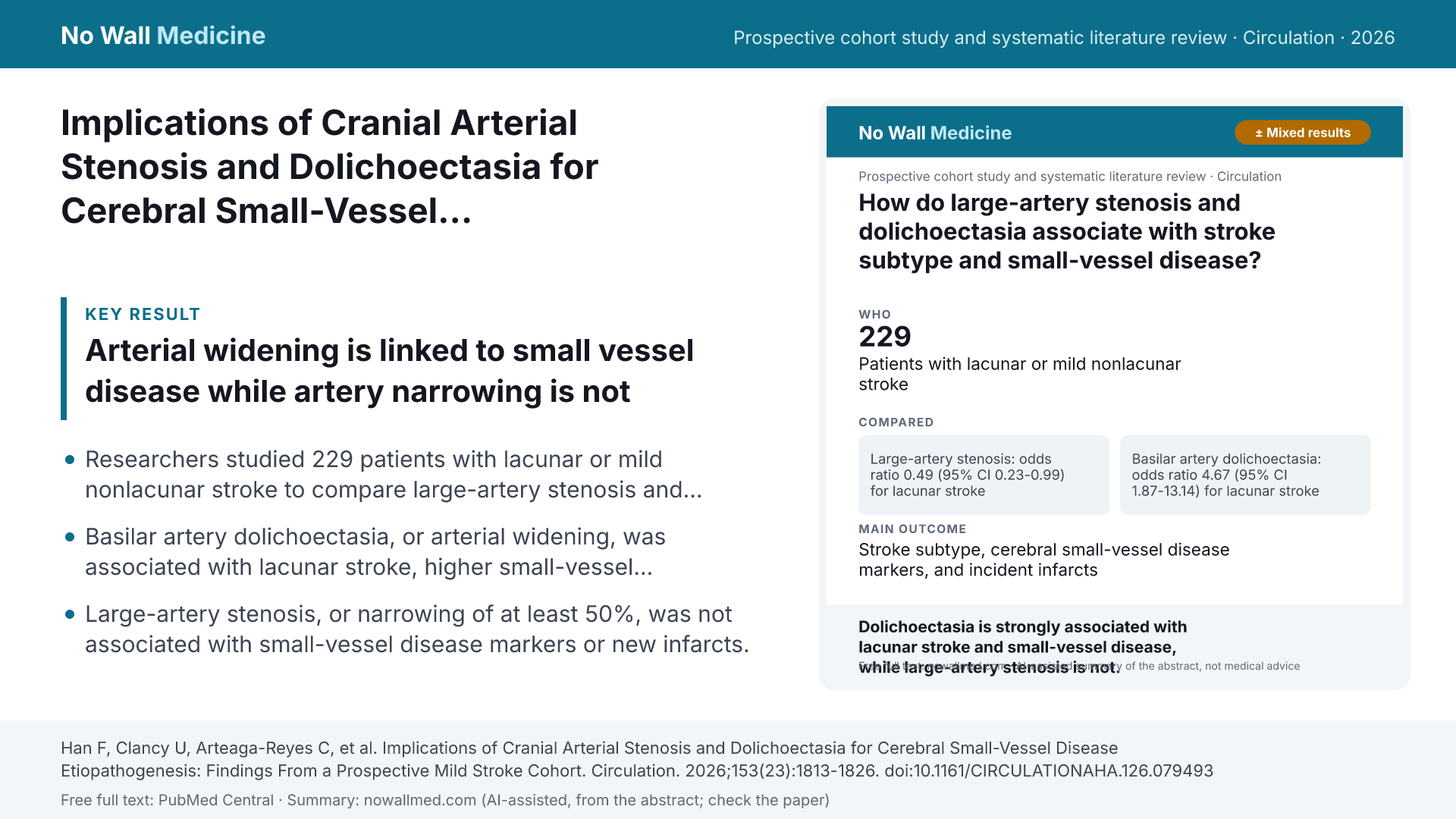
Arterial widening is linked to small vessel disease while artery narrowing is not
Implications of Cranial Arterial Stenosis and Dolichoectasia for Cerebral Small-Vessel Disease Etiopathogenesis: Findings From a Prospective Mild Stroke Cohort
Prospective cohort study and systematic literature reviewMixed results
How do large-artery stenosis and dolichoectasia associate with stroke subtype and small-vessel disease?
Who
229
Patients with lacunar or mild nonlacunar stroke
Compared
Large-artery stenosis: odds ratio 0.49 (95% CI 0.23-0.99) for lacunar stroke
Basilar artery dolichoectasia: odds ratio 4.67 (95% CI 1.87-13.14) for lacunar stroke
Main outcome
Stroke subtype, cerebral small-vessel disease markers, and incident infarcts
Result: odds ratio 4.67 (95% CI 1.87-13.14) for lacunar stroke with dolichoectasia
Bottom line: Dolichoectasia is strongly associated with lacunar stroke and small-vessel disease, while large-artery stenosis is not.
Circulation · 2026-05-06Download image
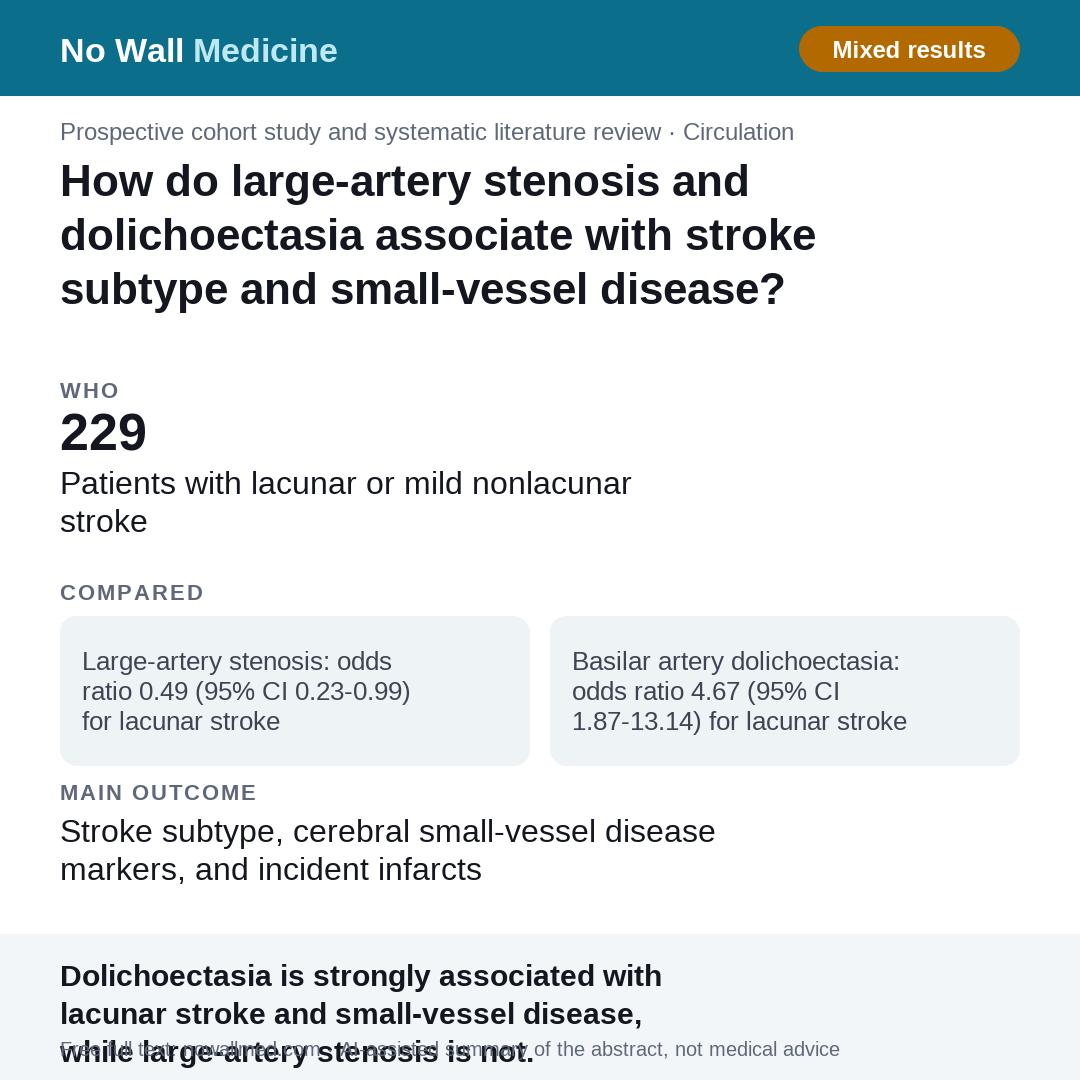
Clinical question: How do large-artery stenosis and dolichoectasia associate with stroke subtype and small-vessel disease?
Why it matters: The contributions of artery narrowing and arterial widening to small-vessel disease and lacunar stroke remain contentious.
Key points
- Researchers studied 229 patients with lacunar or mild nonlacunar stroke to compare large-artery stenosis and arterial widening.
- Basilar artery dolichoectasia, or arterial widening, was associated with lacunar stroke, higher small-vessel disease scores, and more incident infarcts.
- Large-artery stenosis, or narrowing of at least 50%, was not associated with small-vessel disease markers or new infarcts.
Headline and key points written with AI from the paper’s abstract, with every number checked against it. Read the paper before relying on them.
Was this summary helpful?
Subject terms
Headline, design, result, key points, caveat and citation as plain text.
Cite this article
Han F, Clancy U, Arteaga-Reyes C, et al. Implications of Cranial Arterial Stenosis and Dolichoectasia for Cerebral Small-Vessel Disease Etiopathogenesis: Findings From a Prospective Mild Stroke Cohort. Circulation. 2026;153(23):1813-1826. doi:10.1161/CIRCULATIONAHA.126.079493
Spotted a mistake? Suggest a correction