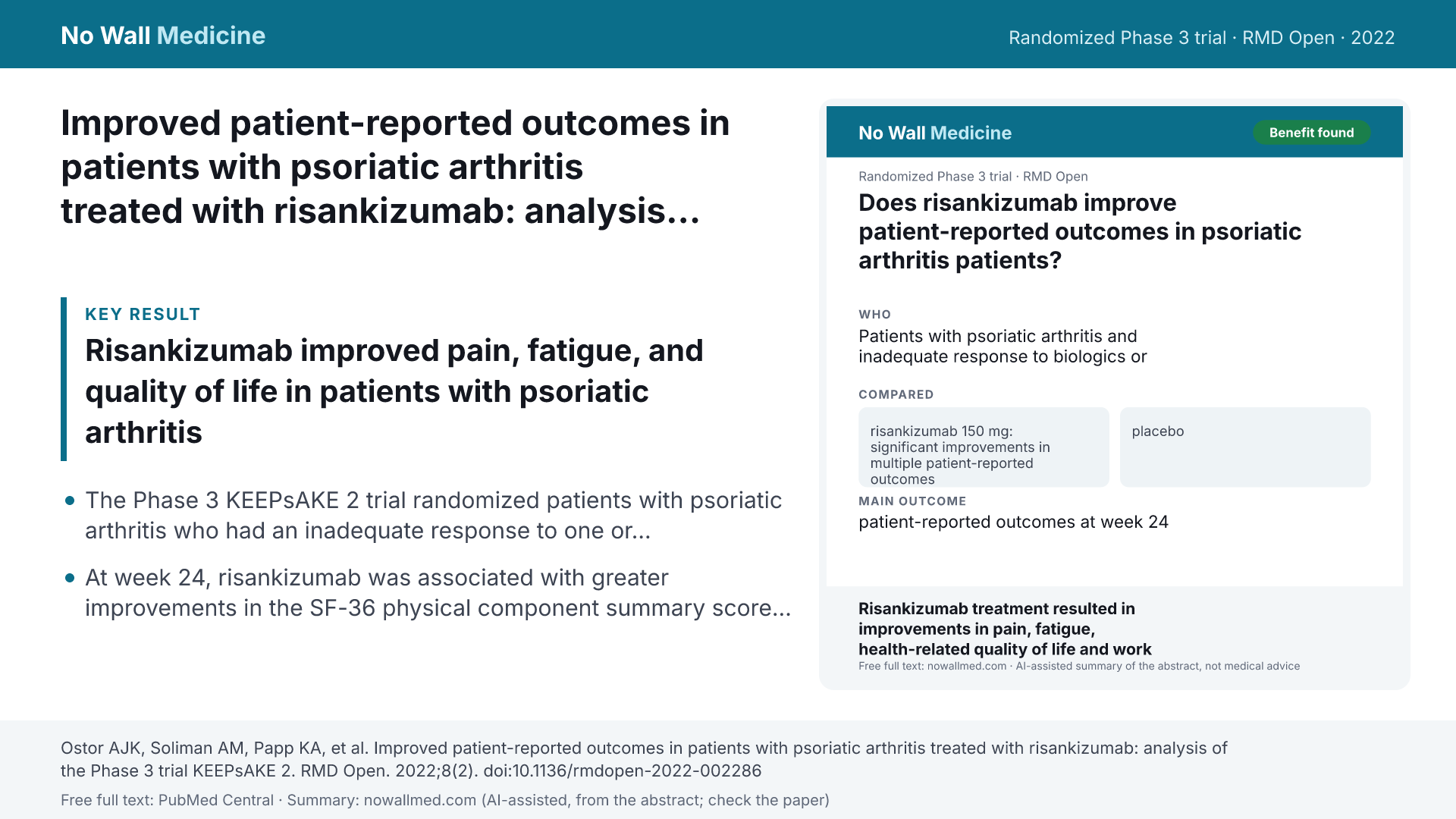
Risankizumab improved pain, fatigue, and quality of life in patients with psoriatic arthritis
Improved patient-reported outcomes in patients with psoriatic arthritis treated with risankizumab: analysis of the Phase 3 trial KEEPsAKE 2
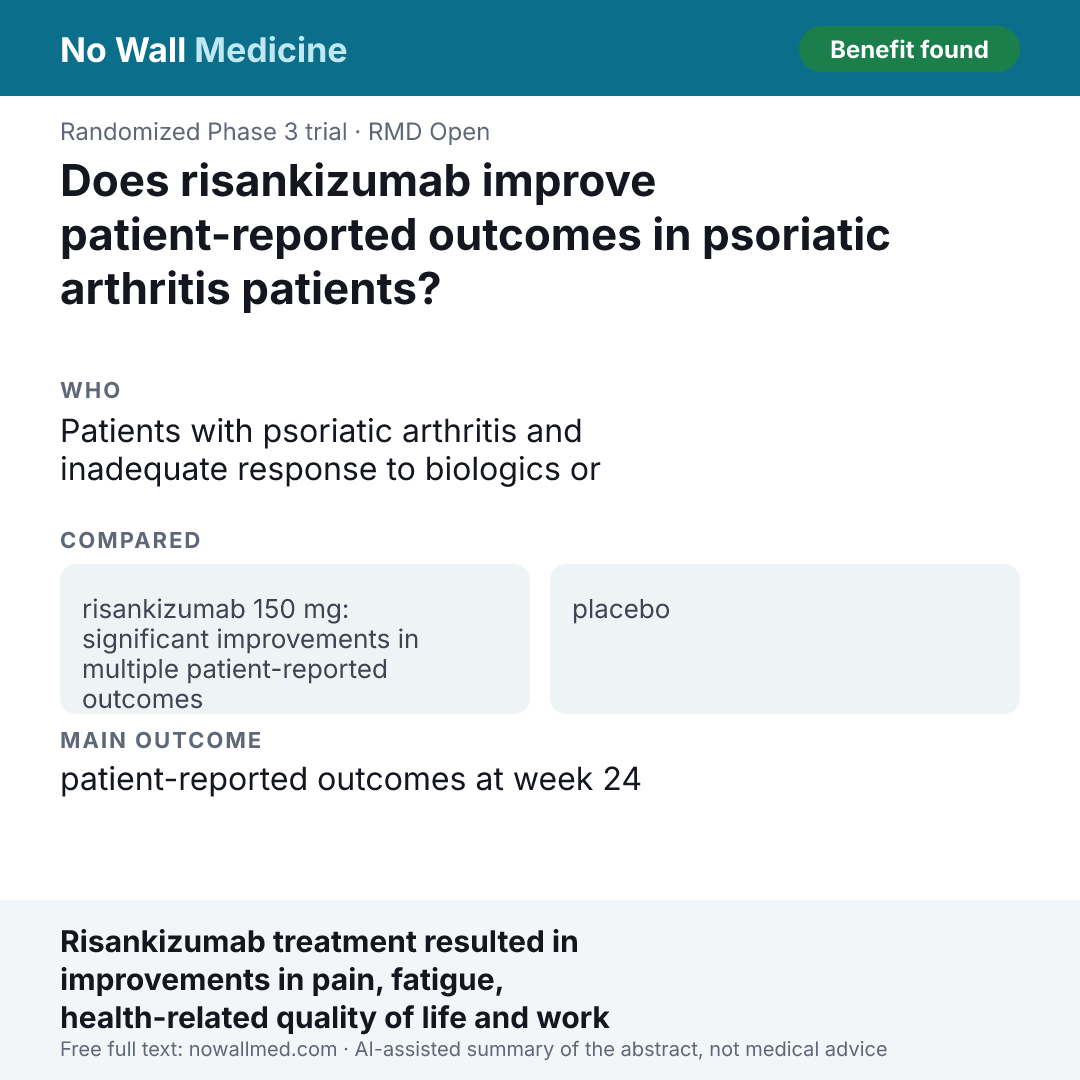
Randomized Phase 3 trialBenefit found
Does risankizumab improve patient-reported outcomes in psoriatic arthritis patients?
Who
Patients with psoriatic arthritis and inadequate response to biologics or conventional synthetic disease-modifying antirheumatic drugs
Compared
risankizumab 150 mg: significant improvements in multiple patient-reported outcomes
placebo
Main outcome
patient-reported outcomes at week 24
Bottom line: Risankizumab treatment resulted in improvements in pain, fatigue, health-related quality of life and work ability.
RMD Open · 2022-06-14 · Save PNG
Same trial (NCT03671148)
Papers we list that report this registered trial, oldest first. Read a secondary analysis alongside the main results.
- Main results Benefit found
Risankizumab was more effective than placebo for patients with active psoriatic arthritis at 24 weeks Ann Rheum Dis 2021-11 - Secondary analysis Benefit found
This paper RMD Open 2022-06 - Related analysis Benefit found
Risankizumab showed sustained symptom improvement in patients with active psoriatic arthritis at 52 weeks Rheumatology 2022-10 - Secondary analysis Benefit found
Risankizumab effective across five psoriatic arthritis phenotypes in long-term trial data Arthritis Res Ther 2025-11
Clinical question: Does risankizumab improve patient-reported outcomes in psoriatic arthritis patients?
Key points
- The Phase 3 KEEPsAKE 2 trial randomized patients with psoriatic arthritis who had an inadequate response to one or two biologics or one or more conventional synthetic disease-modifying antirheumatic drugs to receive risankizumab or a placebo.
- At week 24, risankizumab was associated with greater improvements in the SF-36 physical component summary score (3.9 (2.4 to 5.3)) and the fatigue scale (2.2 (0.6 to 3.9)) compared to placebo.
- Risankizumab treatment was also associated with improvements in pain (-8.1 (-12.8 to -3.5)), patient global assessment of disease activity (-8.8 (-13.5 to -4.2)), and the EQ-5D-5L index (0.08 (0.04 to 0.11)).
Headline and key points written with AI from the paper’s abstract, with every number checked against it. Read the paper before relying on them.
Was this summary helpful?
Abstract
Objectives
Determine the impact of 24-week risankizumab (RZB) versus placebo (PBO) on patient-reported outcomes (PROs) in patients with psoriatic arthritis (PsA) and inadequate response to one or two biologics (Bio-IR) and/or ≥1 conventional synthetic disease-modifying antirheumatic drug (csDMARD-IR). Methods
Patients in the Phase 3 trial, KEEPsAKE 2, were randomised (1:1) to RZB 150 mg or PBO by subcutaneous injection. PROs assessed: 36-Item Short-Form Health Survey (SF-36), Functional Assessment of Chronic Illness Therapy-Fatigue (FACIT-Fatigue), Patient's Assessment of Pain by visual analogue scale (VAS), Patient's global assessment of disease activity (PtGA), EuroQoL-5 Dimension-5 Level (EQ-5D-5L) and Work Productivity and Activity Impairment-PsA (WPAI-PsA). Least squares mean change from baseline at week 24 was compared between RZB versus PBO by mixed-effects repeated regression modelling. Results
At week 24, RZB versus PBO treatment resulted in significant differences (95% CIs) in mean change from baseline in ranked secondary endpoints SF-36 physical component summary score (3.9 (2.4 to 5.3); p<0.001) and FACIT-Fatigue (2.2 (0.6 to 3.9); p=0.009) and improvements in pain (-8.1 (-12.8 to -3.5)), PtGA (-8.8 (-13.5 to -4.2)) and EQ-5D-5L index (0.08 (0.04 to 0.11)) and VAS (5.9 (1.9 to 9.8)) (all nominal p<0.01). More RZB-treated versus PBO-treated patients reported improvements from baseline at week 24 in 7 of 8 SF-36 subdomains (nominal p<0.05). At week 24, more RZB-treated versus PBO-treated patients reported improvements in 3 of 4 WPAI-PsA domains (nominal p≤0.01). Conclusion
Overall, RBZ treatment resulted in improvements in pain, fatigue, health-related quality of life and ability to perform work in Bio-IR and/or csDMARD-IR patients with PsA. Trial registration number
NCT03671148.
Abstract reproduced under the article’s CC BY NC licence.
Subject terms
Headline, design, result, key points, caveat and citation as plain text.
Cite this article
Ostor AJK, Soliman AM, Papp KA, et al. Improved patient-reported outcomes in patients with psoriatic arthritis treated with risankizumab: analysis of the Phase 3 trial KEEPsAKE 2. RMD Open. 2022. doi:10.1136/rmdopen-2022-002286
Spotted a mistake? Suggest a correction