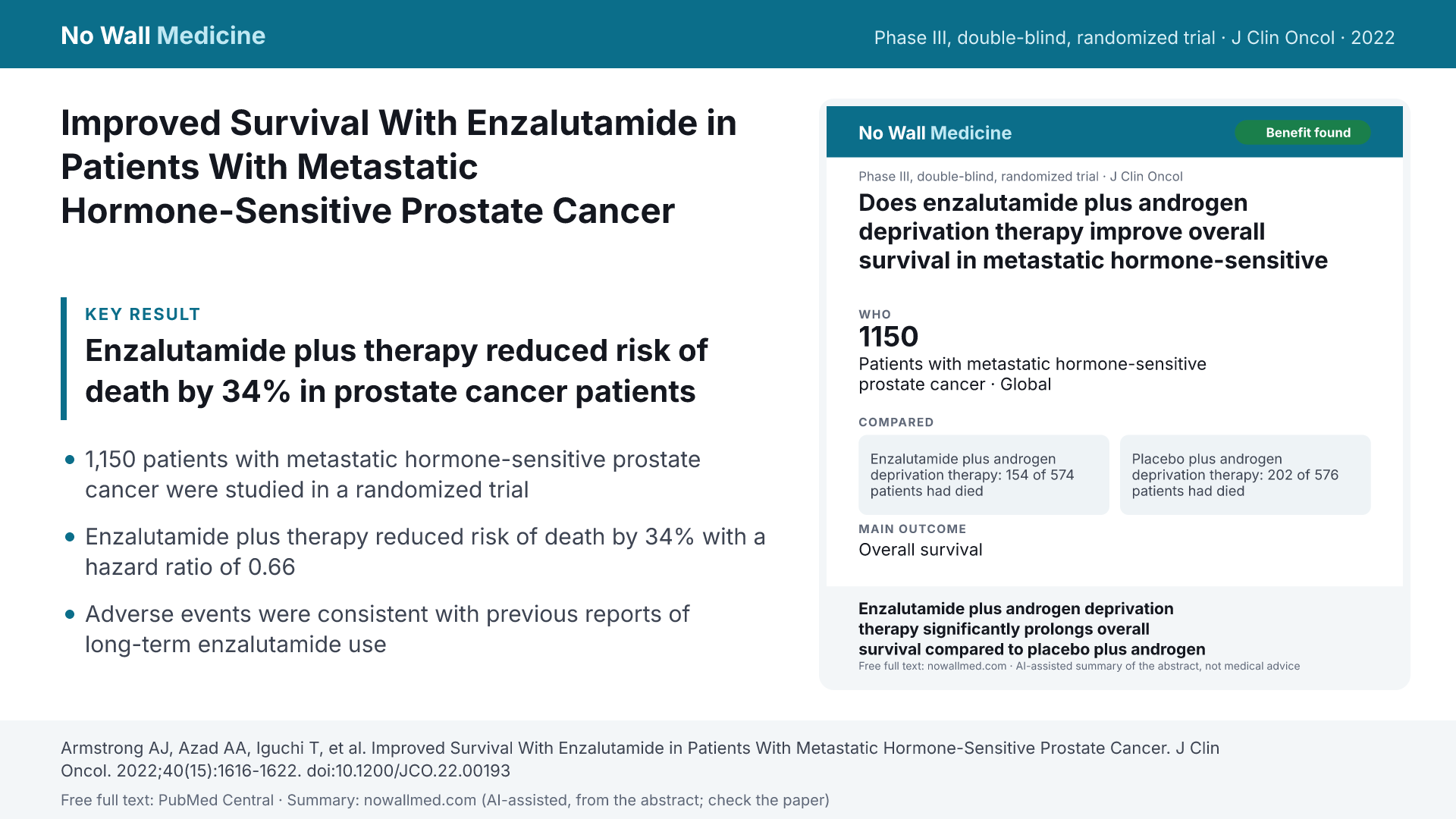
Enzalutamide plus therapy reduced risk of death by 34% in prostate cancer patients
Improved Survival With Enzalutamide in Patients With Metastatic Hormone-Sensitive Prostate Cancer
Phase III, double-blind, randomized trialBenefit found
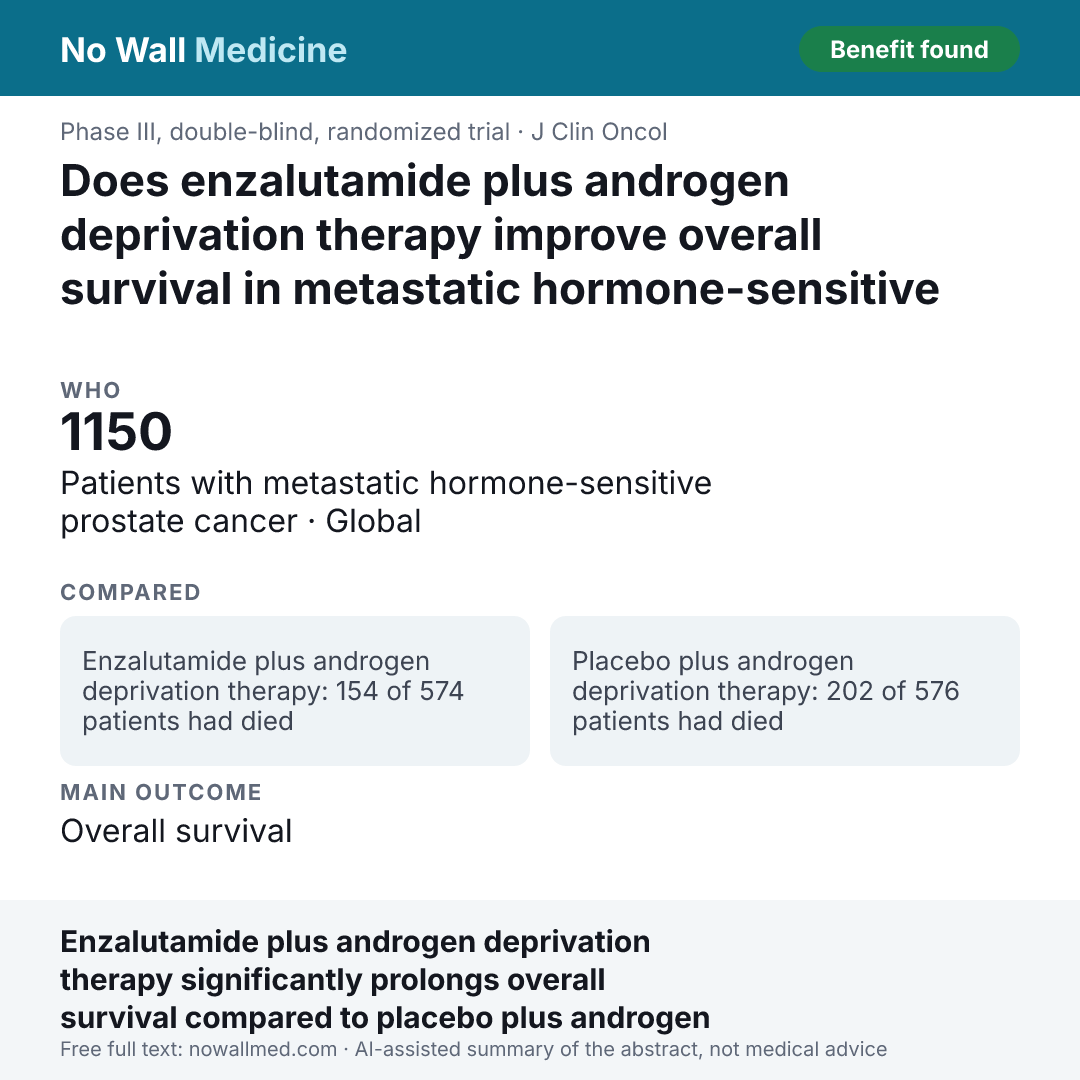
Does enzalutamide plus androgen deprivation therapy improve overall survival in metastatic hormone-sensitive prostate cancer?
Who
1150
Patients with metastatic hormone-sensitive prostate cancer · Global
Compared
Enzalutamide plus androgen deprivation therapy: 154 of 574 patients had died
Placebo plus androgen deprivation therapy: 202 of 576 patients had died
Main outcome
Overall survival
Result: hazard ratio 0.66 (95% CI 0.53 to 0.81)
Bottom line: Enzalutamide plus androgen deprivation therapy significantly prolongs overall survival compared to placebo plus androgen deprivation therapy.
J Clin Oncol · 2022-04-14 · Save PNG
Same trial (NCT02677896)
Papers we list that report this registered trial, oldest first. Read a secondary analysis alongside the main results.
- Main results Benefit found
This paper J Clin Oncol 2022-04 - Secondary analysis Benefit found
Enzalutamide plus androgen deprivation therapy improved survival in patients with oligometastatic prostate cancer Eur Urol 2023-05 - Secondary analysis Benefit found
Enzalutamide plus androgen deprivation therapy was associated with better outcomes in metastatic prostate cancer patients JAMA Netw Open 2025-05 - Secondary analysis Benefit found
Enzalutamide plus androgen-deprivation therapy increased five year survival in metastatic hormone-sensitive prostate cancer Eur Urol 2026-02 - Secondary analysis Mixed results
Imaging progression without prostate-specific antigen rise occurred frequently in patients treated with enzalutamide J Clin Oncol 2026-03
Clinical question: Does enzalutamide plus androgen deprivation therapy improve overall survival in metastatic hormone-sensitive prostate cancer?
Why it matters: Overall survival data were previously immature for enzalutamide in metastatic hormone-sensitive prostate cancer
Key points
- 1,150 patients with metastatic hormone-sensitive prostate cancer were studied in a randomized trial.
- Enzalutamide plus therapy reduced risk of death by 34% with a hazard ratio of 0.66.
- Adverse events were consistent with previous reports of long-term enzalutamide use.
Headline and key points written with AI from the paper’s abstract, with every number checked against it. Read the paper before relying on them.
Was this summary helpful?
Subject terms
Headline, design, result, key points, caveat and citation as plain text.
Cite this article
Armstrong AJ, Azad AA, Iguchi T, et al. Improved Survival With Enzalutamide in Patients With Metastatic Hormone-Sensitive Prostate Cancer. J Clin Oncol. 2022;40(15):1616-1622. doi:10.1200/JCO.22.00193
Spotted a mistake? Suggest a correction