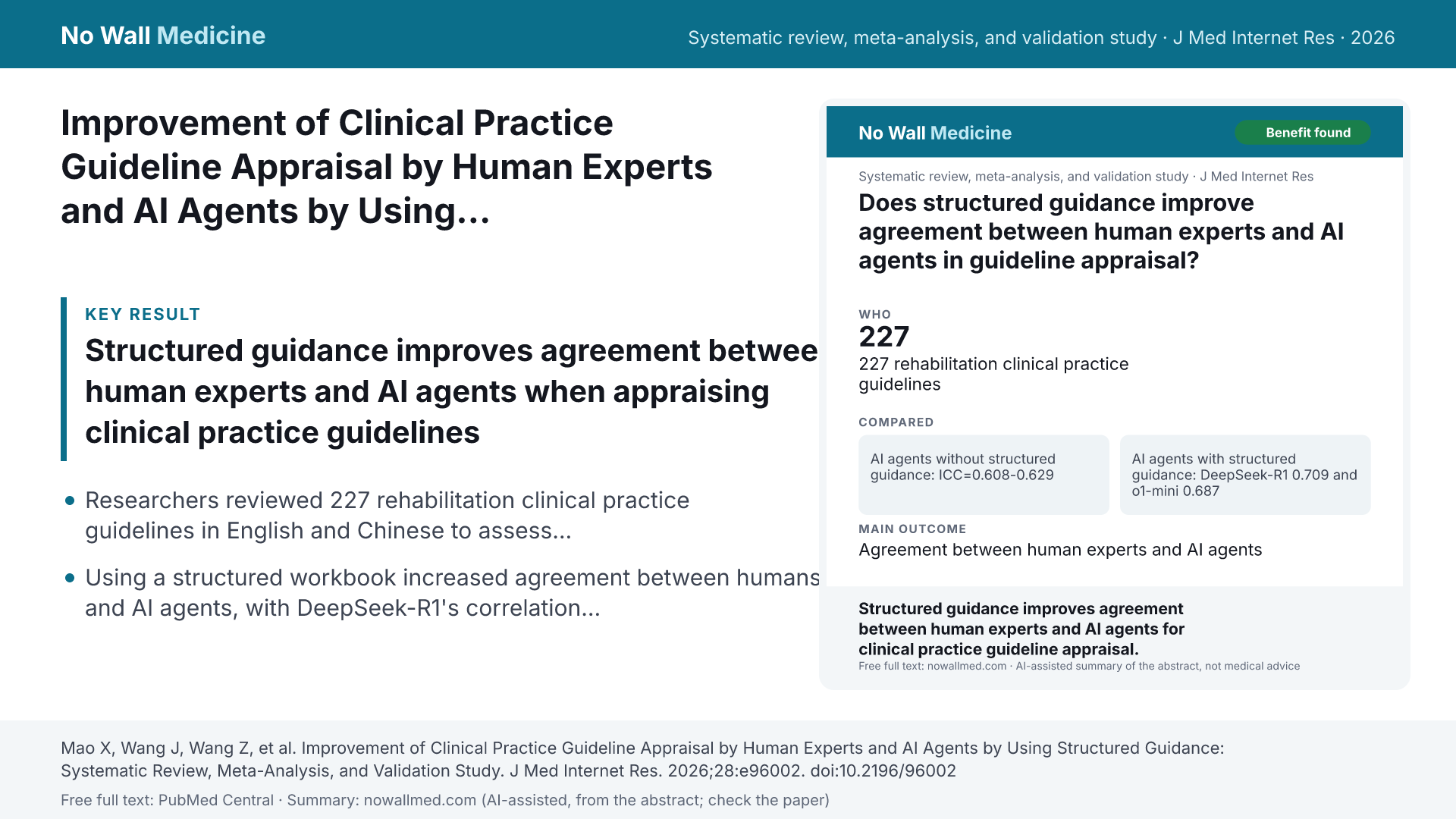
Structured guidance improves agreement between human experts and AI agents when appraising clinical practice guidelines
Improvement of Clinical Practice Guideline Appraisal by Human Experts and AI Agents by Using Structured Guidance: Systematic Review, Meta-Analysis, and Validation Study
Systematic review, meta-analysis, and validation studyBenefit found
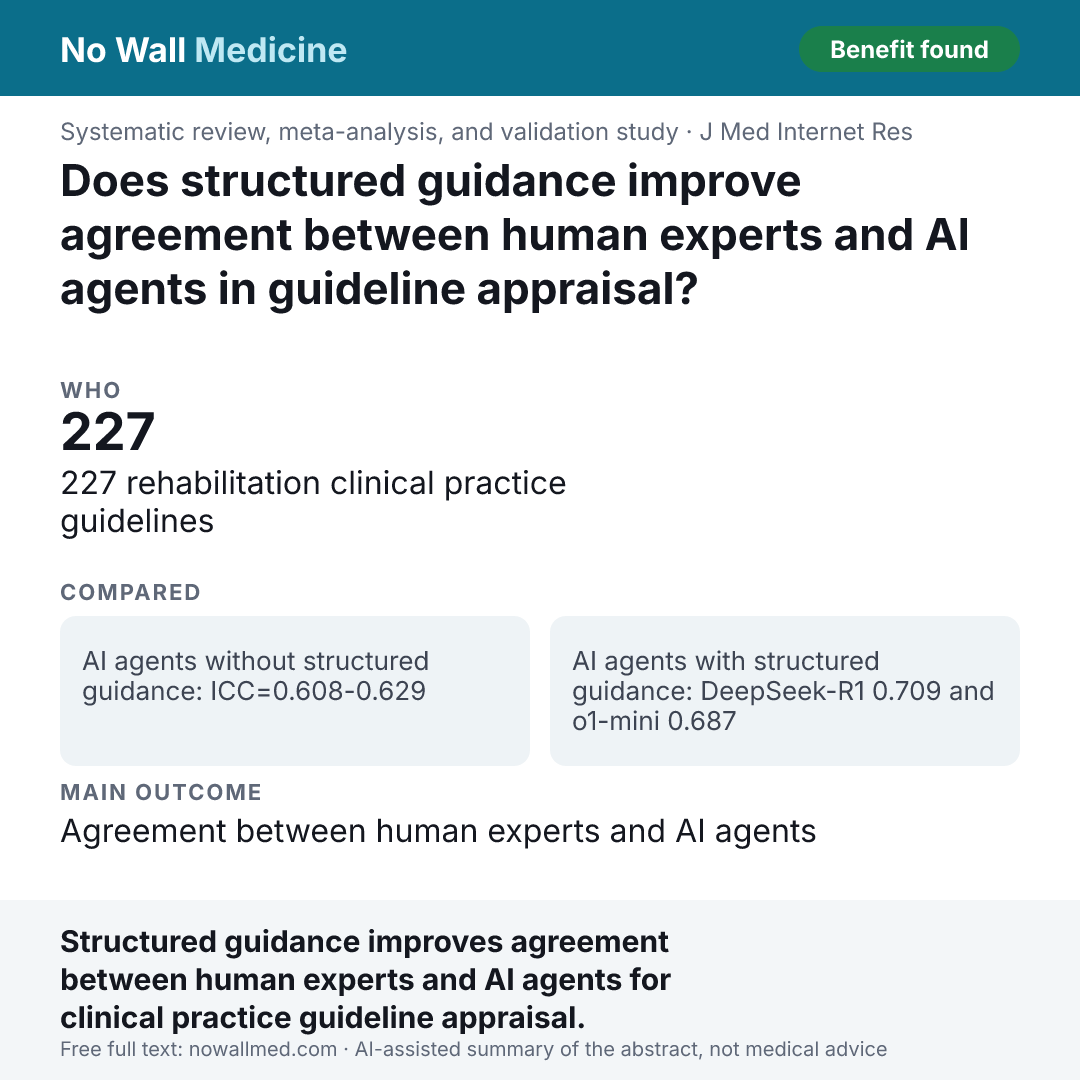
Does structured guidance improve agreement between human experts and AI agents in guideline appraisal?
Who
227
227 rehabilitation clinical practice guidelines
Compared
AI agents without structured guidance: ICC=0.608-0.629
AI agents with structured guidance: DeepSeek-R1 0.709 and o1-mini 0.687
Main outcome
Agreement between human experts and AI agents
Bottom line: Structured guidance improves agreement between human experts and AI agents for clinical practice guideline appraisal.
J Med Internet Res · 2026-08-26 · Save PNG
Clinical question: Does structured guidance improve agreement between human experts and AI agents in guideline appraisal?
Key points
- Researchers reviewed 227 rehabilitation clinical practice guidelines in English and Chinese to assess their methodological and reporting quality.
- Using a structured workbook increased agreement between humans and AI agents, with DeepSeek-R1's correlation coefficient rising from 0.613 to 0.709.
- Overall guideline quality was low, with 35.9% applicability and 52% stakeholder involvement across the reviewed documents.
Headline and key points written with AI from the paper’s abstract, with every number checked against it. Read the paper before relying on them.
Was this summary helpful?
Subject terms
Headline, design, result, key points, caveat and citation as plain text.
Cite this article
Mao X, Wang J, Wang Z, et al. Improvement of Clinical Practice Guideline Appraisal by Human Experts and AI Agents by Using Structured Guidance: Systematic Review, Meta-Analysis, and Validation Study. J Med Internet Res. 2026;28:e96002. doi:10.2196/96002
Spotted a mistake? Suggest a correction