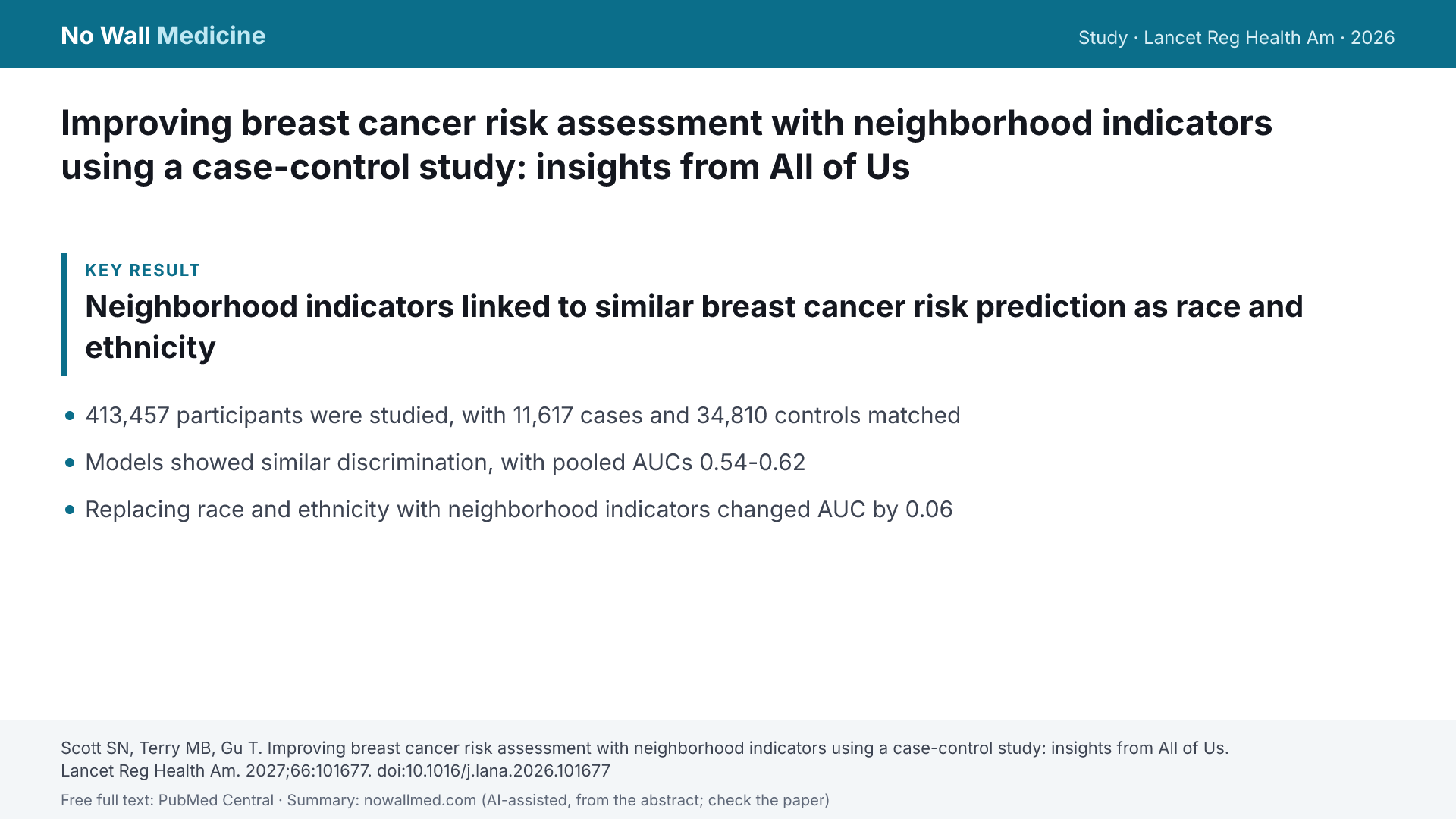
Neighborhood indicators linked to similar breast cancer risk prediction as race and ethnicity
Improving breast cancer risk assessment with neighborhood indicators using a case-control study: insights from All of Us
Why it matters: Breast cancer risk assessment needs improvement to reduce disparities
Key points
- 413,457 participants were studied, with 11,617 cases and 34,810 controls matched.
- Models showed similar discrimination, with pooled AUCs 0.54-0.62.
- Replacing race and ethnicity with neighborhood indicators changed AUC by 0.06.
Limitation the authors note: The study had limited discrimination, with AUCs ranging from 0.54 to 0.62
Study type: Observational study: it can show a link, but not prove that one thing causes another.
Headline and key points written with AI from the paper’s abstract, with every number checked against it. Read the paper before relying on them.
Was this summary helpful?
Headline, design, result, key points, caveat and citation as plain text.
Cite this article
Scott SN, Terry MB, Gu T. Improving breast cancer risk assessment with neighborhood indicators using a case-control study: insights from All of Us. Lancet Reg Health Am. 2027;66:101677. doi:10.1016/j.lana.2026.101677
Spotted a mistake? Suggest a correction