Web-Based System Reduced Suboptimal Musculoskeletal Care In UK Primary Care
Improving Musculoskeletal Care Quality With a Web-Based Clinical Decision Support System in UK Primary Care: Mixed Methods Cluster-Randomized Controlled Trial
Cluster-randomized controlled trialBenefit found
Does a web-based system improve musculoskeletal care?
Who
10182
Adult patients with musculoskeletal conditions · 19 UK general practices
Compared
3%Intervention (2/60)
25%Control (15/60)
Main outcome
Suboptimal care management
Result: adjusted odds ratio 12.30 (95% CI 2.52 to 59.9)
Bottom line: System reduces suboptimal care when used
Limitation: Limited engagement
J Med Internet Res · 2026-10-15Download image
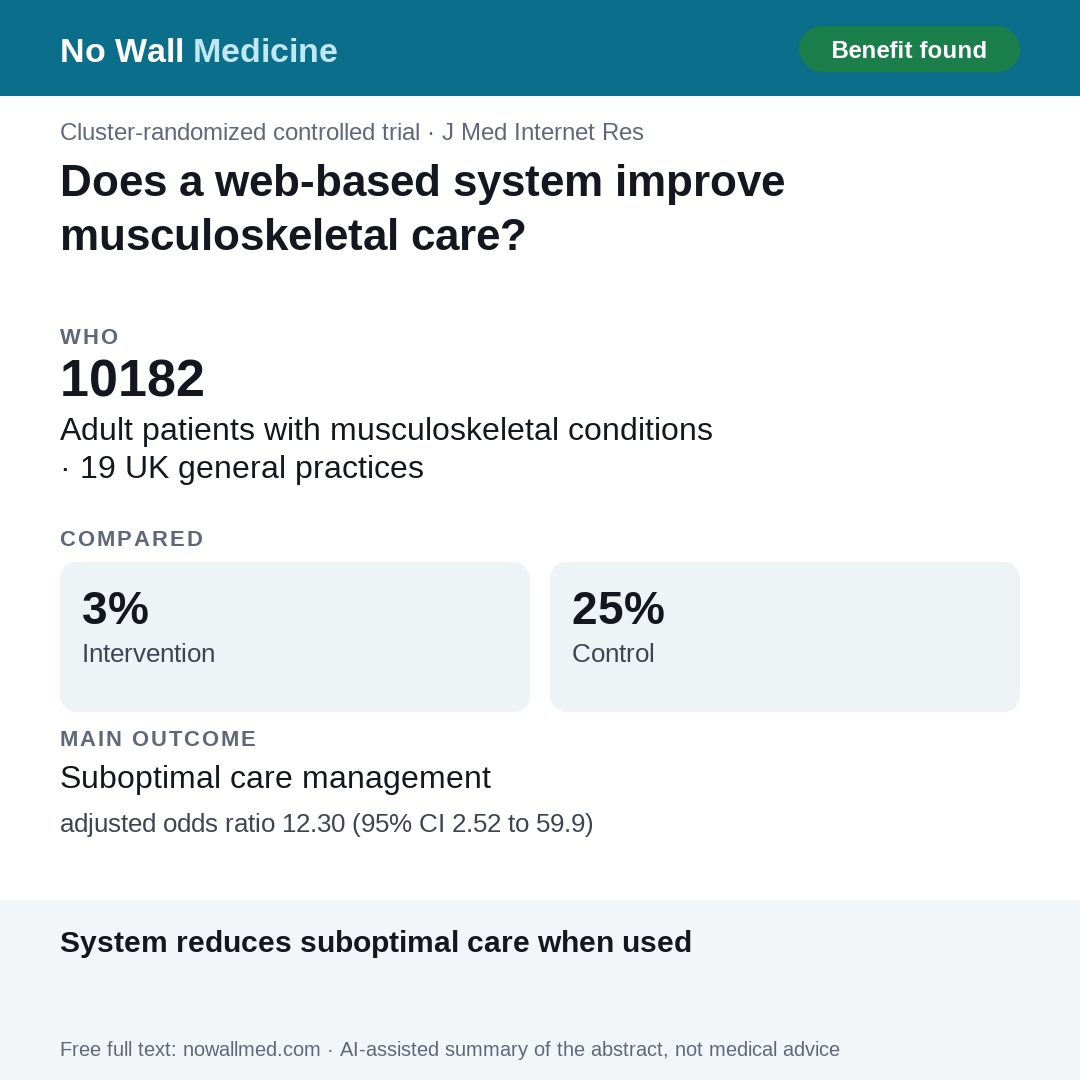
Clinical question: Does a web-based system improve musculoskeletal care?
Why it matters: Doctors have had limited tools to improve musculoskeletal care quality in primary care
In absolute numbers
Intervention: 3% · Control: 25% → a difference of 22 percentage points, so about 5 people would need the treatment for 1 more to benefit (number needed to treat) over the trial’s follow-up.
Worked out by us from the two group results above, not reported by the authors. Check the paper for the exact outcome and timing.
Key points
- Researchers studied 10,182 patients with musculoskeletal conditions in 19 general practices.
- The system reduced suboptimal care to 3% when used, from 25% without it.
- It also increased self-management advice and reduced prescribing and fit-note use.
Limitation the authors note: Overall engagement with the system was limited, underscoring the need for improved digital integration
Headline and key points written with AI from the paper’s abstract, with every number checked against it. Read the paper before relying on them.
Topics
Spotted a mistake? Suggest a correction