Feasibility of using brain monitoring to guide treatment for spreading depolarizations in brain injury
Improving Neurotrauma by Depolarization Inhibition With Combination Therapy: A Phase 2 Randomized Feasibility Trial
Randomized feasibility trialUnclear result
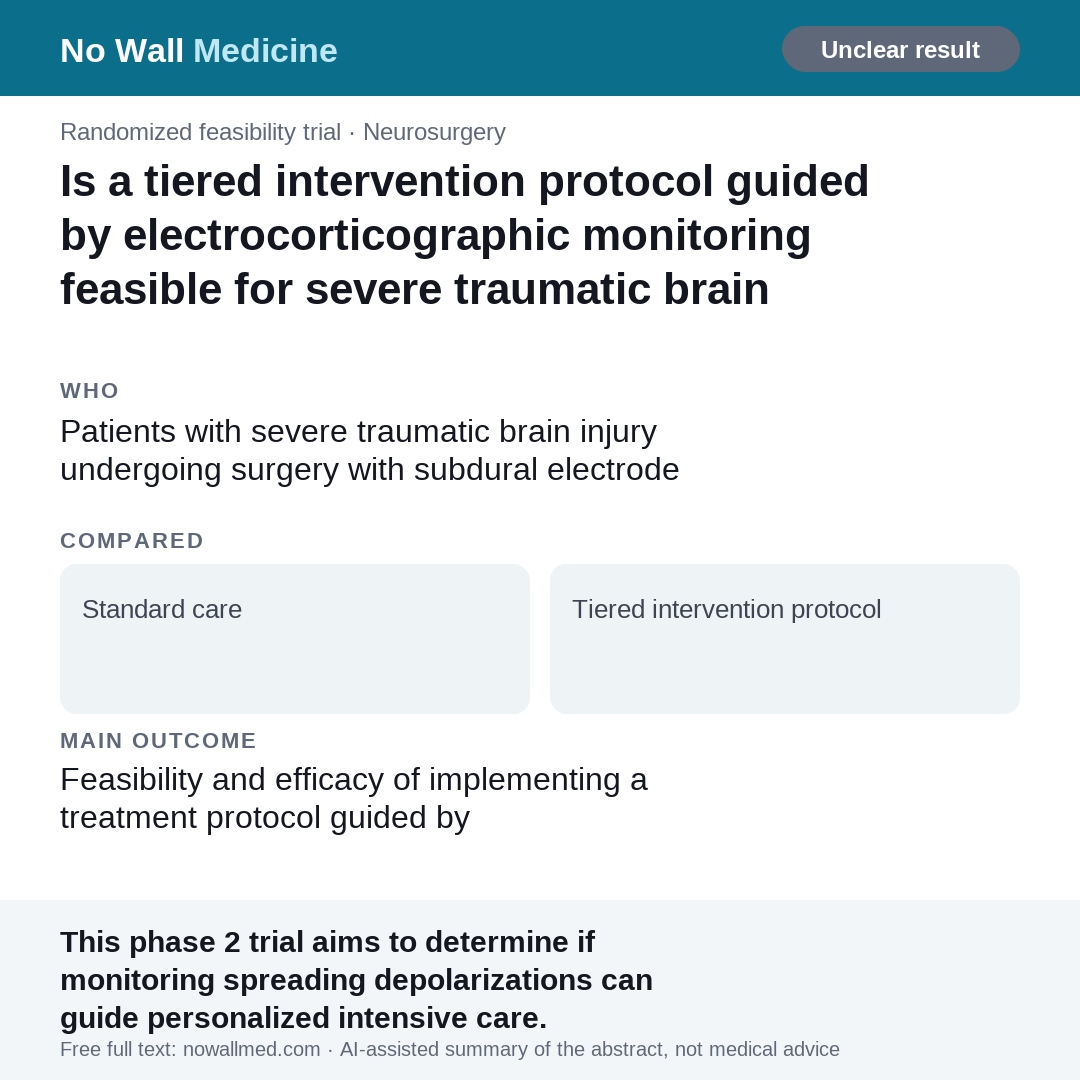
Is a tiered intervention protocol guided by electrocorticographic monitoring feasible for severe traumatic brain injury?
Who
Patients with severe traumatic brain injury undergoing surgery with subdural electrode strip placement
Compared
Standard care
Tiered intervention protocol
Main outcome
Feasibility and efficacy of implementing a treatment protocol guided by electrocorticographic monitoring
Bottom line: This phase 2 trial aims to determine if monitoring spreading depolarizations can guide personalized intensive care.
Neurosurgery · 2023-04-21Download image
Clinical question: Is a tiered intervention protocol guided by electrocorticographic monitoring feasible for severe traumatic brain injury?
Why it matters: It is unknown how to incorporate the monitoring of spreading depolarizations into clinical management protocols for patients with severe traumatic brain injury.
Key points
- The study involves patients with severe traumatic brain injury who have electrode strips placed on the brain surface to monitor spreading depolarizations.
- Patients exhibiting these electrical waves are randomized 1:1 to either standard care or a tiered intervention protocol using blood pressure, temperature, glucose, and ketamine management.
- The trial aims to determine if real-time monitoring can guide clinical management and reduce secondary injury without increasing medical complications.
Headline and key points written with AI from the paper’s abstract, with every number checked against it. Read the paper before relying on them.
Was this summary helpful?
Subject terms
Cite this article
Hartings JA, Dreier JP, Ngwenya LB, Balu R, Carlson AP, Foreman B. Improving Neurotrauma by Depolarization Inhibition With Combination Therapy: A Phase 2 Randomized Feasibility Trial. Neurosurgery. 2023. doi:10.1227/neu.0000000000002509
Spotted a mistake? Suggest a correction
Top studies every Monday
The week’s key trials and guidelines in your specialties, plus any topics you follow. By email, free.
Get the weekly digest