Group metacognitive therapy improved depression and anxiety symptoms in patients undergoing cardiac rehabilitation
Improving the Effectiveness of Psychological Interventions for Depression and Anxiety in Cardiac Rehabilitation: PATHWAY-A Single-Blind, Parallel, Randomized, Controlled Trial of Group Metacognitive Therapy
Single-blind, parallel, randomized, controlled trialBenefit found
Does group metacognitive therapy improve depression and anxiety in cardiac rehabilitation?
Who
332
cardiovascular disease patients in cardiac rehabilitation · 5 National Health Service Trusts in North-West England
Compared
metacognitive therapy plus cardiac rehabilitation
usual cardiac rehabilitation alone
Main outcome
Hospital Anxiety and Depression Scale total score
Result: -3.24 (95% CI, -4.67 to -1.81)
Bottom line: Adding group metacognitive therapy to cardiac rehabilitation significantly improves depression and anxiety symptoms.
Limitation: No control for additional contact to estimate nonspecific effects; did not assess cardiac outcomes.
Circulation · 2021-06-21Download image
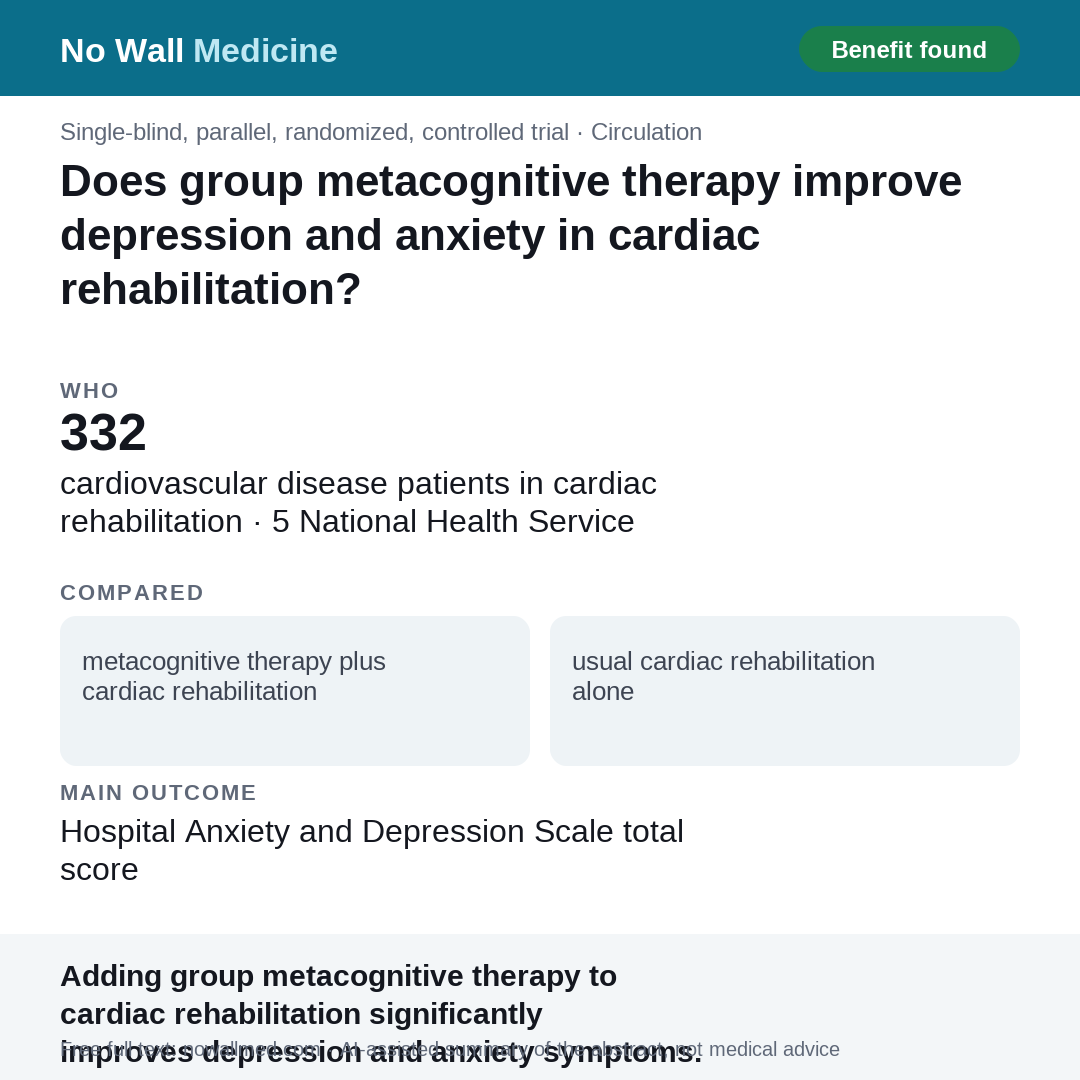
Clinical question: Does group metacognitive therapy improve depression and anxiety in cardiac rehabilitation?
Why it matters: Current psychological treatments for depression and anxiety in patients with cardiovascular disease often offer only small or mixed improvements.
Key points
- Researchers studied 332 cardiac rehabilitation patients who were randomly assigned to receive either group metacognitive therapy plus usual care or usual care alone.
- The group receiving metacognitive therapy showed a significant difference in total Hospital Anxiety and Depression Scale scores at 4 months (-3.24 [95% CI, -4.67 to -1.81], PP=0.005).
- The intervention was associated with changes in psychological mechanisms, including metacognitive beliefs and repetitive negative thinking, with most gains remaining significant at 12 months.
Limitation the authors note: The trial did not control for additional contact as part of the metacognitive therapy to estimate nonspecific effects and was not intended to assess cardiac outcomes.
Headline and key points written with AI from the paper’s abstract, with every number checked against it. Read the paper before relying on them.
Was this summary helpful?
Abstract
Background
Depression and anxiety in cardiovascular disease are significant, contributing to poor prognosis. Unfortunately, current psychological treatments offer mixed, usually small improvements in these symptoms. The present trial tested for the first time the effects of group metacognitive therapy (MCT; 6 sessions) on anxiety and depressive symptoms when delivered alongside cardiac rehabilitation (CR).Methods
A total of 332 CR patients recruited from 5 National Health Service Trusts across the North-West of England were randomly allocated to MCT+CR (n=163, 49.1%) or usual CR alone (n=169, 50.9%). Randomization was 1:1 via minimization balancing arms on sex and Hospital Anxiety and Depression Scale scores within hospital site. The primary outcome was Hospital Anxiety and Depression Scale total after treatment (4-month follow-up). Secondary outcomes were individual Hospital Anxiety and Depression Scales, traumatic stress symptoms, and psychological mechanisms including metacognitive beliefs and repetitive negative thinking. Analysis was intention to treat.Results
The adjusted group difference on the primary outcome, Hospital Anxiety and Depression Scale total score at 4 months, significantly favored the MCT+CR arm (-3.24 [95% CI, -4.67 to -1.81], PP=0.005; standardized effect size, 0.33 [95% CI, 0.101 to 0.568]). The intervention improved outcomes significantly for both depression and anxiety symptoms when assessed separately compared with usual care. Sensitivity analysis using multiple imputation of missing values supported these findings. Most secondary outcomes favored MCT+CR, with medium to high effect sizes for psychological mechanisms of metacognitive beliefs and repetitive negative thinking. No adverse treatment-related events were reported.Conclusions
Group MCT+CR significantly improved depression and anxiety compared with usual care and led to greater reductions in unhelpful metacognitions and repetitive negative thinking. Most gains remained significant at 12 months. Study strengths include a large sample, a theory-based intervention, use of longer-term follow-up, broad inclusion criteria, and involvement of a trials unit. Limitations include no control for additional contact as part of MCT to estimate nonspecific effects, and the trial was not intended to assess cardiac outcomes. Nonetheless, results demonstrated that addition of the MCT intervention had broad and significant beneficial effects on mental health symptoms. Registration: URL: https://www.clinicaltrials.gov; Unique identifier: ISRCTN74643496.
Abstract reproduced under the article’s CC BY-NC-ND licence.
Subject terms
Cite this article
Wells A, Reeves D, Capobianco L, Heal C, Davies L, Heagerty A. Improving the Effectiveness of Psychological Interventions for Depression and Anxiety in Cardiac Rehabilitation: PATHWAY-A Single-Blind, Parallel, Randomized, Controlled Trial of Group Metacognitive Therapy. Circulation. 2021. doi:10.1161/CIRCULATIONAHA.120.052428
Spotted a mistake? Suggest a correction
Top studies every Monday
The week’s key trials and guidelines in your specialties, plus any topics you follow. By email, free.
Get the weekly digest