Smartphone-based self-guided hypnotherapy was not found to be as effective as in-person therapy for IBS
In-person therapist-delivered hypnotherapy versus smartphone-based self-guided hypnotherapy in IBS: a multicentre three-armed randomised controlled trial
Multicentre, three-armed non-inferiority randomised controlled trialNo clear difference
Is smartphone-based self-guided hypnotherapy non-inferior to in-person therapist-delivered hypnotherapy for IBS?
Who
230
Patients with irritable bowel syndrome aged 16-75 years · Multicentre
Compared
48%In-person therapist-delivered hypnotherapy
33%Smartphone-based self-guided hypnotherapy
22%Online self-guided psychoeducation
Main outcome
Abdominal pain response per Food and Drug Administration definition
Result: -14.7%, 95% CI -29.3% to 0.9%
Bottom line: Smartphone-based self-guided hypnotherapy was not shown to be non-inferior to in-person therapist-delivered hypnotherapy for reducing abdominal pain.
Gut · 2026-07-25Download image
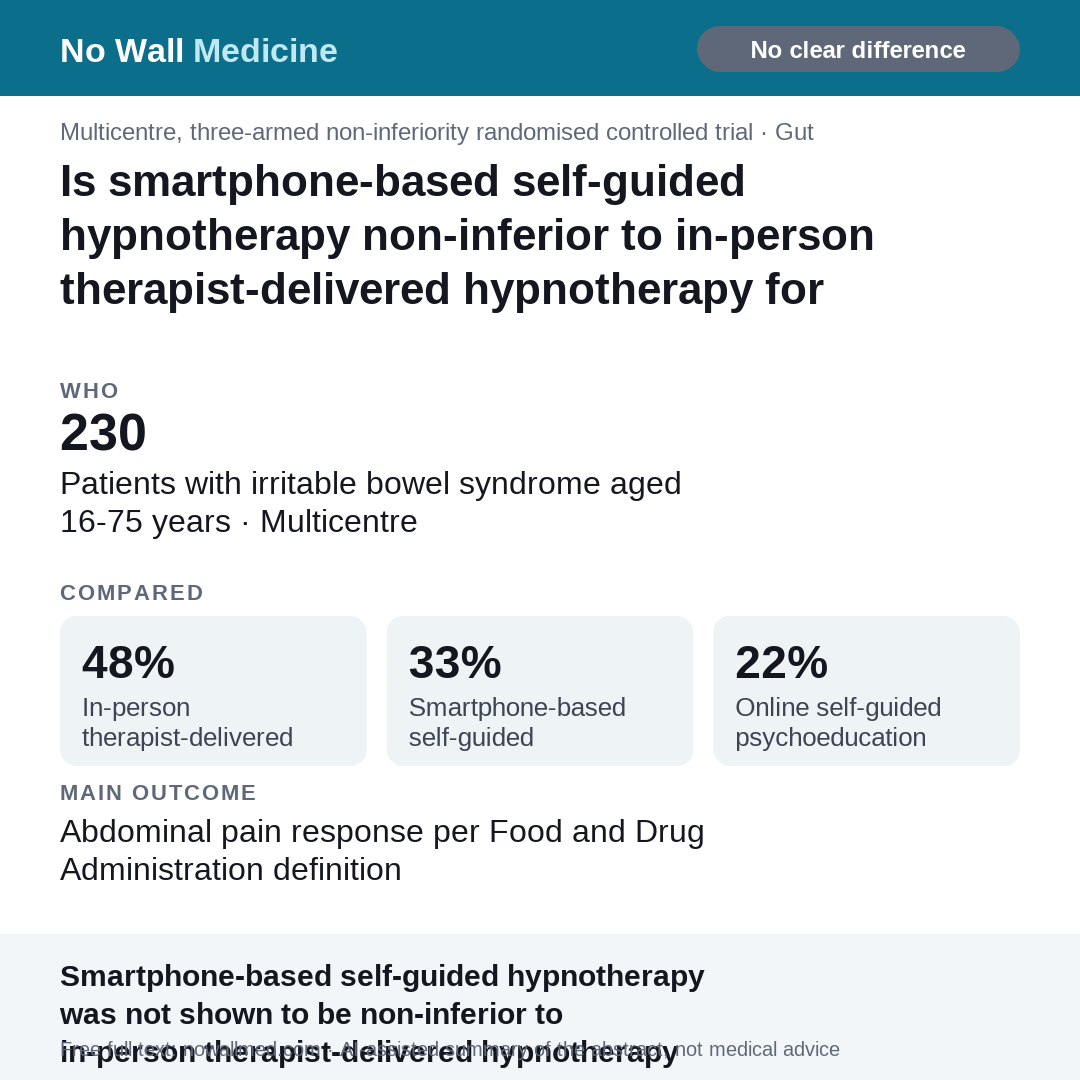
Clinical question: Is smartphone-based self-guided hypnotherapy non-inferior to in-person therapist-delivered hypnotherapy for IBS?
Why it matters: Access to therapist-led hypnotherapy for irritable bowel syndrome is limited by costs and availability.
Key points
- Researchers studied 230 patients with irritable bowel syndrome (IBS) comparing in-person hypnotherapy, smartphone-based self-guided hypnotherapy, and online psychoeducation.
- The abdominal pain response rate was 48% for in-person therapy, 33% for smartphone-based hypnotherapy, and 22% for psychoeducation.
- The study could not show that smartphone-based hypnotherapy was non-inferior to in-person therapy for reducing abdominal pain.
Headline and key points written with AI from the paper’s abstract, with every number checked against it. Read the paper before relying on them.
Abstract
Background
Hypnotherapy is an evidence-based therapy recommended for IBS, but access to therapist-led hypnotherapy is limited by costs and availability. Objective
We studied the effectiveness of smartphone-based self-guided hypnotherapy versus in-person therapist-delivered hypnotherapy. Design
This multicentre, three-armed non-inferiority randomised controlled trial (RCT) included patients with IBS (Rome IV, 16-75 years). Patients were randomised to 12-week in-person therapist-delivered hypnotherapy, smartphone-based self-guided hypnotherapy or online self-guided psychoeducation. The primary endpoint was abdominal pain response per Food and Drug Administration (FDA) definition (≥30% reduction from baseline in weekly average of worst daily abdominal pain in at least 2 out of 4 weeks follow-up). The non-inferiority margin was 10%. Secondary endpoints included ≥50 points IBS-symptom severity scale reduction and changes in psychological symptoms. Results
A total of 230 patients (mean±SD age 38.2±13.8 years, 70.4% female) were randomised. FDA abdominal pain response rates were 48% for in-person therapist-delivered hypnotherapy, 33% for smartphone-based self-guided hypnotherapy and 22% for psychoeducation. Non-inferiority of online to in-person hypnotherapy could not be shown (-14.7%, 95% CI -29.3% to 0.9%). In-person hypnotherapy was more effective than psychoeducation (OR 3.48, 95% CI 1.68 to 7.20, p<0.001) at week 16, both hypnotherapy groups were more effective at 6-month follow-up (OR 3.11, 95% CI 1.37 to 7.09, p=0.007 and OR 4.68, 95% CI 2.07 to 10.57, p<0.001). There were no significant treatment effects on psychological symptoms between groups. Conclusion
This multicentre RCT could not demonstrate non-inferiority of smartphone-based self-guided hypnotherapy compared with in-person therapist-delivered hypnotherapy in reducing abdominal pain. However, substantial response rates for smartphone-based self-guided hypnotherapy highlight its potential as a broadly applicable and cost-effective alternative. Trial registration number
NCT03899779.
Abstract reproduced under the article’s CC BY NC licence.
Cite this article
Snijkers JTW, Bosman MHMA, Winkens B, Haarhuis BJT, Witteman BJM, Pijnenborg N. In-person therapist-delivered hypnotherapy versus smartphone-based self-guided hypnotherapy in IBS: a multicentre three-armed randomised controlled trial. Gut. 2026. doi:10.1136/gutjnl-2026-338385
Spotted a mistake? Suggest a correction