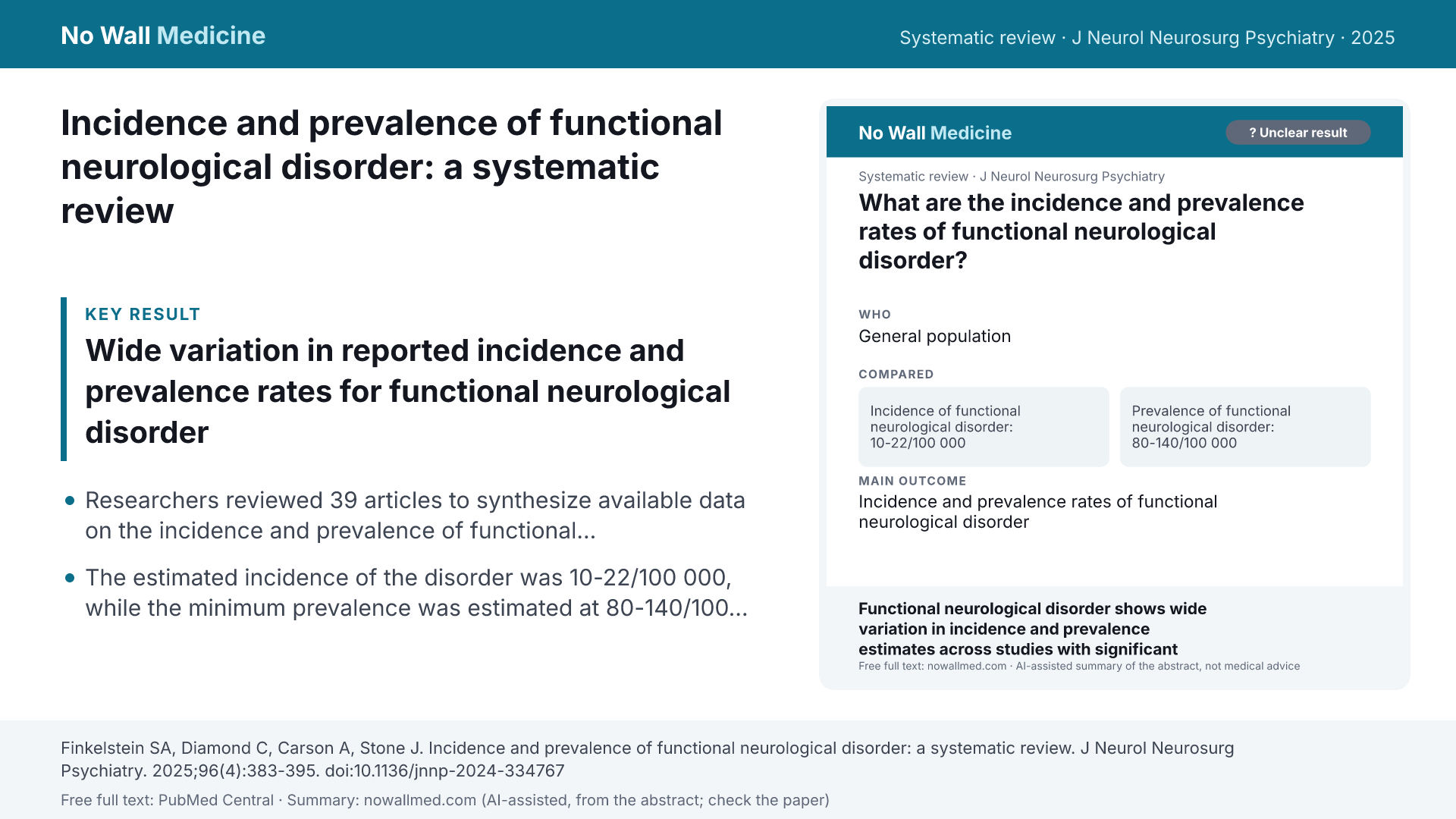
Wide variation in reported incidence and prevalence rates for functional neurological disorder
Incidence and prevalence of functional neurological disorder: a systematic review
Systematic reviewUnclear result
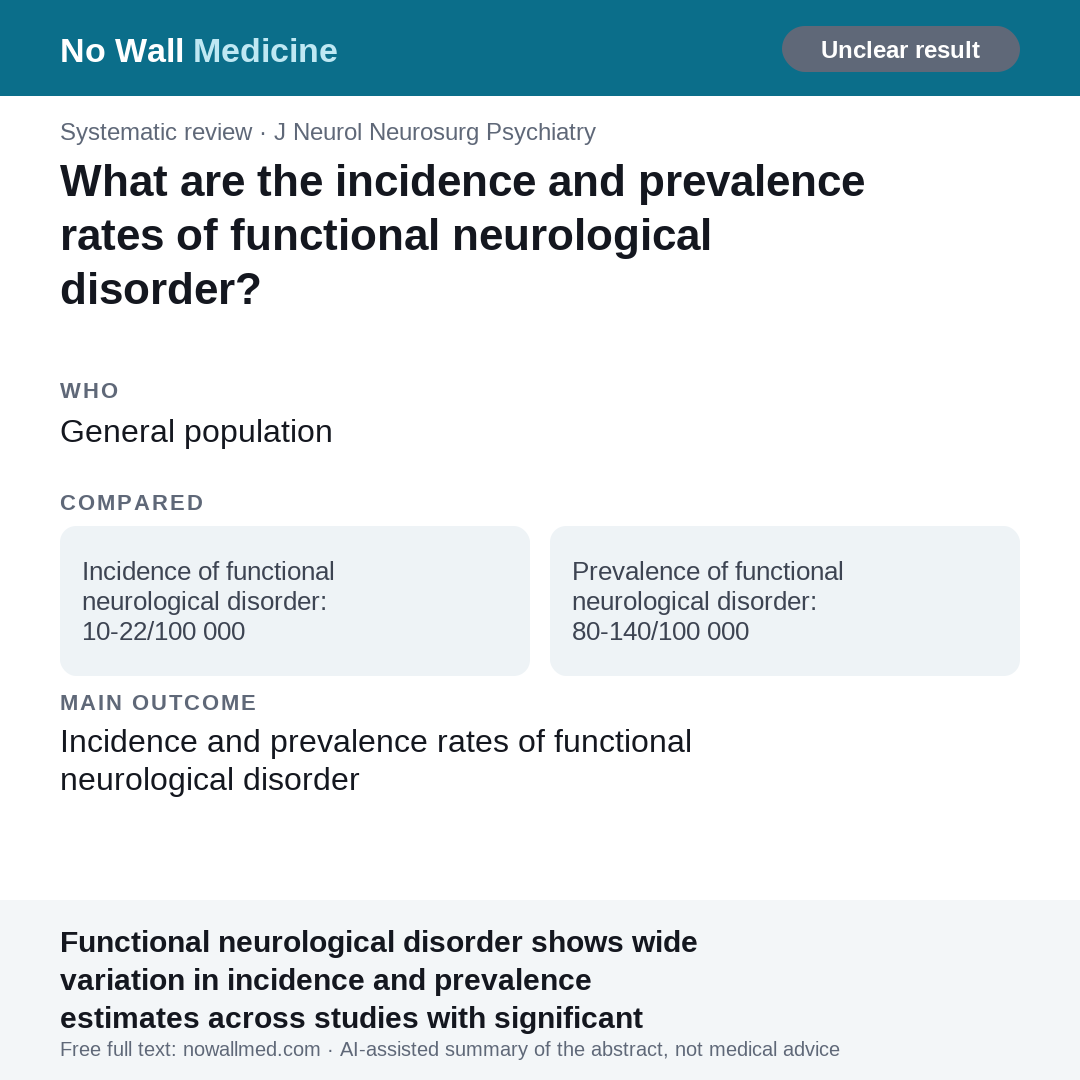
What are the incidence and prevalence rates of functional neurological disorder?
Who
General population
Compared
Incidence of functional neurological disorder: 10-22/100 000
Prevalence of functional neurological disorder: 80-140/100 000
Main outcome
Incidence and prevalence rates of functional neurological disorder
Bottom line: Functional neurological disorder shows wide variation in incidence and prevalence estimates across studies with significant heterogeneity.
Limitation: Methodological differences and significant heterogeneity among studies, with likely underestimates.
J Neurol Neurosurg Psychiatry · 2025-03-24Download image
Clinical question: What are the incidence and prevalence rates of functional neurological disorder?
Why it matters: Robust epidemiological data on the incidence and prevalence of functional neurological disorder is needed for resource allocation and planning due to high symptom burden.
Key points
- Researchers reviewed 39 articles to synthesize available data on the incidence and prevalence of functional neurological disorder, a condition involving neurological symptoms without a structural cause.
- The estimated incidence of the disorder was 10-22/100 000, while the minimum prevalence was estimated at 80-140/100 000 with a possible range of 50-1600/100 000.
- The estimated incidence for pediatric cases was found to be between 1 and 18/100 000.
Limitation the authors note: Methodological differences and significant heterogeneity among studies made comparison difficult, and most studies likely provide underestimates.
Headline and key points written with AI from the paper’s abstract, with every number checked against it. Read the paper before relying on them.
Was this summary helpful?
Abstract
Background
Robust epidemiological data regarding population incidence and prevalence of functional neurological disorder (FND) would be helpful with regards to resource allocation and planning for this disorder, particularly given high symptom burden and high healthcare utilisation. We therefore aimed to systematically review and synthesise available data on FND incidence and prevalence. Methods
PubMed was searched to identify original research articles that reported on the incidence or prevalence of FND. Risk of bias assessment for each study was conducted. Incidence and prevalence rates of FND were additionally estimated by extrapolating data from low risk of bias studies on functional seizures alone. Results
Thirty-nine articles were included. Nineteen reported on FND incidence, 21 reported on prevalence. Comparison between studies was difficult due to methodological differences and significant heterogeneity of incidence and prevalence estimates was found. The incidence of FND was estimated at 10-22/100 000, while minimum prevalence of FND was estimated at 80-140/100 000, with a possible range of 50-1600/100 000. Incidence of paediatric FND was estimated to be between 1 and 18/100 000. Conclusions
The range of incidence and prevalence varies widely across studies, with significant heterogeneity among studies and most studies likely provide underestimates due to methodological challenges. However, using our best method as a conservative estimate, there are likely a minimum of 50-100 000 people with FND in the UK, as an example country. Given that FND appears to be more prevalent than many other well-known and well-funded neurological disorders, incidence and prevalence data suggested here indicate the need for greater research and clinical funding allocation to FND programmes.
Abstract reproduced under the article’s CC BY licence.
Subject terms
Cite this article
Finkelstein SA, Diamond C, Carson A, Stone J. Incidence and prevalence of functional neurological disorder: a systematic review. J Neurol Neurosurg Psychiatry. 2025. doi:10.1136/jnnp-2024-334767
Spotted a mistake? Suggest a correction