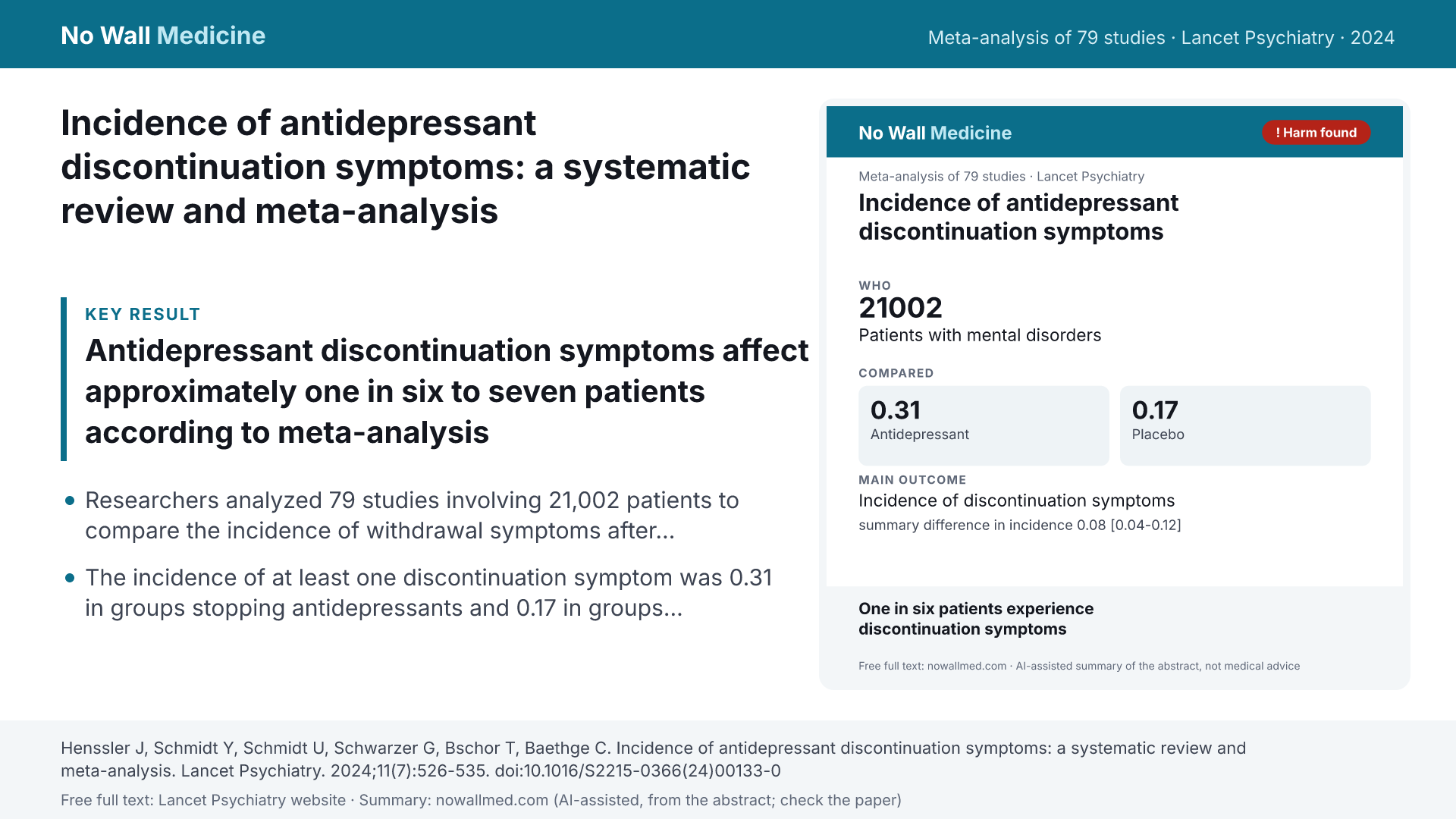
Antidepressant discontinuation symptoms affect approximately one in six to seven patients according to meta-analysis
Incidence of antidepressant discontinuation symptoms: a systematic review and meta-analysis
Meta-analysis of 79 studiesHarm found
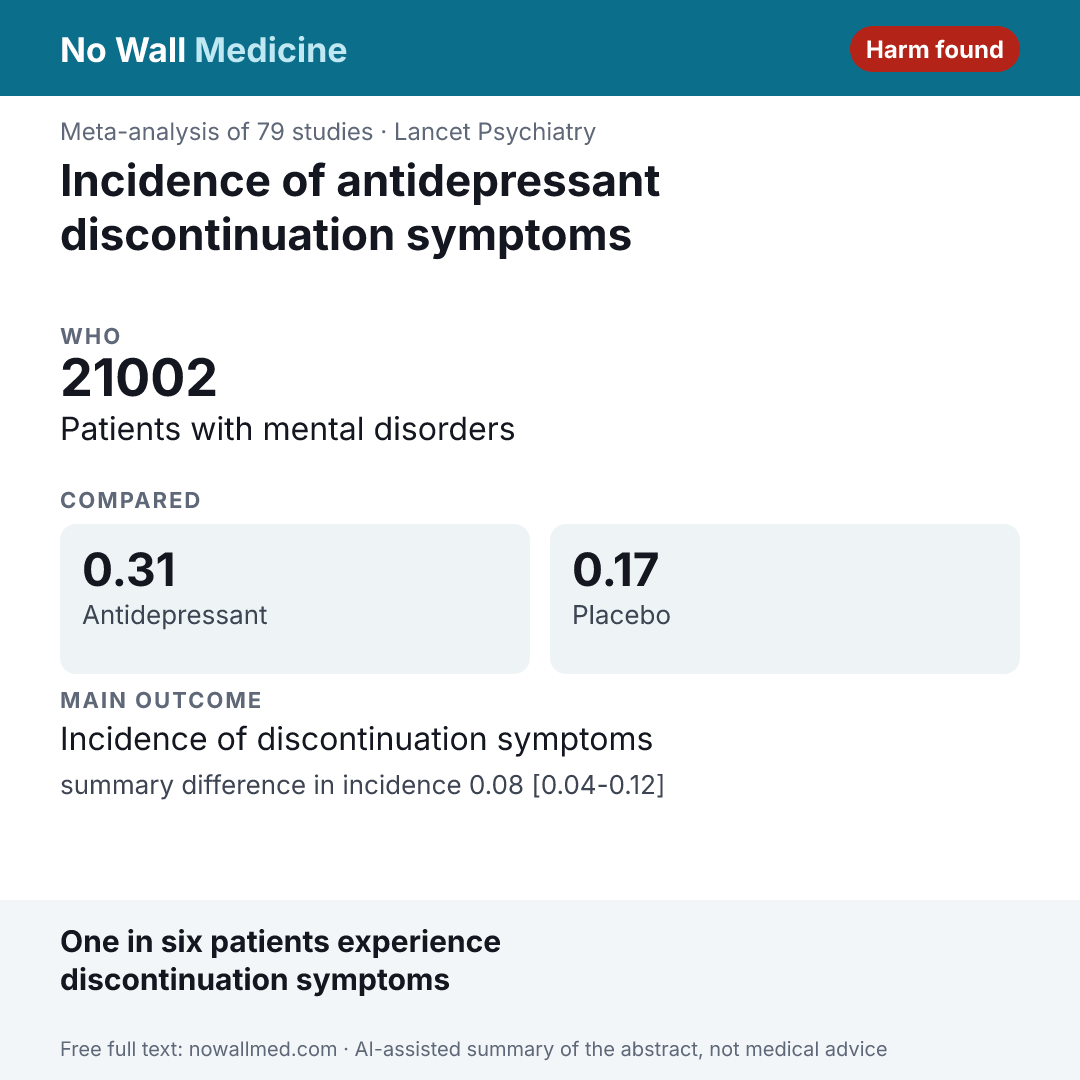
Incidence of antidepressant discontinuation symptoms
Who
21002
Patients with mental disorders
Compared
0.31Antidepressant (95% CI 0.27-0.35)
0.17Placebo (0.14-0.21)
Main outcome
Incidence of discontinuation symptoms
Result: summary difference in incidence 0.08 [0.04-0.12]
Bottom line: One in six patients experience discontinuation symptoms
Limitation: Heterogeneity of results was substantial
Lancet Psychiatry · 2024-06-05 · Save PNG
Why it matters: The exact incidence of antidepressant discontinuation symptoms has not been quantified to inform patients and clinicians during treatment cessation.
Key points
- Researchers analyzed 79 studies involving 21,002 patients to compare the incidence of withdrawal symptoms after stopping antidepressants versus a placebo.
- The incidence of at least one discontinuation symptom was 0.31 in groups stopping antidepressants and 0.17 in groups stopping placebo.
- Severe discontinuation symptoms occurred in 0.028 of patients stopping antidepressants compared to 0.006 of patients stopping placebo.
Limitation the authors note: The authors noted that heterogeneity of results was substantial and data on ethnicity were not consistently reported.
Headline and key points written with AI from the paper’s abstract, with every number checked against it. Read the paper before relying on them.
Was this summary helpful?
Abstract
Background
Antidepressant discontinuation symptoms are becoming an increasingly important part of clinical practice, but the incidence of antidepressant discontinuation symptoms has not been quantified. An estimate of antidepressant discontinuation symptoms incidence could inform patients and clinicians in the discontinuation of treatment, and provide useful information to researchers in antidepressant treatments. We aimed to assess the incidence of antidepressant discontinuation symptoms in patients discontinuing both antidepressants and placebo in the published literature. Methods
We systematically searched Medline, EMBASE, and CENTRAL from database inception until Oct 13, 2022 for randomised controlled trials (RCTs), other controlled trials, and observational studies assessing the incidence of antidepressant discontinuation symptoms. To be included, studies must have investigated cessation or tapering of an established antidepressant drug (excluding antipsychotics, lithium, or thyroxine) or placebo in participants with any mental, behavioural, or neurodevelopmental disorder. We excluded studies in neonates, and those using antidepressants for physical conditions such as pain syndromes due to organic disease. After study selection, summary data extraction, and risk of bias evaluation, data were pooled in random-effects meta-analyses. The main outcome was the incidence of antidepressant discontinuation symptoms after discontinuation of antidepressants or placebo. We also analysed the incidence of severe discontinuation symptoms. Sensitivity and meta-regression analyses tested a selection of methodological variables. Findings
From 6095 articles screened, 79 studies (44 RCTs and 35 observational studies) covering 21 002 patients were selected (72% female, 28% male, mean age 45 years [range 19·6-64·5]). Data on ethnicity were not consistently reported. 16 532 patients discontinued from an antidepressant, and 4470 patients discontinued from placebo. Incidence of at least one antidepressant discontinuation symptom was 0·31 (95% CI 0·27-0·35) in 62 study groups after discontinuation of antidepressants, and 0·17 (0·14-0·21) in 22 study groups after discontinuation of placebo. Between antidepressant and placebo groups of included RCTs, the summary difference in incidence was 0·08 [0·04-0·12]. The incidence of severe antidepressant discontinuation symptoms after discontinuation of an antidepressant was 0·028 (0·014-0·057) compared with 0·006 (0·002-0·013) after discontinuation of placebo. Desvenlafaxine, venlafaxine, imipramine, and escitalopram were associated with higher frequencies of discontinuation symptoms, and imipramine, paroxetine, and either desvenlafaxine or venlafaxine were associated with a higher severity of symptoms. Heterogeneity of results was substantial. Interpretation
Considering non-specific effects, as evidenced in placebo groups, the incidence of antidepressant discontinuation symptoms is approximately 15%, affecting one in six to seven patients who discontinue their medication. Subgroup analyses and heterogeneity figures point to factors not accounted for by diagnosis, medication, or trial-related characteristics, and might indicate subjective factors on the part of investigators, patients, or both. Residual or re-emerging psychopathology needs to be considered when interpreting the results, but our findings can inform clinicians and patients about the probable extent of antidepressant discontinuation symptoms without causing undue alarm. Funding
None.
Abstract reproduced under the article’s CC BY NC licence.
Subject terms
Headline, design, result, key points, caveat and citation as plain text.
Cite this article
Henssler J, Schmidt Y, Schmidt U, Schwarzer G, Bschor T, Baethge C. Incidence of antidepressant discontinuation symptoms: a systematic review and meta-analysis. Lancet Psychiatry. 2024. doi:10.1016/S2215-0366(24)00133-0
Spotted a mistake? Suggest a correction