Mailed communications using behavioral science principles did not increase hypertension medication adherence
Incorporating Behavioral Science in Medication Adherence Communication: A Randomized Clinical Trial
Randomized clinical trialNo clear difference
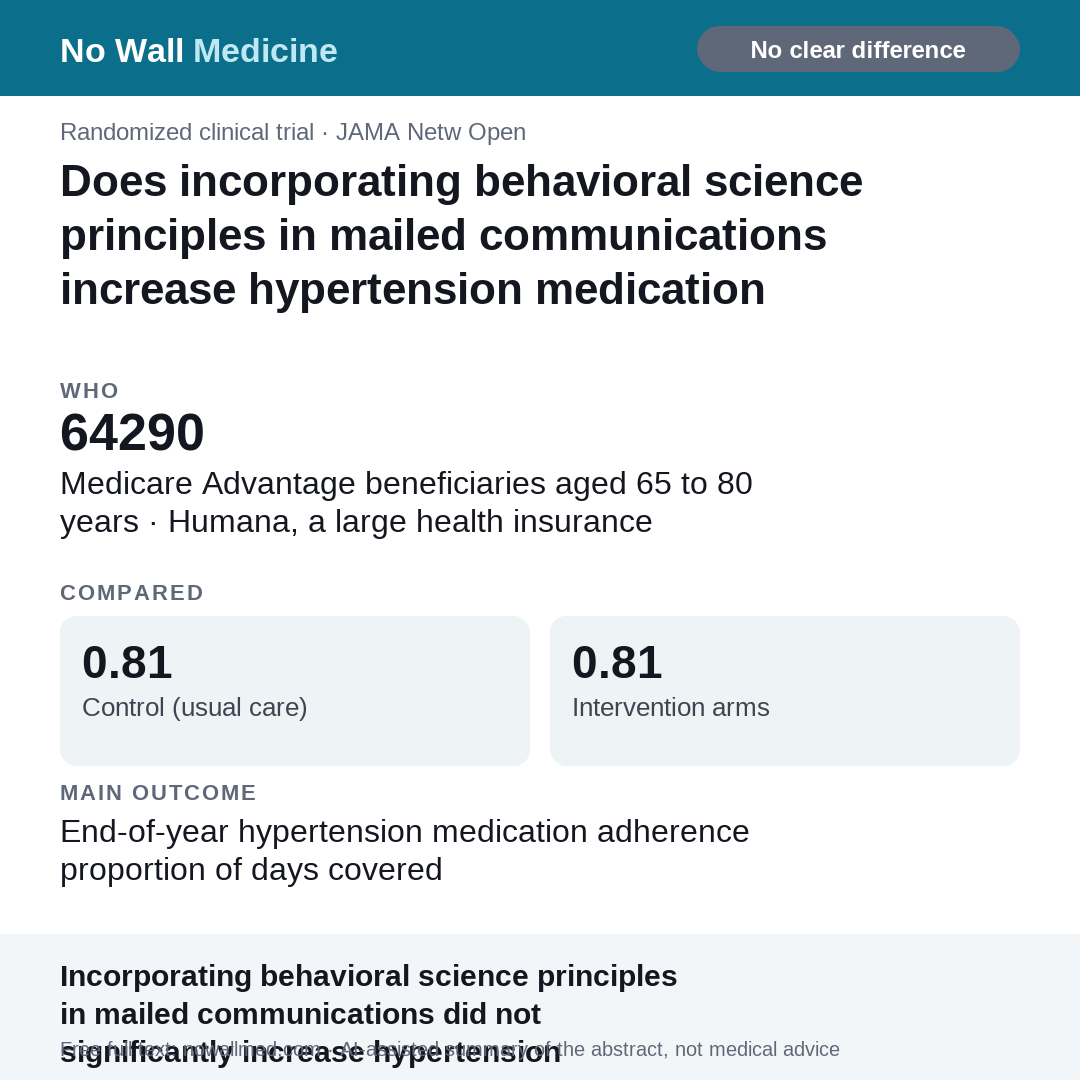
Does incorporating behavioral science principles in mailed communications increase hypertension medication adherence?
Who
64290
Medicare Advantage beneficiaries aged 65 to 80 years · Humana, a large health insurance provider
Compared
0.81Control (usual care) (0.12)
0.81Intervention arms (0.12)
Main outcome
End-of-year hypertension medication adherence proportion of days covered
Result: absolute mean difference 0.00 (95% CI, -0.01 to 0.01)
Bottom line: Incorporating behavioral science principles in mailed communications did not significantly increase hypertension medication adherence.
JAMA Netw Open · 2025-05-01Download image
Clinical question: Does incorporating behavioral science principles in mailed communications increase hypertension medication adherence?
Why it matters: Adherence to medications for high blood pressure remains suboptimal, which increases the risk of heart attack and stroke.
Key points
- The study randomized 64,290 Medicare Advantage beneficiaries aged 65 to 80 years to receive one of seven different mailed communication strategies or usual care.
- The mean end-of-year medication adherence was 0.81 in the control group and showed no difference in any of the intervention arms.
- The proportion of participants reaching an adherence level of 80% or greater was 71.7% in the control group and ranged from 70.4% to 71.9% in intervention groups.
Headline and key points written with AI from the paper’s abstract, with every number checked against it. Read the paper before relying on them.
Topics
Cite this article
Keller P, Robertson T, Kao LS, Li Y, Merrell B, Chung L. Incorporating Behavioral Science in Medication Adherence Communication: A Randomized Clinical Trial. JAMA Netw Open. 2025. doi:10.1001/jamanetworkopen.2025.10162
Spotted a mistake? Suggest a correction
Top studies every Monday
The week’s key trials and guidelines in your specialties, plus any topics you follow. By email, free.
Get the weekly digest