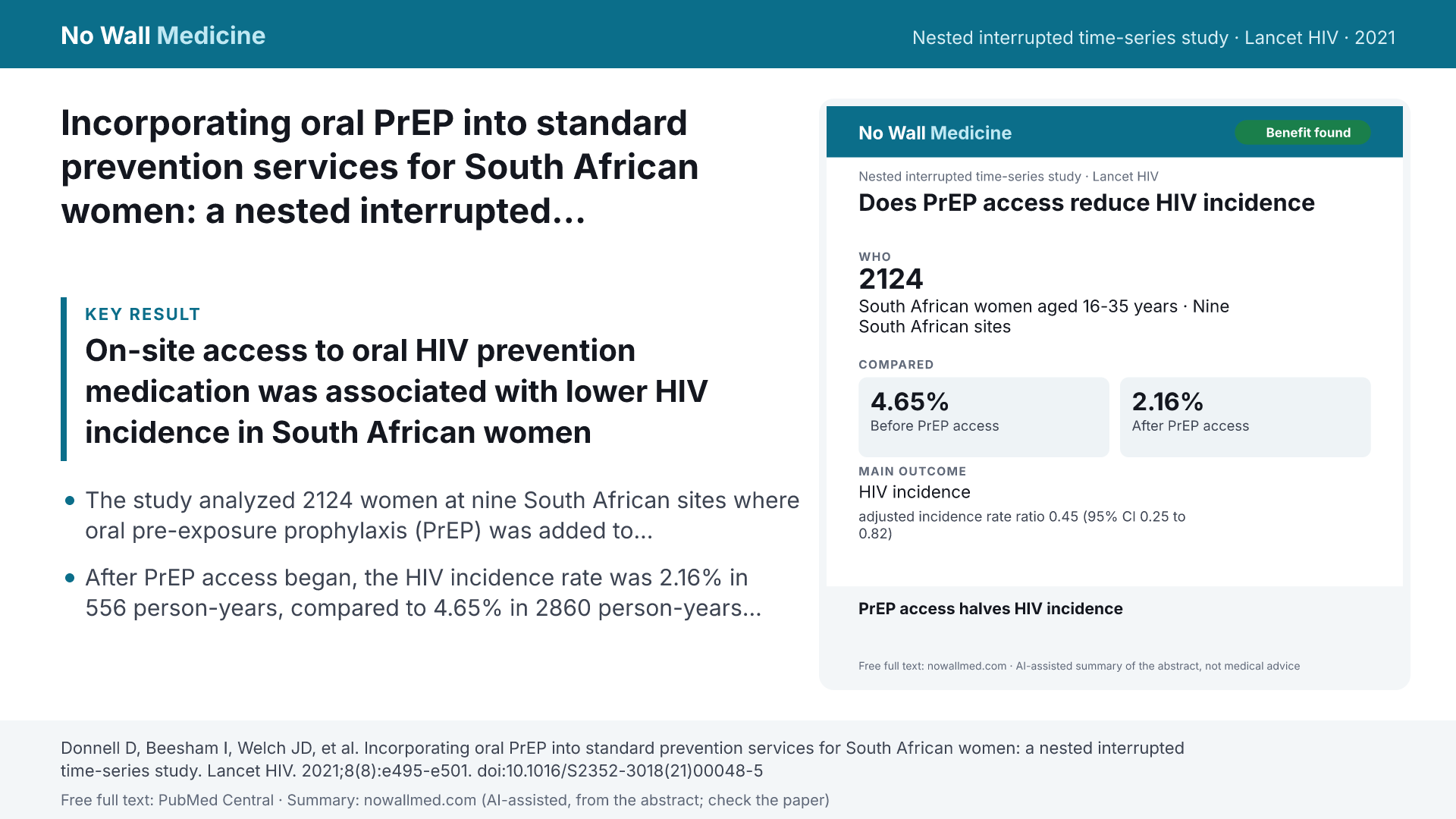
On-site access to oral HIV prevention medication was associated with lower HIV incidence in South African women
Incorporating oral PrEP into standard prevention services for South African women: a nested interrupted time-series study
Nested interrupted time-series studyBenefit found
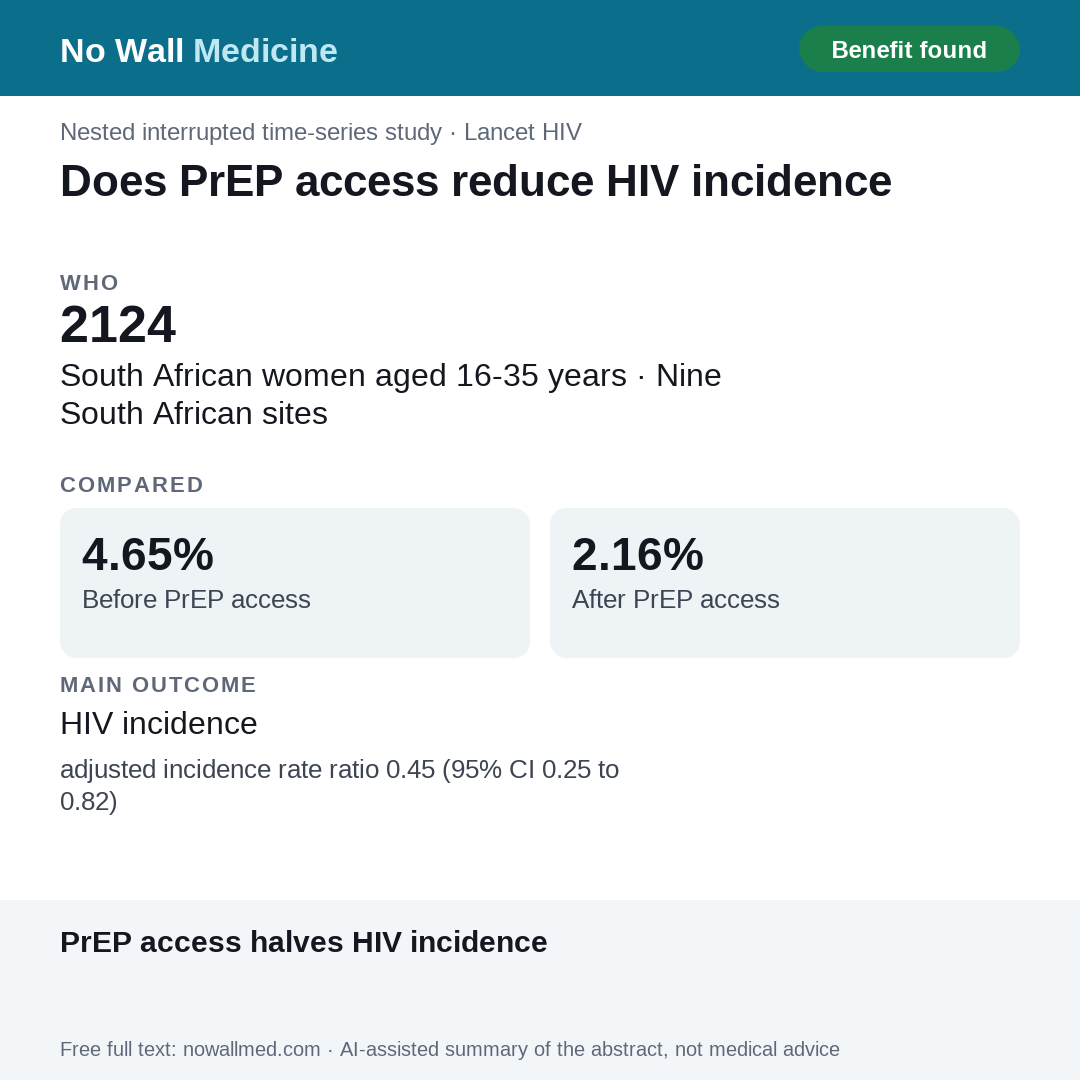
Does PrEP access reduce HIV incidence
Who
2124
South African women aged 16-35 years · Nine South African sites
Compared
4.65%Before PrEP access
2.16%After PrEP access
Main outcome
HIV incidence
Result: adjusted incidence rate ratio 0.45 (95% CI 0.25 to 0.82)
Bottom line: PrEP access halves HIV incidence
Funded by: Bill & Melinda Gates Foundation
Lancet HIV · 2021-06-11Download image
Why it matters: The effect of incorporating oral pre-exposure prophylaxis into standard prevention services for women in clinical trials was unknown.
Key points
- The study analyzed 2124 women at nine South African sites where oral pre-exposure prophylaxis (PrEP) was added to standard prevention services.
- After PrEP access began, the HIV incidence rate was 2.16% in 556 person-years, compared to 4.65% in 2860 person-years before access.
- In a sensitivity analysis of the 180 days before and after access, the incidence was 5.00 per 100 person-years versus 2.29 per 100 person-years.
Headline and key points written with AI from the paper’s abstract, with every number checked against it. Read the paper before relying on them.
Was this summary helpful?
Abstract
Background
As oral pre-exposure prophylaxis (PrEP) becomes the standard of prevention globally, its potential effect on HIV incidence in clinical trials of new prevention interventions is unknown, particularly for trials among women. In a trial measuring HIV incidence in African women, oral PrEP was incorporated into the standard of prevention in the trial's last year. We assessed the effect of on-site access to PrEP on HIV incidence in this natural experiment. Methods
We did a nested interrupted time-series study using data from the ECHO trial. At 12 sites in four countries (Eswatini, Kenya, South Africa, and Zambia), women (aged 16-35 years) were randomly assigned to receive one of three contraceptives between Dec 14, 2015, and Sept 12, 2017, and followed up quarterly for up to 18 months to determine the effect of contraceptive method on HIV acquisition. Women were eligible if they wanted long-acting contraception, were medically qualified to receive study contraceptives, and had not used any of the study contraceptives in the past 6 months. The present analyses are limited to nine South African sites where on-site access to oral PrEP was implemented between March 13 and June 12, 2018. Using an interrupted time-series design, we compared HIV incidence before versus after PrEP access, limited to quarterly study visits at which on-site PrEP access was available to at least some participants and, in a sensitivity analysis, to the 180 days before and after access. The outcome was incident HIV infection, detected using two rapid HIV tests done in parallel for each participant at every scheduled follow-up visit. This study is registered on ClinicalTrials.gov, NCT02550067. Findings
2124 women were followed up after on-site PrEP access began, of whom 543 (26%) reported PrEP use. A total of 12 HIV seroconversions were observed in 556 person-years (incidence 2·16%) after on-site PrEP access, compared with 133 HIV seroconversions in 2860 person-years (4·65%) before PrEP access (adjusted incidence rate ratio [IRR] 0·45, 95% CI 0·25-0·82, p=0·0085). Similar results were also observed when limiting the analysis to 180 days before versus after PrEP access. A total of 46 HIV seroconversions were observed in 919 person-years within 180 days before PrEP access, compared with 11 seroconversions in 481 person-years in the 180 days following PrEP access (incidence 5·00 vs 2·29 per 100 person-years; IRR 0·43, 95% CI 0·22-0·88, p=0·012). Interpretation
On-site access to PrEP as part of standard of prevention in a clinical trial among women in South Africa was associated with halving HIV incidence, when approximately a quarter of women started PrEP. Providing access to on-site PrEP could decrease incidence in HIV prevention trials. These data are also among the first to show in any setting that access to PrEP is associated with decreased HIV acquisition among South African women. Funding
Bill & Melinda Gates Foundation, United States Agency for International Development, President's Emergency Plan for AIDS Relief, the Swedish International Development Cooperation Agency, South African Medical Research Council, and United Nations Population Fund.
Abstract reproduced under the article’s CC BY licence.
Subject terms
Cite this article
Donnell D, Beesham I, Welch JD, Heffron R, Pleaner M, Kidoguchi L. Incorporating oral PrEP into standard prevention services for South African women: a nested interrupted time-series study. Lancet HIV. 2021. doi:10.1016/S2352-3018(21)00048-5
Spotted a mistake? Suggest a correction