High protein and polyunsaturated fatty acid intake was associated with lower liver fat
Increase in PUFA and protein, and decrease in carbohydrate intake improves liver fat in 12 months and the role of weight loss as a mediator: A randomized controlled trial
Randomized controlled trialBenefit found
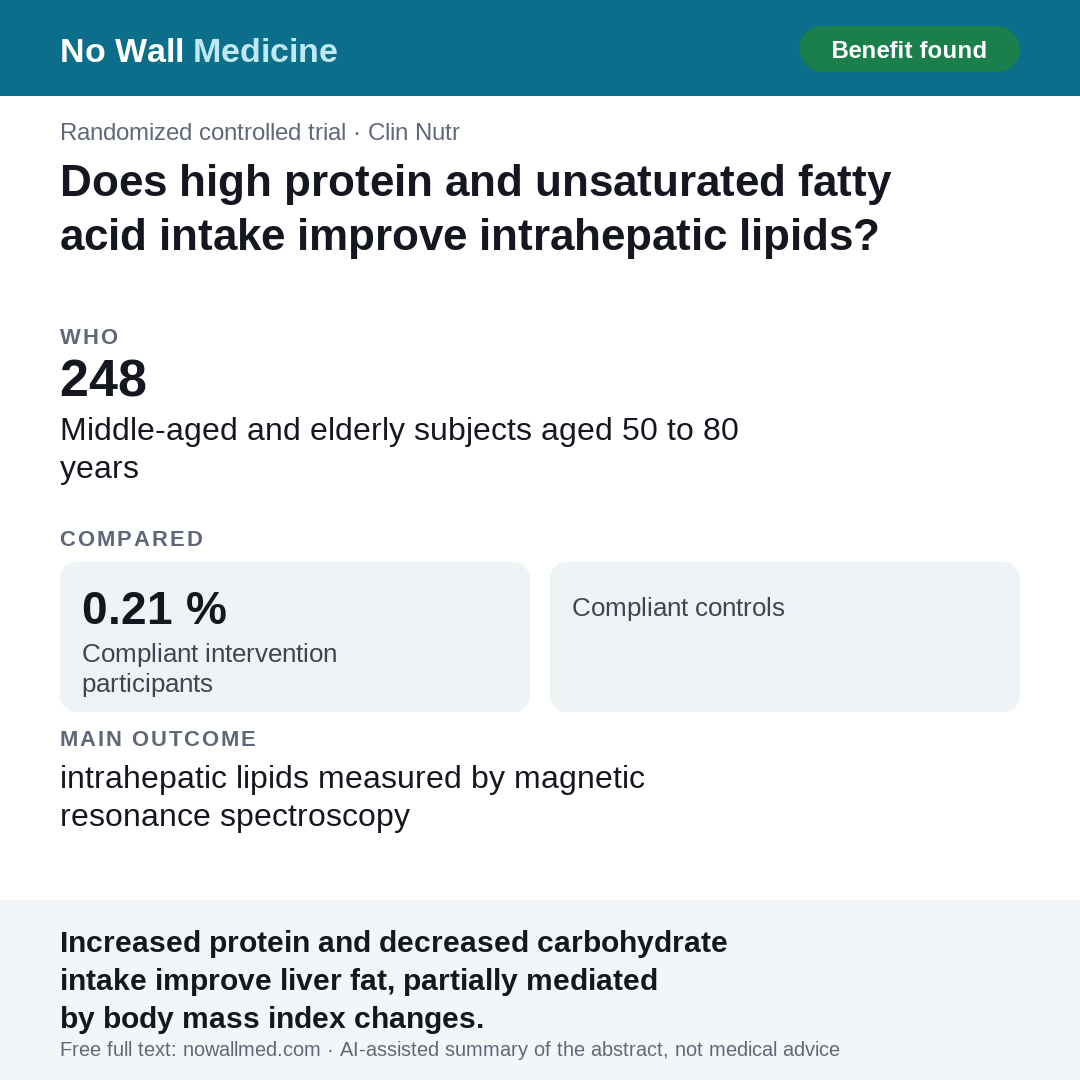
Does high protein and unsaturated fatty acid intake improve intrahepatic lipids?
Who
248
Middle-aged and elderly subjects aged 50 to 80 years
Compared
0.21 %Compliant intervention participants (95 % CI 0.01, 0.40)
Compliant controls
Main outcome
intrahepatic lipids measured by magnetic resonance spectroscopy
Result: estimate of relative change 0.21 % (95 % CI 0.01, 0.40)
Bottom line: Increased protein and decreased carbohydrate intake improve liver fat, partially mediated by body mass index changes.
Clin Nutr · 2024-11-14Download image
Clinical question: Does high protein and unsaturated fatty acid intake improve intrahepatic lipids?
Why it matters: It was unknown which specific macronutrient components drive improvements in liver fat during long-term dietary interventions.
Key points
- Researchers analyzed 248 middle-aged and elderly participants to measure how different macronutrients affected intrahepatic lipids, which is the amount of fat in the liver.
- Stronger increases in protein and polyunsaturated fatty acid intake and greater decreases in carbohydrate intake were associated with stronger improvements in liver fat.
- The improvement in liver fat from increased polyunsaturated fatty acid intake was partly independent of changes in body mass index.
Headline and key points written with AI from the paper’s abstract, with every number checked against it. Read the paper before relying on them.
Topics
Cite this article
Pletsch-Borba L, Wernicke C, Machann J, Meyer NM, Huong Nguyen T, Pohrt A. Increase in PUFA and protein, and decrease in carbohydrate intake improves liver fat in 12 months and the role of weight loss as a mediator: A randomized controlled trial. Clin Nutr. 2024. doi:10.1016/j.clnu.2024.11.010
Spotted a mistake? Suggest a correction
Top studies every Monday
The week’s key trials and guidelines in your specialties, by email. Free.
Get the weekly digest