Higher levels of effector memory CD4+ T cells were associated with chronic childhood immune thrombocytopenia
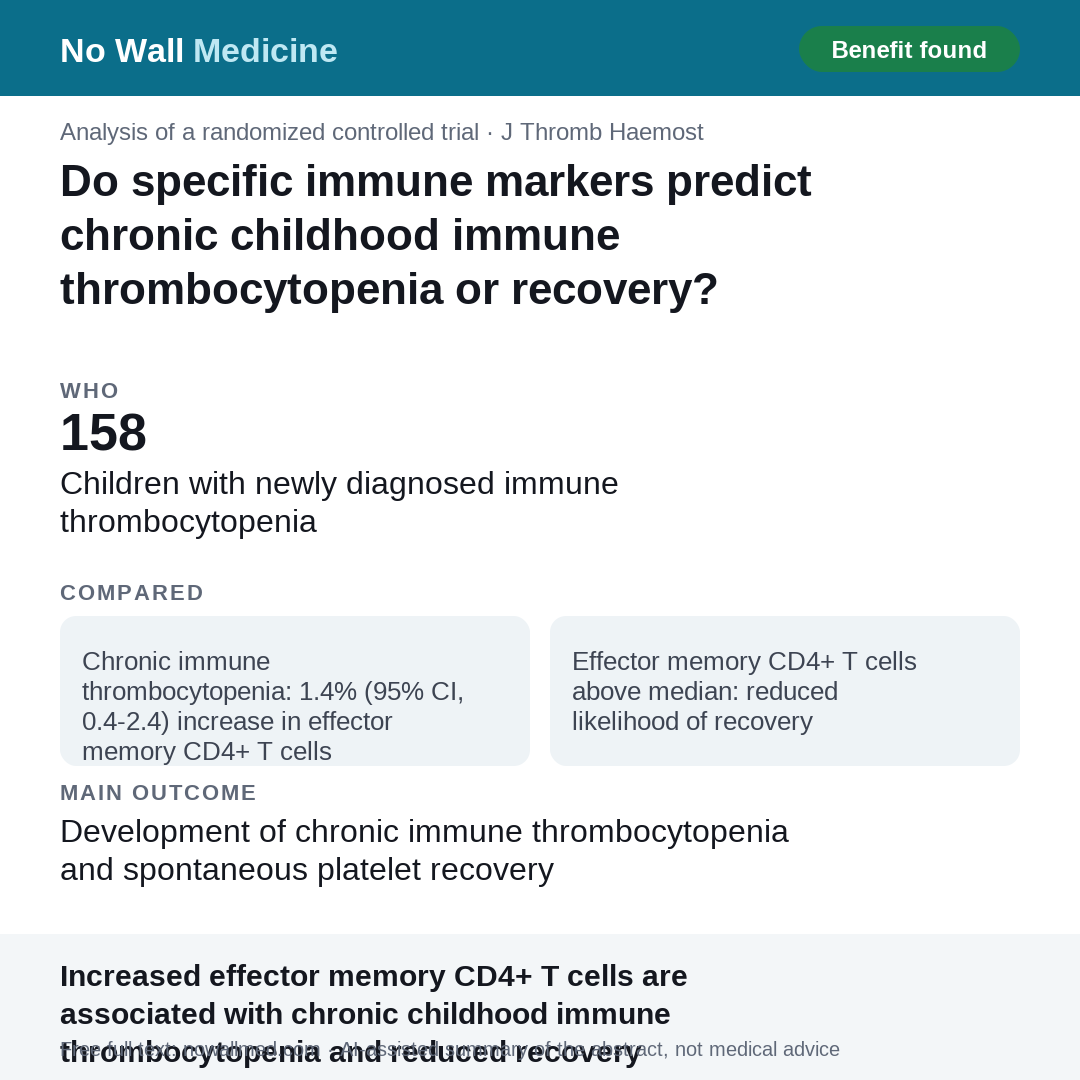
Increased effector memory CD4+ T cells are associated with chronic childhood immune thrombocytopenia
Analysis of a randomized controlled trialBenefit found
Do specific immune markers predict chronic childhood immune thrombocytopenia or recovery?
Who
158
Children with newly diagnosed immune thrombocytopenia
Compared
Chronic immune thrombocytopenia: 1.4% (95% CI, 0.4-2.4) increase in effector memory CD4+ T cells
Effector memory CD4+ T cells above median: reduced likelihood of recovery
Main outcome
Development of chronic immune thrombocytopenia and spontaneous platelet recovery
Result: hazard ratio 0.55 (95% CI, 0.35-0.85)
Bottom line: Increased effector memory CD4+ T cells are associated with chronic childhood immune thrombocytopenia and reduced recovery likelihood.
Limitation: Single-cell RNA-sequencing was performed on only 6 children
J Thromb Haemost · 2025-06-10Download image
Clinical question: Do specific immune markers predict chronic childhood immune thrombocytopenia or recovery?
Why it matters: Reliable diagnostic and prognostic immune markers for predicting the development of chronic immune thrombocytopenia in children are currently underdeveloped and not used in clinical practice.
Key points
- Researchers analyzed immune profiles in 158 children with newly diagnosed immune thrombocytopenia, a condition where the immune system destroys platelets, over a 1 year period.
- Chronic immune thrombocytopenia was associated with an age-adjusted increase in effector memory CD4+ T cells by 1.4% (95% CI, 0.4-2.4).
- A frequency of these cells above the median was associated with a reduced likelihood of platelet recovery, with an age- and treatment-adjusted hazard ratio of 0.55 (95% CI, 0.35-0.85).
Headline and key points written with AI from the paper’s abstract, with every number checked against it. Read the paper before relying on them.
Topics
Cite this article
Schmidt DE, Heitink-Pollé KMJ, Nicolet BP, Porcelijn L, Bruin MCA, Weterings N. Increased effector memory CD4+ T cells are associated with chronic childhood immune thrombocytopenia. J Thromb Haemost. 2025. doi:10.1016/j.jtha.2025.06.004
Spotted a mistake? Suggest a correction
Top studies every Monday
The week’s key trials and guidelines in your specialties, plus any topics you follow. By email, free.
Get the weekly digest