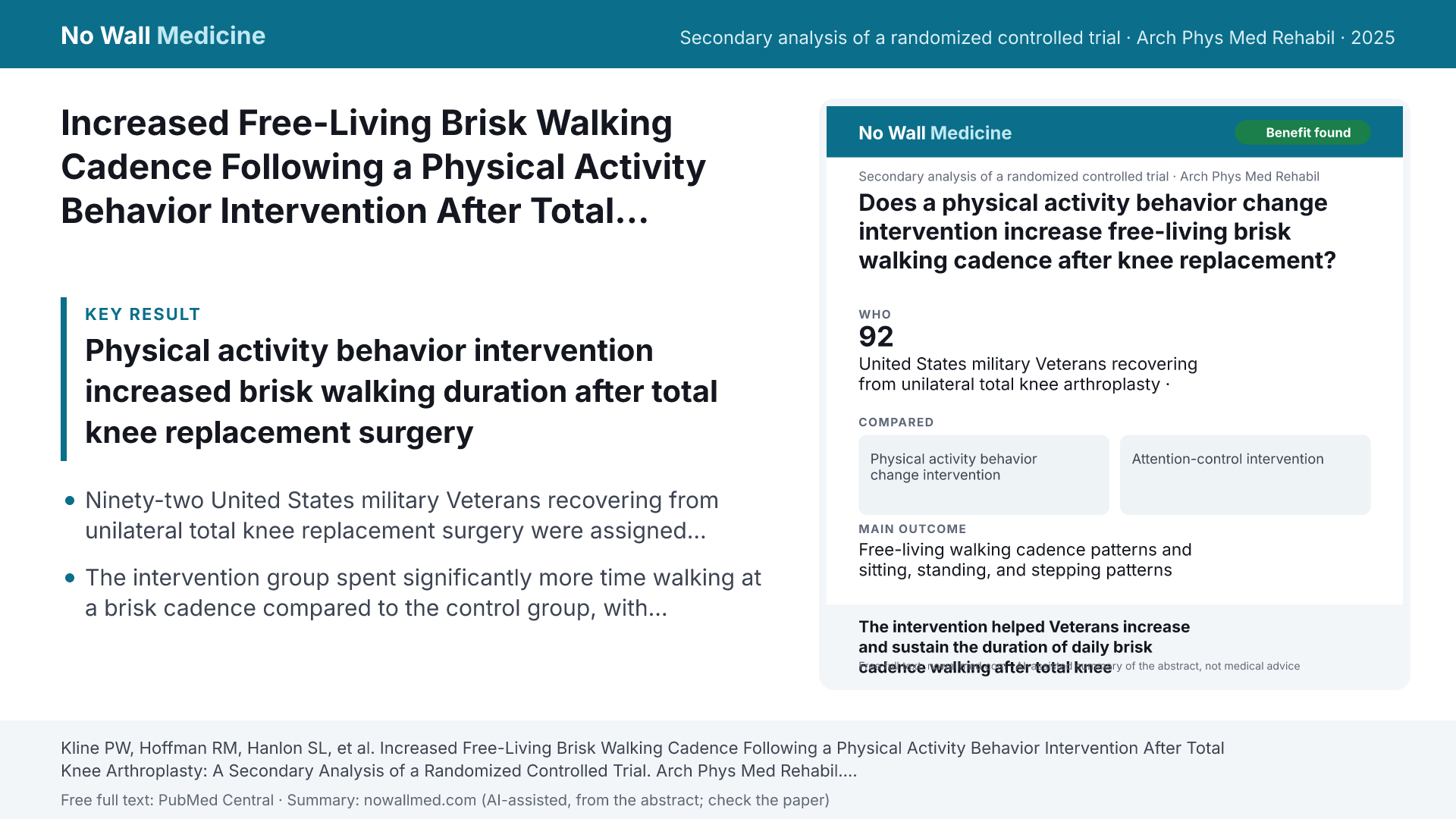
Physical activity behavior intervention increased brisk walking duration after total knee replacement surgery
Increased Free-Living Brisk Walking Cadence Following a Physical Activity Behavior Intervention After Total Knee Arthroplasty: A Secondary Analysis of a Randomized Controlled Trial
Secondary analysis of a randomized controlled trialBenefit found
Does a physical activity behavior change intervention increase free-living brisk walking cadence after knee replacement?
Who
92
United States military Veterans recovering from unilateral total knee arthroplasty · Veterans Affairs Medical Center
Compared
Physical activity behavior change intervention
Attention-control intervention
Main outcome
Free-living walking cadence patterns and sitting, standing, and stepping patterns
Result: ∆=8.36 min; 95% confidence interval, 4.83-11.88
Bottom line: The intervention helped Veterans increase and sustain the duration of daily brisk cadence walking after total knee arthroplasty.
Arch Phys Med Rehabil · 2025-04-02 · Save PNG
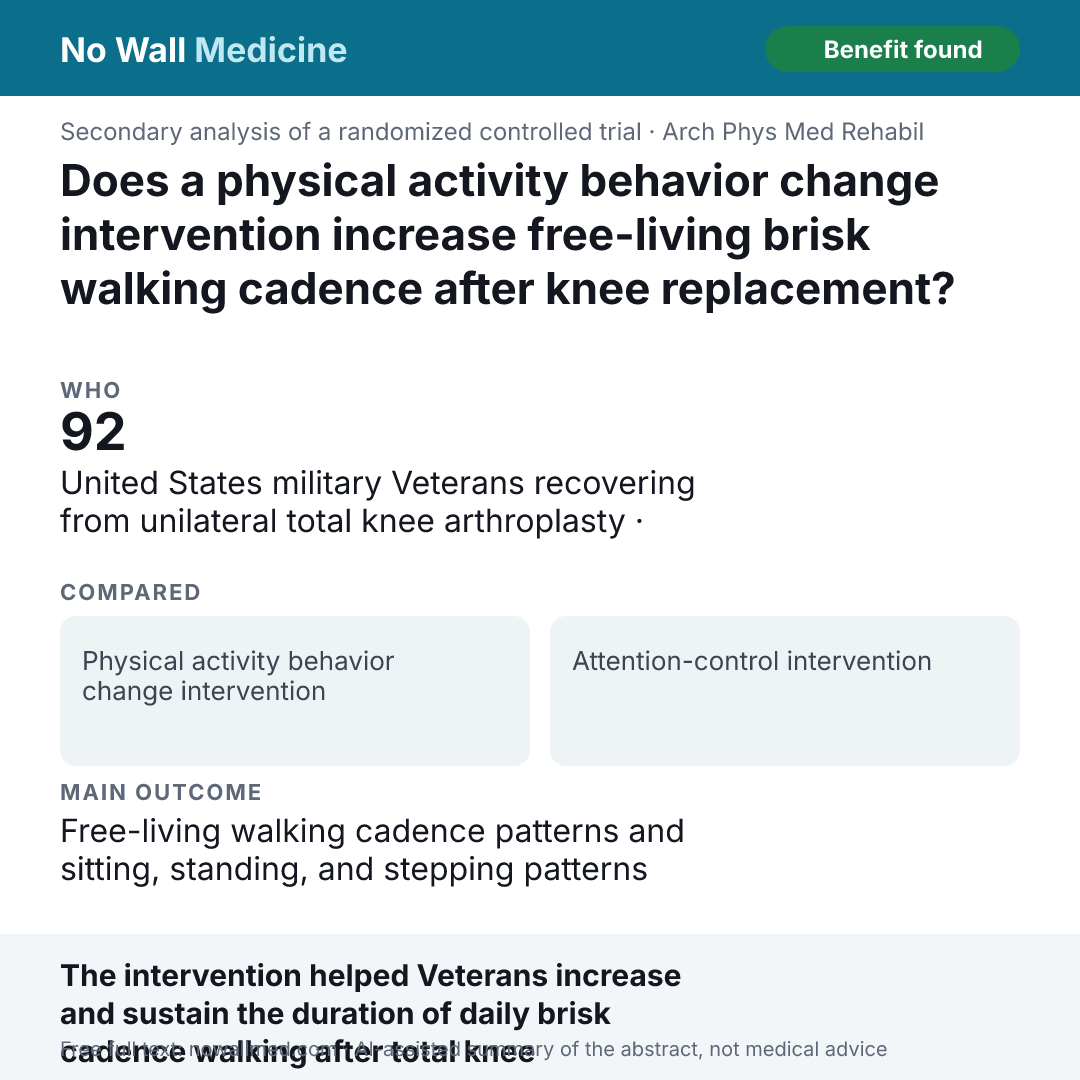
Clinical question: Does a physical activity behavior change intervention increase free-living brisk walking cadence after knee replacement?
Key points
- Ninety-two United States military Veterans recovering from unilateral total knee replacement surgery were assigned to either a physical activity behavior change intervention or an attention-control group.
- The intervention group spent significantly more time walking at a brisk cadence compared to the control group, with a difference of 8.36 min at 38 weeks.
- No differences were observed between the groups regarding total time or bout durations for sitting, standing, or stepping at any measured time point.
Headline and key points written with AI from the paper’s abstract, with every number checked against it. Read the paper before relying on them.
Was this summary helpful?
Subject terms
Headline, design, result, key points, caveat and citation as plain text.
Cite this article
Kline PW, Hoffman RM, Hanlon SL, et al. Increased Free-Living Brisk Walking Cadence Following a Physical Activity Behavior Intervention After Total Knee Arthroplasty: A Secondary Analysis of a Randomized Controlled Trial. Arch Phys Med Rehabil. 2025;106(11):1672-1679. doi:10.1016/j.apmr.2025.03.044
Spotted a mistake? Suggest a correction