Higher urea levels in children receiving early nutrition linked to infection and mortality risks
Increased ureagenesis revealing metabolic intolerance to enhanced nutrition in the PICU: a secondary analysis of the PEPaNIC RCT
Randomized trialHarm found
Does early parenteral nutrition harm critically ill children?
Who
1440
Critically ill children newborn to seventeen years · Three pediatric intensive care units
Compared
Early parenteral nutrition: higher urea concentrations
Late parenteral nutrition: lower urea concentrations
Main outcome
Risk of new infections and recovery
Result: adjusted OR 1.746 (95%CI 1.353-2.265) for new infection
Bottom line: Early parenteral nutrition harms critically ill children
Crit Care · 2026-09-25Download image
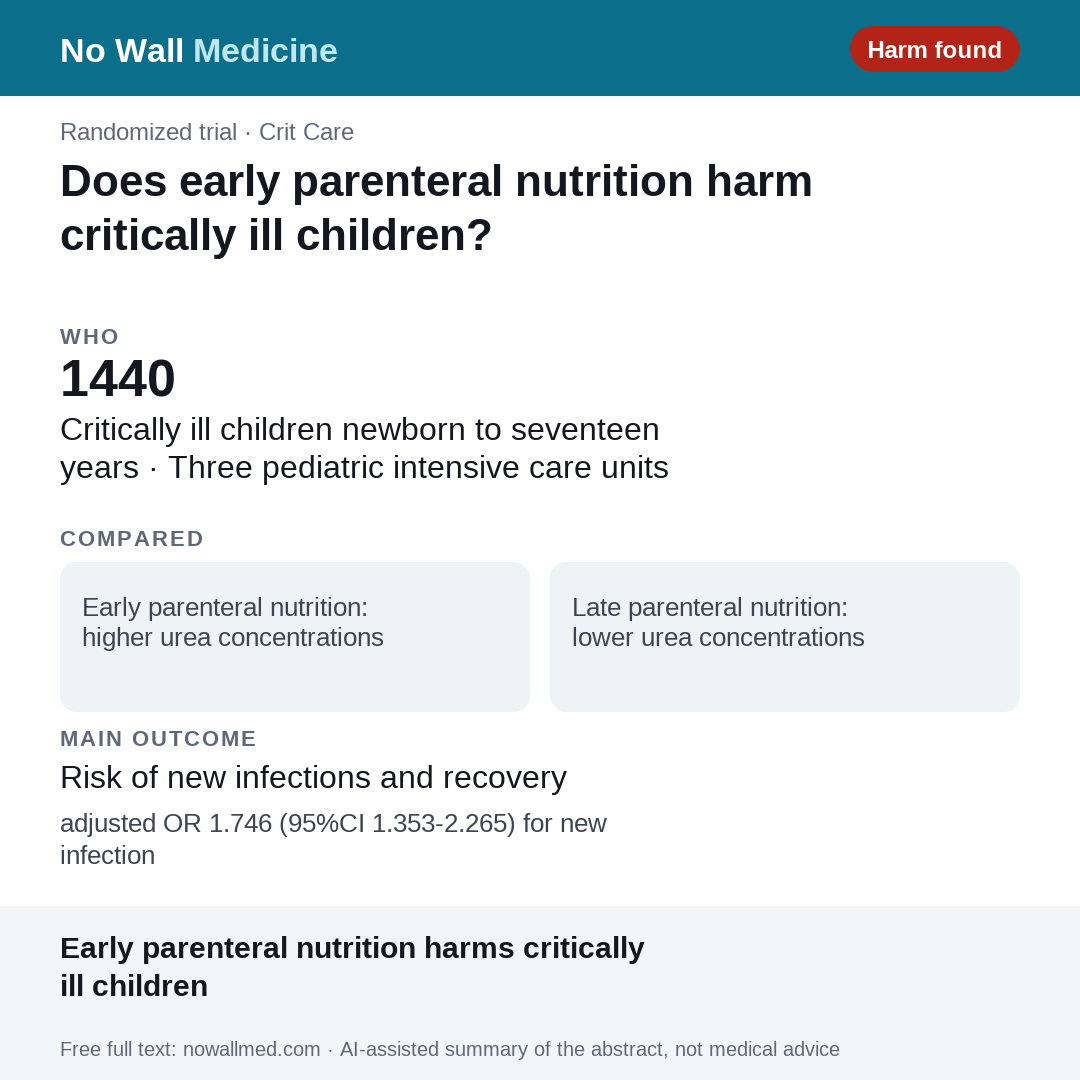
Clinical question: Does early parenteral nutrition harm critically ill children?
Why it matters: It was hypothesized that increased urea production, or ureagenesis, could explain why early intravenous feeding caused harm in critically ill children.
Key points
- Researchers analyzed 665 patients receiving early parenteral nutrition (intravenous feeding) and 663 patients receiving late parenteral nutrition in pediatric intensive care units.
- Higher urea and urea/creatinine ratios in the first week were associated with an increased risk of new infection and higher 90-day mortality.
- Increased urea levels also correlated with a lower likelihood of earlier discharge from the pediatric intensive care unit and the hospital.
Headline and key points written with AI from the paper’s abstract, with every number checked against it. Read the paper before relying on them.
Topics
Cite this article
Vanhorebeek I, Umman Serin N, Verbruggen SCAT, Joosten KFM, Van den Berghe G, Gunst J. Increased ureagenesis revealing metabolic intolerance to enhanced nutrition in the PICU: a secondary analysis of the PEPaNIC RCT. Crit Care. 2026. doi:10.1186/s13054-026-06345-7
Spotted a mistake? Suggest a correction