Classroom sensitization sessions delivered by lay counselors increased student referrals for mental health support
Increasing demand for school counselling through a lay counsellor-delivered classroom sensitisation intervention: a stepped-wedge cluster randomised controlled trial in New Delhi, India
Stepped-wedge, cluster randomised controlled trialBenefit found
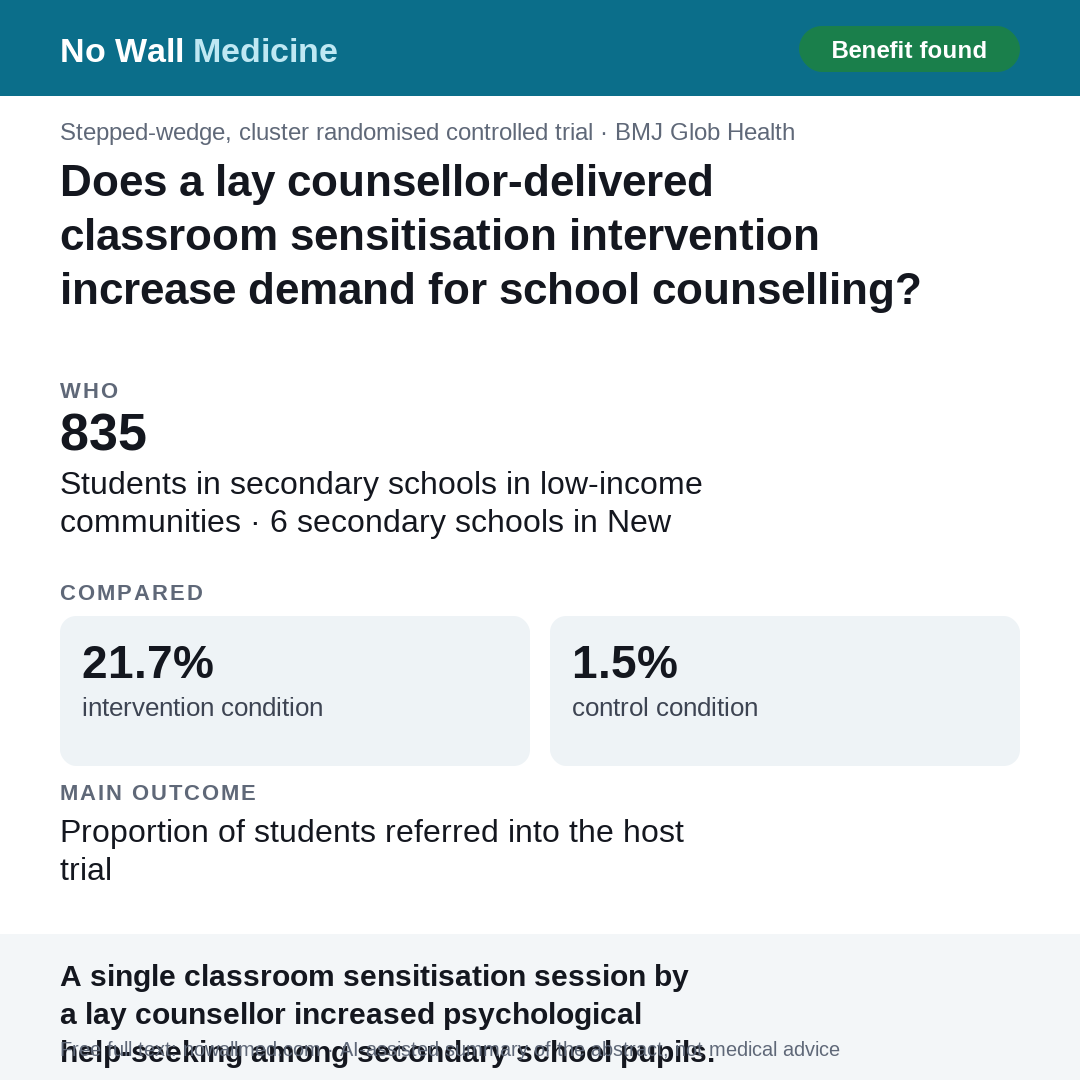
Does a lay counsellor-delivered classroom sensitisation intervention increase demand for school counselling?
Who
835
Students in secondary schools in low-income communities · 6 secondary schools in New Delhi, India
Compared
21.7%intervention condition
1.5%control condition
Main outcome
Proportion of students referred into the host trial
Result: OR=111.36, 95% CI 35.56 to 348.77
Bottom line: A single classroom sensitisation session by a lay counsellor increased psychological help-seeking among secondary school pupils.
BMJ Glob Health · 2021-06-26Download image
Clinical question: Does a lay counsellor-delivered classroom sensitisation intervention increase demand for school counselling?
Why it matters: It was unknown if a classroom-based sensitization session delivered by a lay counselor could reduce barriers to mental health service referrals in low-income school settings.
In absolute numbers
intervention condition: 21.7% · control condition: 1.5% → a difference of 20.2 percentage points, so about 5 people would need the treatment for 1 more to benefit (number needed to treat) over the trial’s follow-up.
Worked out by us from the two group results above, not reported by the authors. Check the paper for the exact outcome and timing.
Key points
- Researchers conducted a cluster randomized controlled trial involving 70 classes across 6 secondary schools in New Delhi, India.
- The proportion of students referred to the mental health trial was 21.7% in the classroom intervention group compared to 1.5% in the control group.
- Self-referrals were higher in the classroom intervention group at 98.1% compared to 89.1% in the control group.
Headline and key points written with AI from the paper’s abstract, with every number checked against it. Read the paper before relying on them.
Was this summary helpful?
Abstract
Introduction
We evaluated a classroom-based sensitisation intervention that was designed to reduce demand-side barriers affecting referrals to a school counselling programme. The sensitisation intervention was offered in the context of a host trial evaluating a low-intensity problem-solving treatment for common adolescent mental health problems. Methods
We conducted a stepped-wedge, cluster randomised controlled trial with 70 classes in 6 secondary schools serving low-income communities in New Delhi, India.The classes were randomised to receive a classroom sensitisation session involving a brief video presentation and moderated group discussion, delivered by a lay counsellor over one class period (intervention condition, IC), in two steps of 4 weeks each. The control condition (CC) was whole-school sensitisation (teacher-meetings and whole-school activities such as poster displays). The primary outcome was the proportion of students referred into the host trial. Secondary outcomes were the proportion of students who met mental health caseness criteria and the proportion of self-referred adolescents. Results
Between 20 August 2018 and 9 December 2018, 835 students (23.3% of all students) were referred into the host trial. The referred sample included 591 boys (70.8%), and had a mean age of 15.8 years, SD=0.06; 194 students (31.8% of 610 with complete data) met mental health caseness criteria. The proportion of students referred in each trial conditionwas significantly higher in the IC (IC=21.7%, CC=1.5%, OR=111.36, 95% CI 35.56 to 348.77, p<0.001). The proportion of self-referred participants was also higher in the IC (IC=98.1%, CC=89.1%, Pearson χ2 (1)=16.92, p<0.001). Although the proportion of referred students meeting caseness criteria was similar in both conditions (IC=32.0% vs CC=28.1%), the proportion weighted for the total student population was substantially higher in the IC (IC=5.2%, CC=0.3%, OR=52.39, 95% CI 12.49 to 219.66,p<0.001). Conclusion
A single, lay counsellor-delivered, classroom sensitisation session increased psychological help-seeking for common mental health problems among secondary school pupils from urban, low-income communities in India. Trial registration number
NCT03633916.
Abstract reproduced under the article’s CC BY NC licence.
Subject terms
Cite this article
Parikh R, Hoogendoorn A, Michelson D, Ruwaard J, Sharma R, Bhat B. Increasing demand for school counselling through a lay counsellor-delivered classroom sensitisation intervention: a stepped-wedge cluster randomised controlled trial in New Delhi, India. BMJ Glob Health. 2021. doi:10.1136/bmjgh-2020-003902
Spotted a mistake? Suggest a correction
Top studies every Monday
The week’s key trials and guidelines in your specialties, plus any topics you follow. By email, free.
Get the weekly digest