Imaging-confirmed nerve compression and severe pain are common indications for lumbar disc herniation surgery
Indications for surgery versus conservative treatment in the management of lumbar disc herniations: A systematic review
Systematic reviewUnclear result
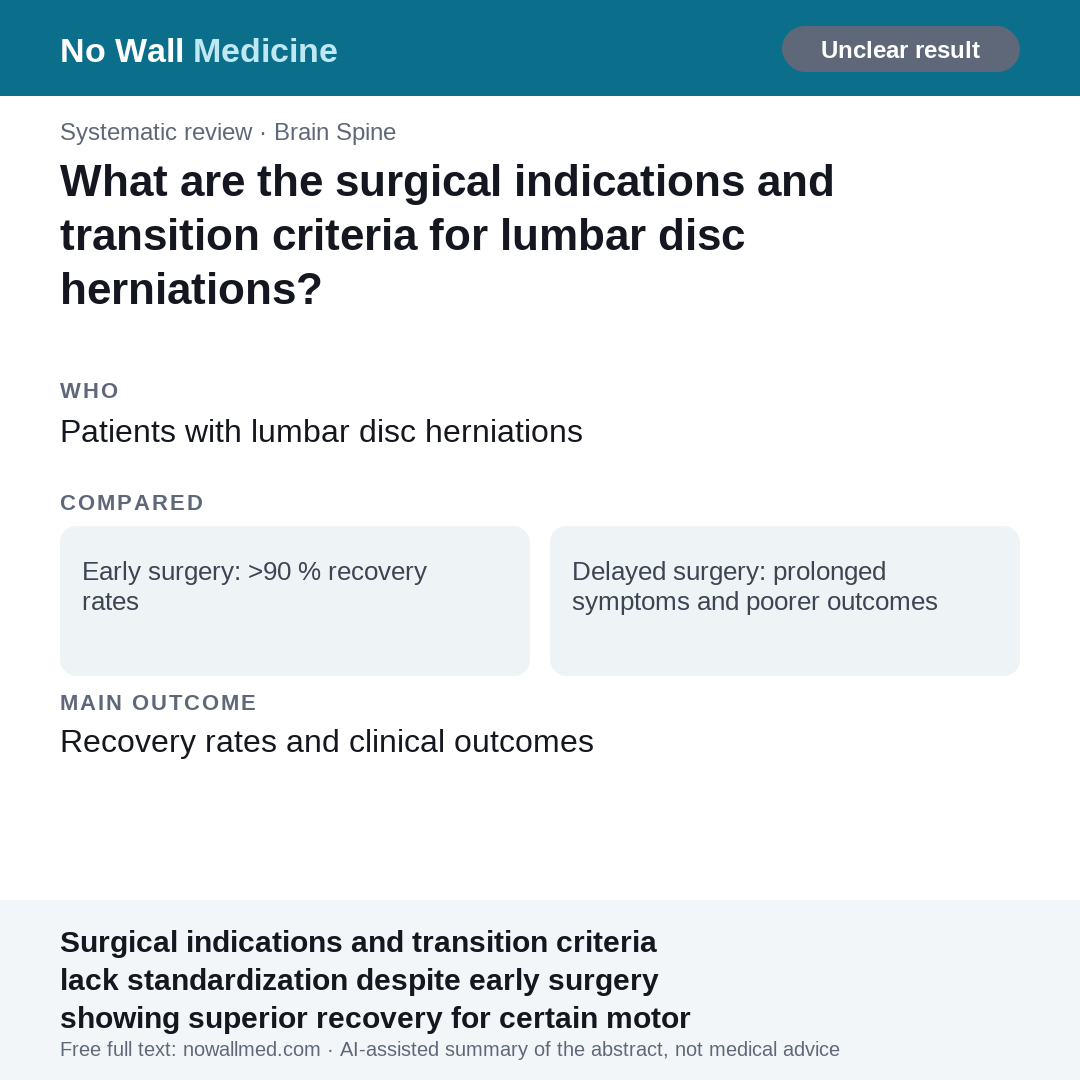
What are the surgical indications and transition criteria for lumbar disc herniations?
Who
Patients with lumbar disc herniations
Compared
Early surgery: >90 % recovery rates
Delayed surgery: prolonged symptoms and poorer outcomes
Main outcome
Recovery rates and clinical outcomes
Bottom line: Surgical indications and transition criteria lack standardization despite early surgery showing superior recovery for certain motor deficits.
Limitation: Significant heterogeneity in surgical indications, timing, and decision-making criteria.
Brain Spine · 2025-09-27Download image
Clinical question: What are the surgical indications and transition criteria for lumbar disc herniations?
Why it matters: Clinical decision-making lacks standardization regarding surgical indications, timing, and the specific criteria for transitioning from conservative management to surgery for lumbar disc herniations.
Key points
- Researchers reviewed 20 studies to identify surgical indications and criteria for transitioning from non-surgical care for lumbar disc herniation, a condition causing nerve root pain.
- Early surgery within 48 h to 6 weeks was associated with superior recovery, particularly for mild to moderate motor deficits graded ≤ MRC 3/4, achieving >90 % recovery rates.
- Transitioning to surgery often involved a 4-6 week trial of conservative therapy, neurological progression, or worsening imaging findings.
Limitation the authors note: Significant heterogeneity was observed in thresholds for motor and sensory deficits and definitions of conservative treatment failure.
Headline and key points written with AI from the paper’s abstract, with every number checked against it. Read the paper before relying on them.
Was this summary helpful?
Cite this article
Thavarajasingam SG, Salih A, Arif A, Varadpande M, Sabeshan P, Ponniah HS. Indications for surgery versus conservative treatment in the management of lumbar disc herniations: A systematic review. Brain Spine. 2025. doi:10.1016/j.bas.2025.105619
Spotted a mistake? Suggest a correction
Top studies every Monday
The week’s key trials and guidelines in your specialties, plus any topics you follow. By email, free.
Get the weekly digest