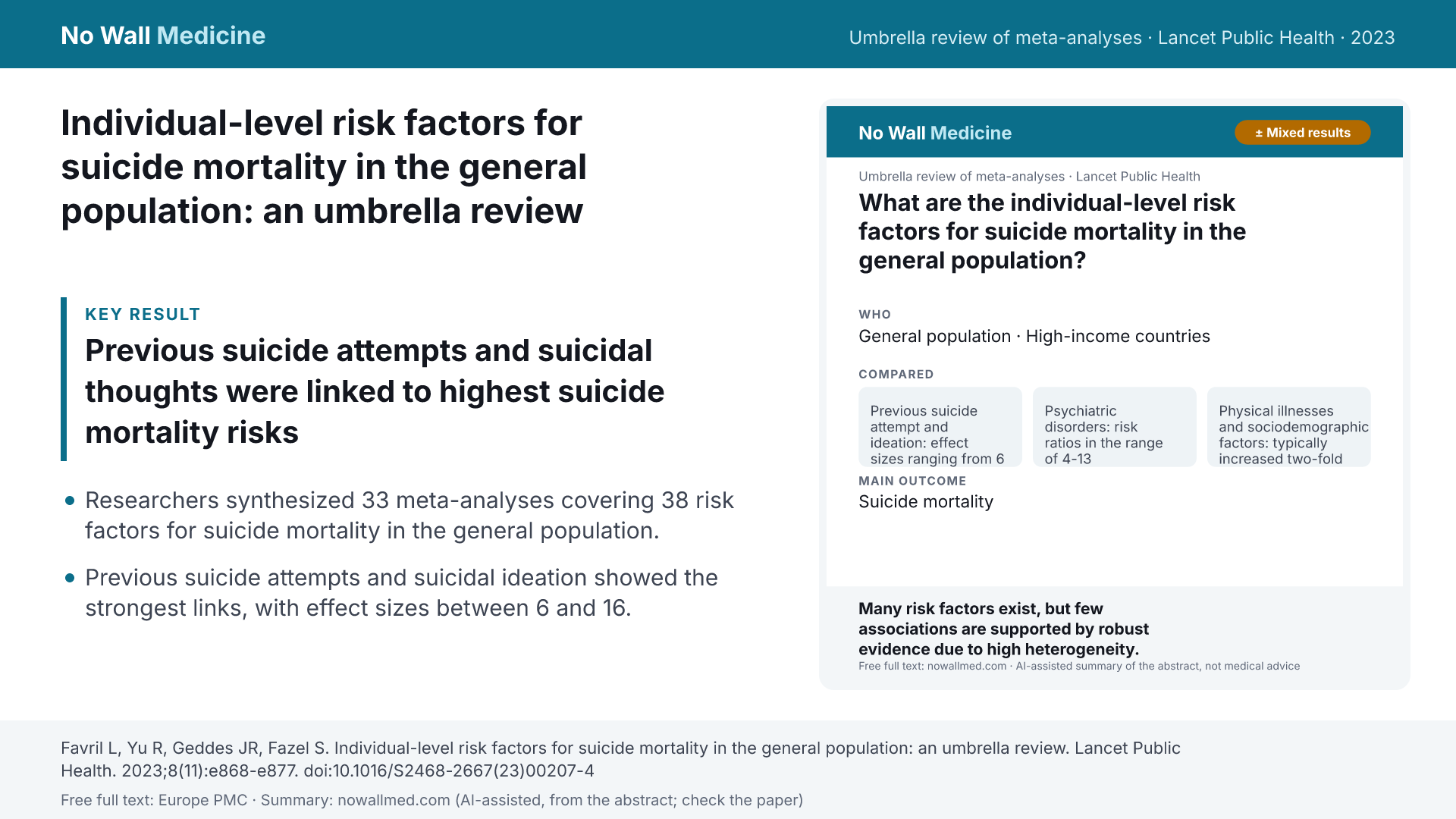
Previous suicide attempts and suicidal thoughts were linked to highest suicide mortality risks
Individual-level risk factors for suicide mortality in the general population: an umbrella review
Umbrella review of meta-analysesMixed results
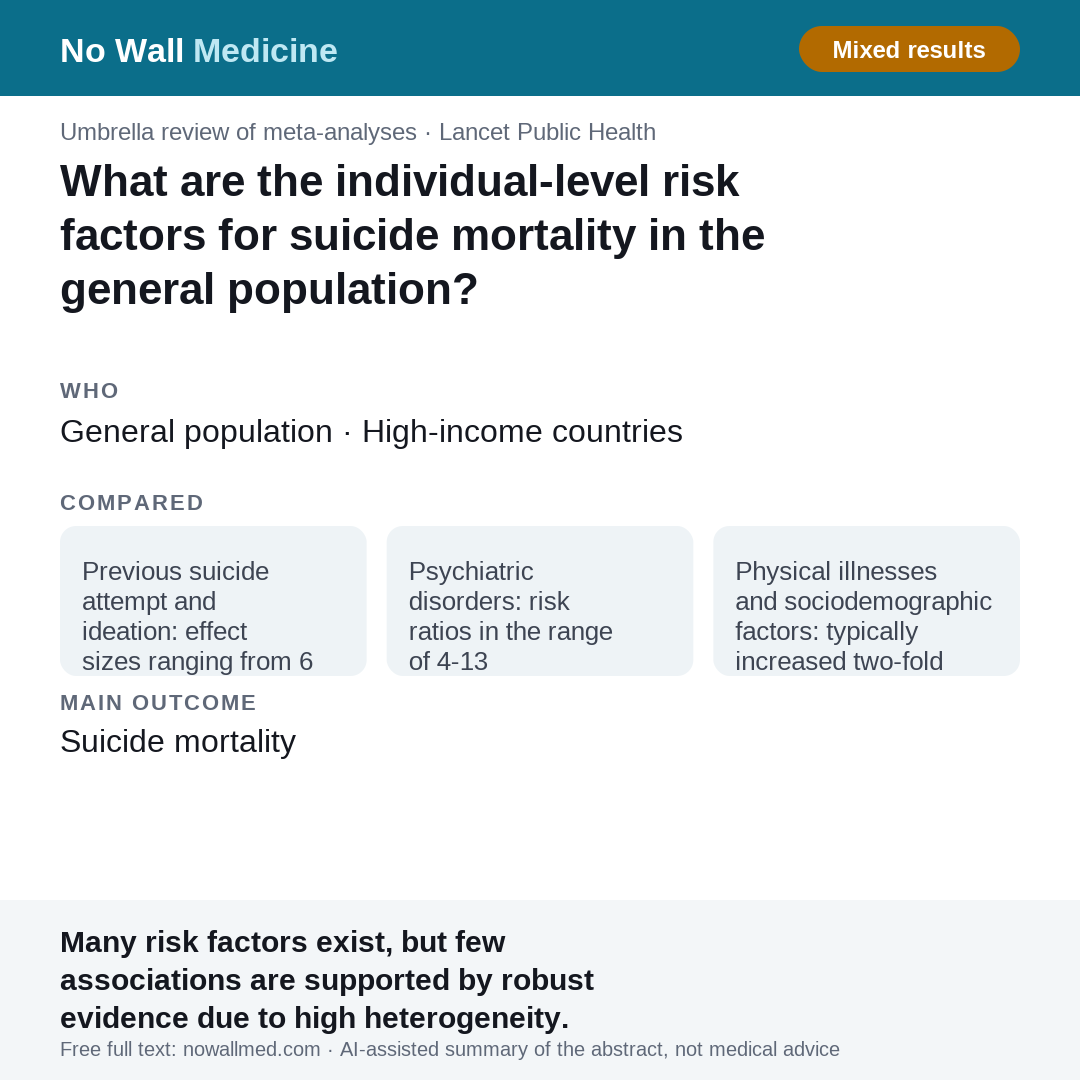
What are the individual-level risk factors for suicide mortality in the general population?
Who
General population · High-income countries
Compared
Previous suicide attempt and ideation: effect sizes ranging from 6 to 16
Psychiatric disorders: risk ratios in the range of 4-13
Physical illnesses and sociodemographic factors: typically increased two-fold
Main outcome
Suicide mortality
Bottom line: Many risk factors exist, but few associations are supported by robust evidence due to high heterogeneity.
Limitation: Quality was limited by excess significance, high heterogeneity, and poor replicability for almost two-thirds of factors.
Funded by: Wellcome Trust
Lancet Public Health · 2023-10-29Download image
Clinical question: What are the individual-level risk factors for suicide mortality in the general population?
Why it matters: The range and magnitude of individual-level risk factors for suicide mortality in the general population were not fully summarized across existing evidence.
Key points
- Researchers synthesized 33 meta-analyses covering 38 risk factors for suicide mortality in the general population.
- Previous suicide attempts and suicidal ideation showed the strongest links, with effect sizes between 6 and 16.
- Psychiatric disorders were associated with risk ratios between 4-13, while physical illnesses and unemployment typically showed a two-fold increase in risk.
Limitation the authors note: The quality of evidence was limited by excess significance, high heterogeneity, and prediction intervals suggesting poor replicability for almost two-thirds of identified risk factors.
Headline and key points written with AI from the paper’s abstract, with every number checked against it. Read the paper before relying on them.
Was this summary helpful?
Abstract
Background
Deaths by suicide remain a major public health challenge worldwide. Identifying and targeting risk factors for suicide mortality is a potential approach to prevention. We aimed to summarise current knowledge on the range and magnitude of individual-level risk factors for suicide mortality in the general population and evaluate the quality of the evidence.Methods
In this umbrella review, five bibliographic databases were systematically searched for articles published from database inception to Aug 31, 2022. We included meta-analyses of observational studies on individual-level risk factors for suicide mortality in the general population. Biological, genetic, perinatal, and ecological risk factors were beyond the scope of this study. Effect sizes were synthesised and compared across domains. To test robustness and consistency of the findings, evidence for small-study effects and excess significance bias (ie, the ratio between the overall meta-analysis effect size and that of its largest included study) was examined, and prediction intervals were calculated. Risk of bias was assessed by the Risk of Bias in Systematic Reviews instrument. The protocol was pre-registered with PROSPERO (CRD42021230119).Findings
We identified 33 meta-analyses on 38 risk factors for suicide mortality in the general population. 422 (93%) of the 454 primary studies included in the meta-analyses were from high-income countries. A previous suicide attempt and suicidal ideation emerged as strong risk factors (with effect sizes ranging from 6 to 16). Psychiatric disorders were associated with a greatly elevated risk of suicide mortality, with risk ratios in the range of 4-13. Suicide risk for physical illnesses (such as cancer and epilepsy) and sociodemographic factors (including unemployment and low education) were typically increased two-fold. Contact with the criminal justice system, state care in childhood, access to firearms, and parental death by suicide also increased the risk of suicide mortality. Among risk factors for which sex-stratified analyses were available, associations were generally similar for males and females. However, the quality of the evidence was limited by excess significance and high heterogeneity, and prediction intervals suggested poor replicability for almost two-thirds of identified risk factors.Interpretation
A wide range of risk factors were identified across various domains, which underscores suicide mortality as a multifactorial phenomenon. Prevention strategies that span individual and population approaches should account for the identified factors and their relative strengths. Despite the large number of risk factors investigated, few associations were supported by robust evidence. Evidence of causal inference will need to be tested in high-quality study designs.Funding
Wellcome Trust.
Abstract reproduced under the article’s CC BY licence.
Subject terms
Cite this article
Favril L, Yu R, Geddes JR, Fazel S. Individual-level risk factors for suicide mortality in the general population: an umbrella review. Lancet Public Health. 2023. doi:10.1016/S2468-2667(23)00207-4
Spotted a mistake? Suggest a correction