Individual participant data meta-analysis yielded similar primary results to aggregate data for eczema prevention
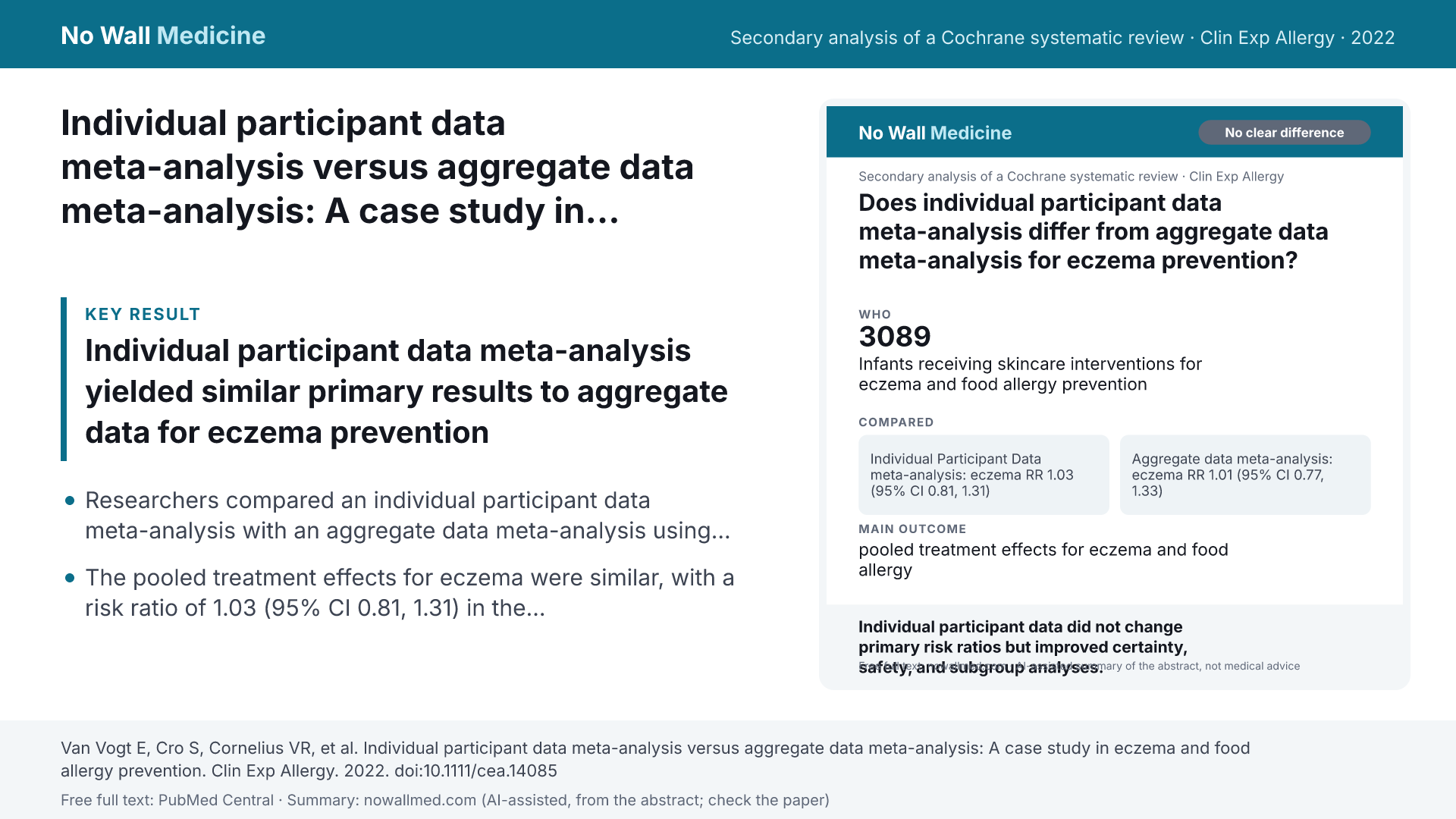
Individual participant data meta-analysis versus aggregate data meta-analysis: A case study in eczema and food allergy prevention
Secondary analysis of a Cochrane systematic reviewNo clear difference
Does individual participant data meta-analysis differ from aggregate data meta-analysis for eczema prevention?
Who
3089
Infants receiving skincare interventions for eczema and food allergy prevention
Compared
Individual Participant Data meta-analysis: eczema RR 1.03 (95% CI 0.81, 1.31)
Aggregate data meta-analysis: eczema RR 1.01 (95% CI 0.77, 1.33)
Main outcome
pooled treatment effects for eczema and food allergy
Bottom line: Individual participant data did not change primary risk ratios but improved certainty, safety, and subgroup analyses.
Clin Exp Allergy · 2022-01-10Download image
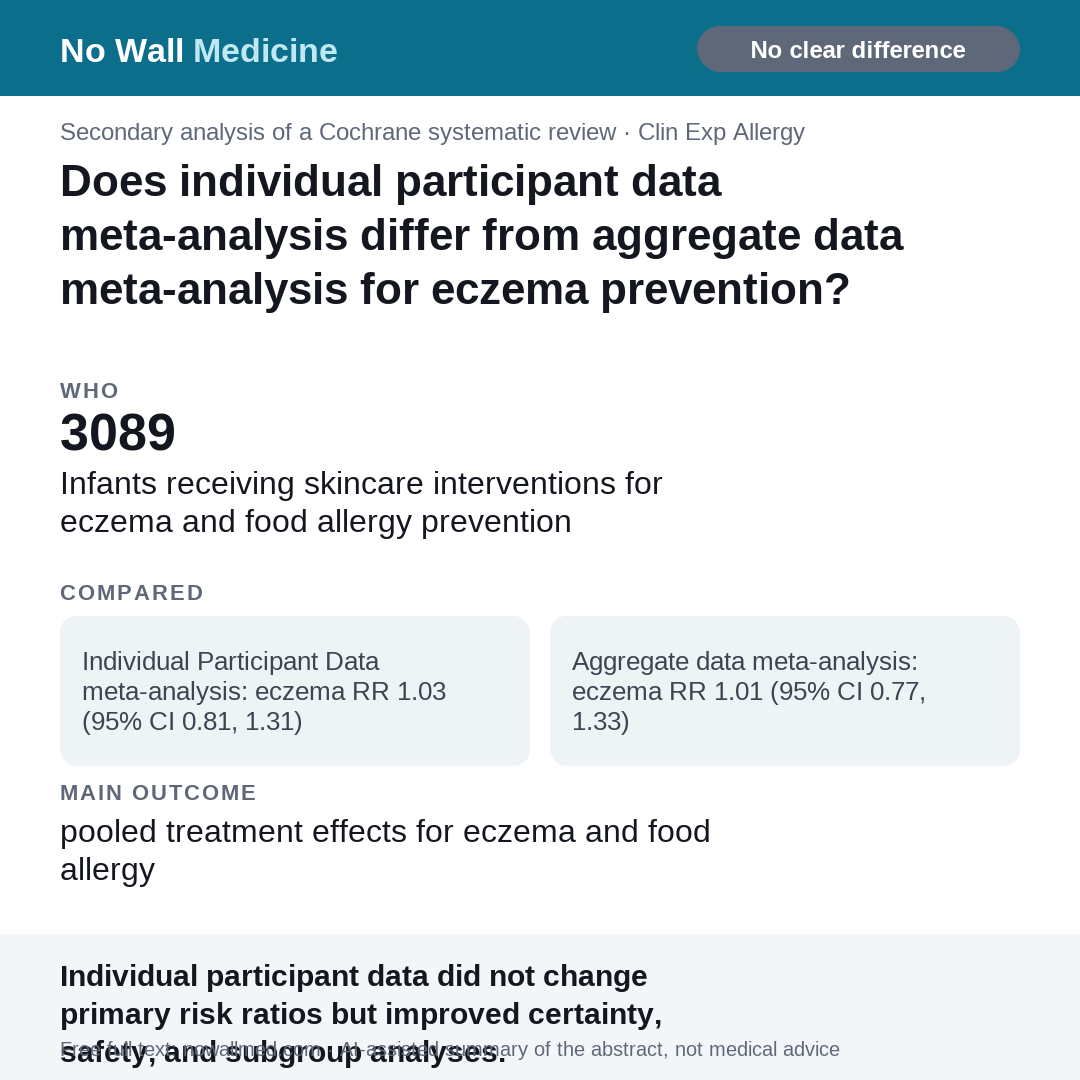
Clinical question: Does individual participant data meta-analysis differ from aggregate data meta-analysis for eczema prevention?
Why it matters: It is unknown how the choice between using individual participant data or aggregate data from published reports impacts the findings of a meta-analysis.
Key points
- Researchers compared an individual participant data meta-analysis with an aggregate data meta-analysis using a Cochrane systematic review of skincare interventions for infants.
- The pooled treatment effects for eczema were similar, with a risk ratio of 1.03 (95% CI 0.81, 1.31) in the individual participant data analysis and 1.01 (95% CI 0.77, 1.33) in the aggregate analysis.
- Individual participant data allowed for higher certainty of evidence, more adverse event data, and analyses of treatment adherence and subgroup interactions that were not possible with aggregate data.
Headline and key points written with AI from the paper’s abstract, with every number checked against it. Read the paper before relying on them.
Was this summary helpful?
Subject terms
Cite this article
Van Vogt E, Cro S, Cornelius VR, et al. Individual participant data meta-analysis versus aggregate data meta-analysis: A case study in eczema and food allergy prevention. Clin Exp Allergy. 2022. doi:10.1111/cea.14085
Spotted a mistake? Suggest a correction