Chemotherapy or chemoradiotherapy before surgery is associated with longer survival in esophageal cancer patients
Individual Participant Data Network Meta-Analysis of Neoadjuvant Chemotherapy or Chemoradiotherapy in Esophageal or Gastroesophageal Junction Carcinoma
Individual participant data network meta-analysisBenefit found
What is the optimal neoadjuvant treatment for resectable esophageal or gastroesophageal junction carcinoma?
Who
4,985
Patients with resectable thoracic esophagus or gastroesophageal junction carcinoma
Compared
Chemotherapy followed by surgery: hazard ratio 0.86 (0.75 to 0.99)
Chemoradiotherapy followed by surgery: hazard ratio 0.77 (0.68 to 0.87)
Upfront surgery
Main outcome
overall survival
Result: hazard ratio 0.90 (0.74 to 1.09) for chemoradiotherapy versus chemotherapy
Bottom line: Neoadjuvant chemotherapy or chemoradiotherapy improves overall survival compared to upfront surgery alone.
J Clin Oncol · 2023-07-12Download image
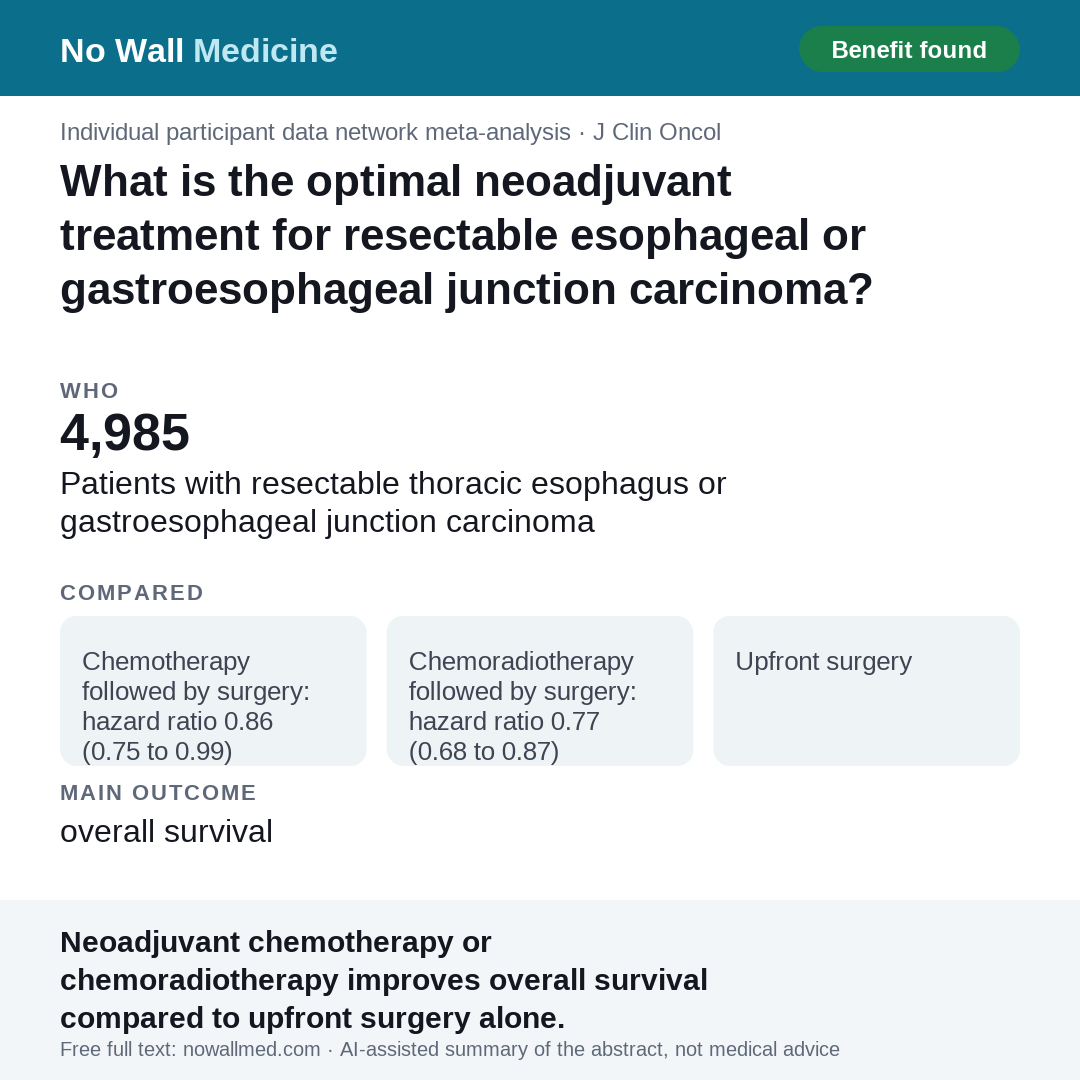
Clinical question: What is the optimal neoadjuvant treatment for resectable esophageal or gastroesophageal junction carcinoma?
Why it matters: The optimal treatment strategy for resectable thoracic esophagus or gastroesophageal junction cancer remains a matter of debate.
Key points
- Researchers analyzed data from 4,985 patients across 26 randomized controlled trials comparing upfront surgery, chemotherapy followed by surgery, and chemoradiotherapy followed by surgery.
- Chemotherapy followed by surgery had a hazard ratio of 0.86 (0.75 to 0.99) and chemoradiotherapy followed by surgery had a hazard ratio of 0.77 (0.68 to 0.87) for overall survival compared to surgery alone.
- No statistically significant difference in overall survival was found when comparing chemoradiotherapy followed by surgery to chemotherapy followed by surgery, with a hazard ratio of 0.90 (0.74 to 1.09).
Headline and key points written with AI from the paper’s abstract, with every number checked against it. Read the paper before relying on them.
Was this summary helpful?
Subject terms
Cite this article
Faron M, Cheugoua-Zanetsie M, Tierney J, Thirion P, Nankivell M, Winter K. Individual Participant Data Network Meta-Analysis of Neoadjuvant Chemotherapy or Chemoradiotherapy in Esophageal or Gastroesophageal Junction Carcinoma. J Clin Oncol. 2023. doi:10.1200/JCO.22.02279
Spotted a mistake? Suggest a correction
Top studies every Monday
The week’s key trials and guidelines in your specialties, plus any topics you follow. By email, free.
Get the weekly digest