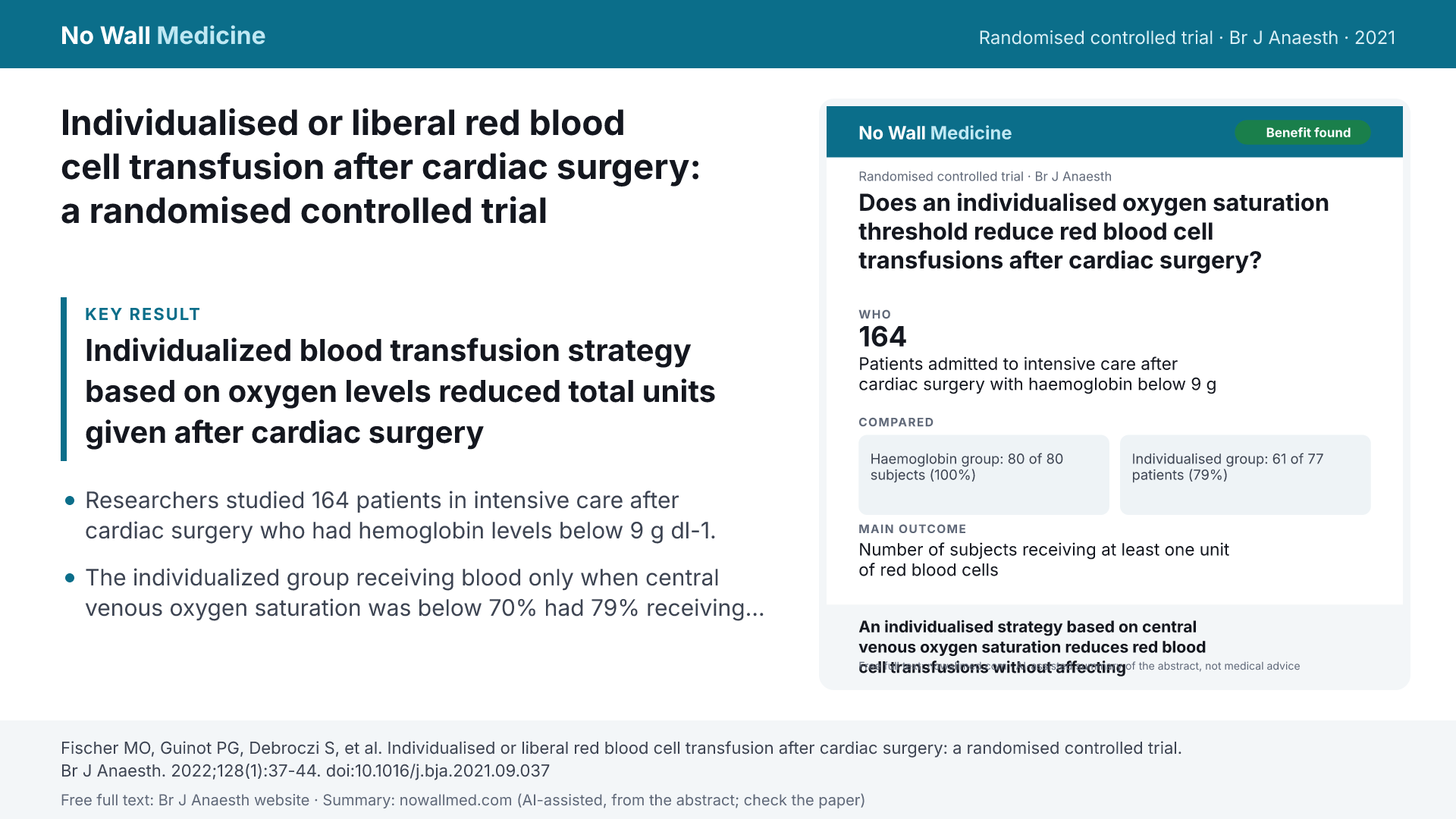
Individualized blood transfusion strategy based on oxygen levels reduced total units given after cardiac surgery
Individualised or liberal red blood cell transfusion after cardiac surgery: a randomised controlled trial
Randomised controlled trialBenefit found
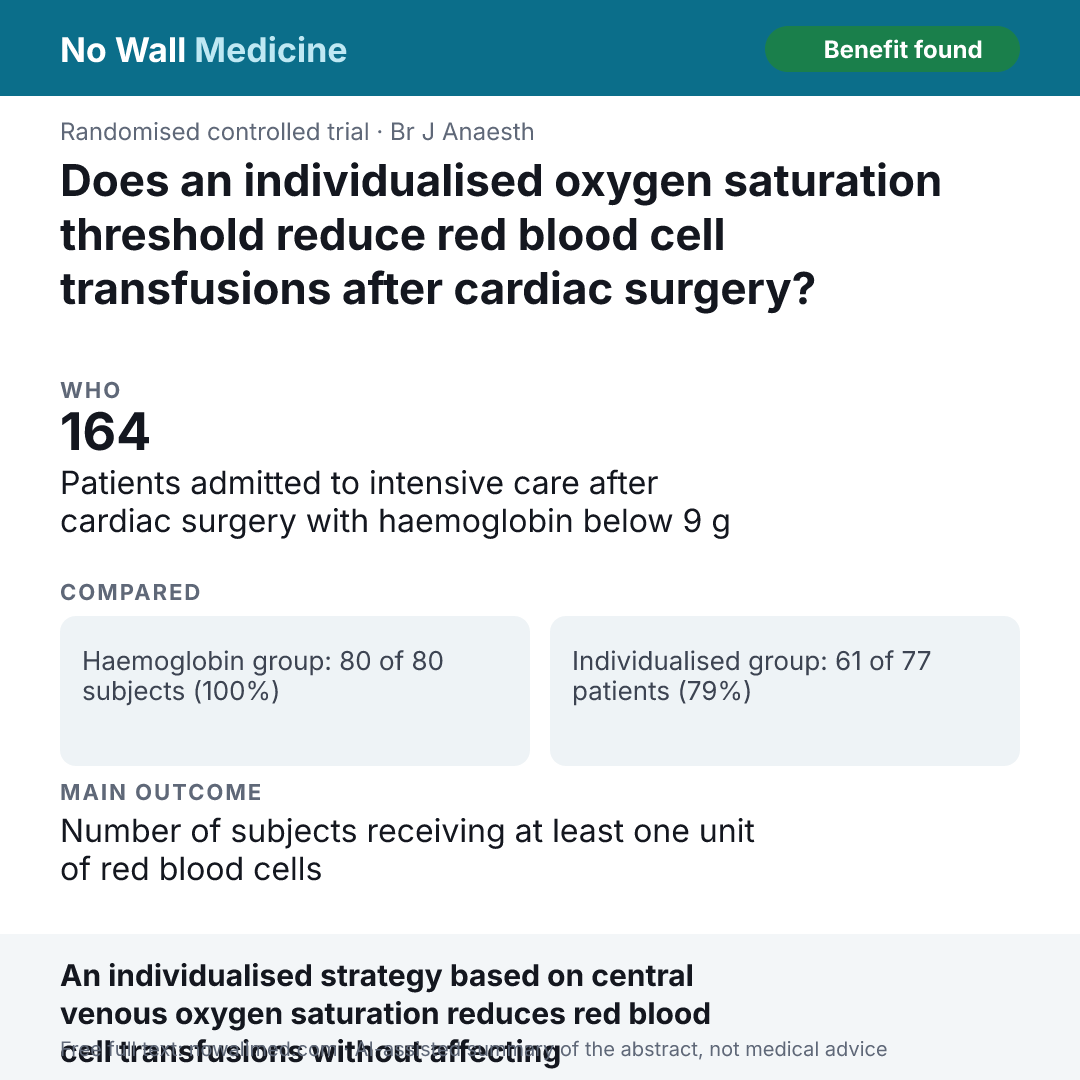
Does an individualised oxygen saturation threshold reduce red blood cell transfusions after cardiac surgery?
Who
164
Patients admitted to intensive care after cardiac surgery with haemoglobin below 9 g dl-1 · Two French academic hospitals
Compared
Haemoglobin group: 80 of 80 subjects (100%)
Individualised group: 61 of 77 patients (79%)
Main outcome
Number of subjects receiving at least one unit of red blood cells
Result: absolute risk -21% [-32.0; -14.0]
Bottom line: An individualised strategy based on central venous oxygen saturation reduces red blood cell transfusions without affecting morbidity or mortality.
Br J Anaesth · 2021-11-30 · Save PNG
Clinical question: Does an individualised oxygen saturation threshold reduce red blood cell transfusions after cardiac surgery?
Why it matters: Current guidelines for blood transfusions in intensive care units rely on hemoglobin levels rather than considering oxygen delivery or consumption.
Key points
- Researchers studied 164 patients in intensive care after cardiac surgery who had hemoglobin levels below 9 g dl-1.
- The individualized group receiving blood only when central venous oxygen saturation was below 70% had 79% receiving at least one unit, compared to 100% in the hemoglobin group.
- There was no significant difference between the two groups regarding a composite outcome of kidney injury, stroke, heart attack, heart failure, intestinal ischemia, or hospital death.
Headline and key points written with AI from the paper’s abstract, with every number checked against it. Read the paper before relying on them.
Was this summary helpful?
Subject terms
Headline, design, result, key points, caveat and citation as plain text.
Cite this article
Fischer MO, Guinot PG, Debroczi S, et al. Individualised or liberal red blood cell transfusion after cardiac surgery: a randomised controlled trial. Br J Anaesth. 2022;128(1):37-44. doi:10.1016/j.bja.2021.09.037
Spotted a mistake? Suggest a correction