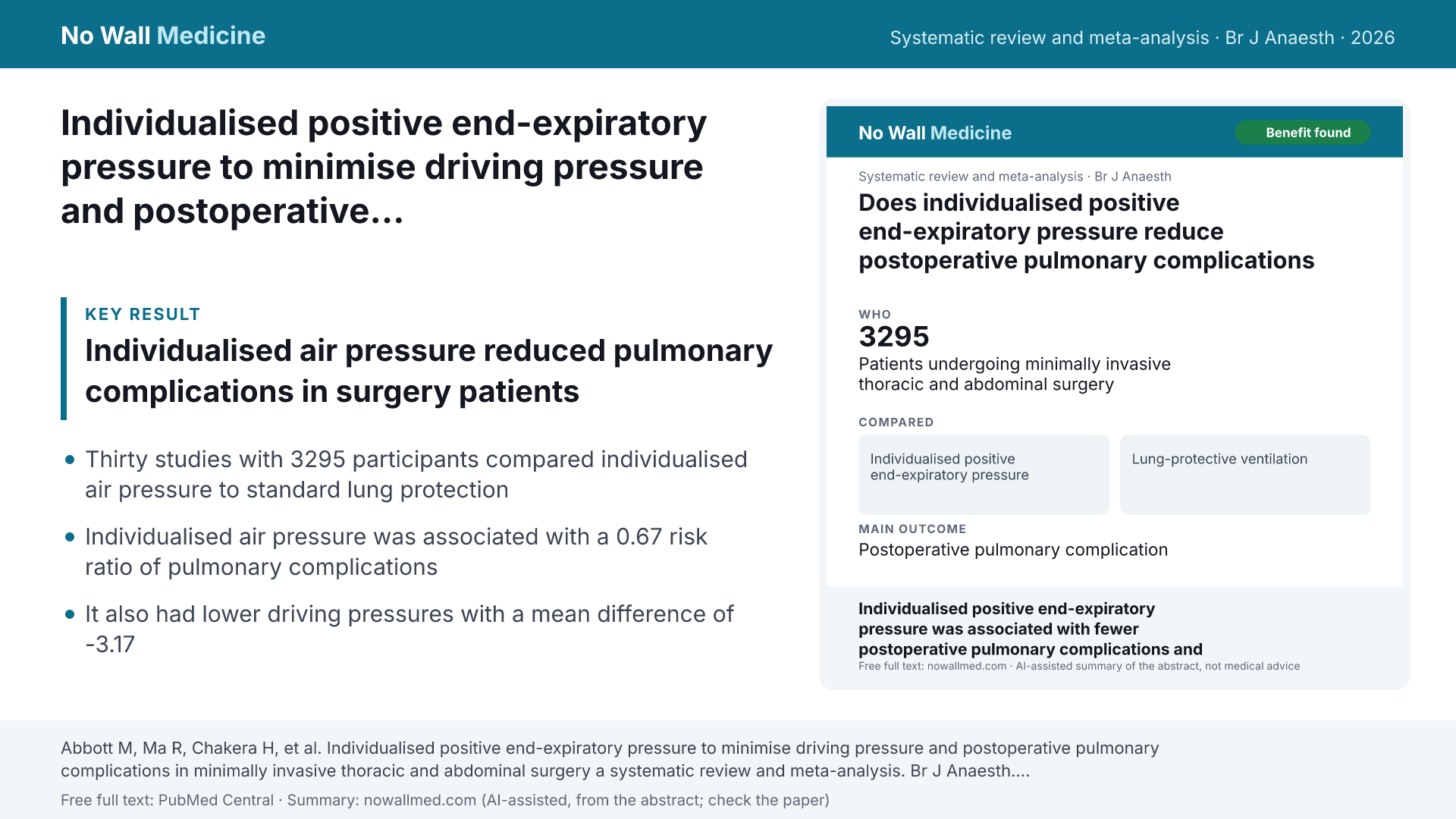
Individualised air pressure reduced pulmonary complications in surgery patients
Individualised positive end-expiratory pressure to minimise driving pressure and postoperative pulmonary complications in minimally invasive thoracic and abdominal surgery a systematic review and meta-analysis
Systematic review and meta-analysisBenefit found
Does individualised positive end-expiratory pressure reduce postoperative pulmonary complications and driving pressure?
Who
3295
Patients undergoing minimally invasive thoracic and abdominal surgery
Compared
Individualised positive end-expiratory pressure
Lung-protective ventilation
Main outcome
Postoperative pulmonary complication
Result: risk ratio 0.67 (95% CI 0.56-0.79)
Bottom line: Individualised positive end-expiratory pressure was associated with fewer postoperative pulmonary complications and lower driving pressures.
Limitation: Showing causality requires further research.
Br J Anaesth · 2026-04-10 · Save PNG
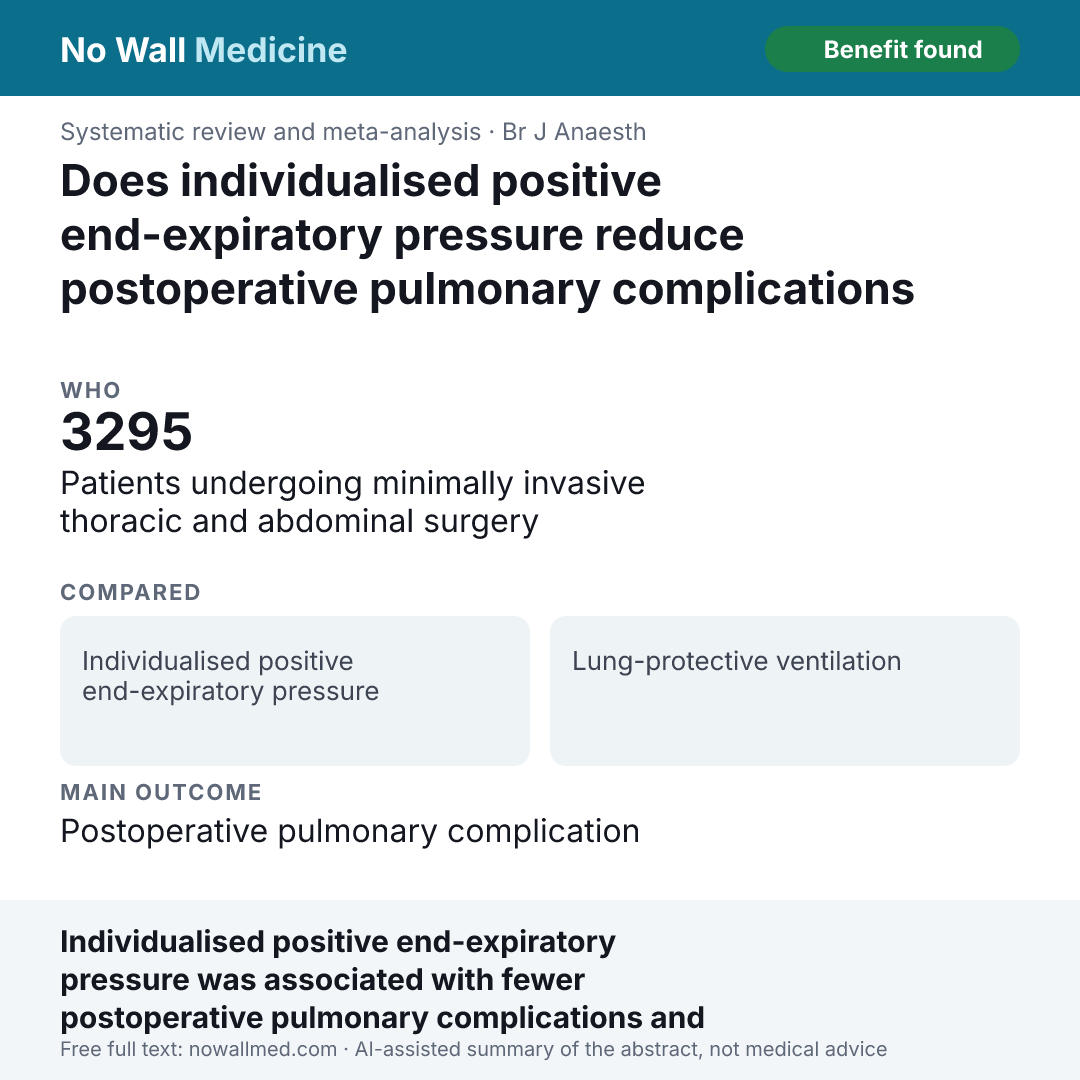
Clinical question: Does individualised positive end-expiratory pressure reduce postoperative pulmonary complications and driving pressure?
Key points
- Thirty studies with 3295 participants compared individualised air pressure to standard lung protection.
- Individualised air pressure was associated with a 0.67 risk ratio of pulmonary complications.
- It also had lower driving pressures with a mean difference of -3.17.
Limitation the authors note: The certainty of evidence was moderate, requiring further research to show causality
Headline and key points written with AI from the paper’s abstract, with every number checked against it. Read the paper before relying on them.
Was this summary helpful?
Subject terms
Headline, design, result, key points, caveat and citation as plain text.
Cite this article
Abbott M, Ma R, Chakera H, et al. Individualised positive end-expiratory pressure to minimise driving pressure and postoperative pulmonary complications in minimally invasive thoracic and abdominal surgery a systematic review and meta-analysis. Br J Anaesth. 2026;137(1):231-243. doi:10.1016/j.bja.2026.02.036
Spotted a mistake? Suggest a correction