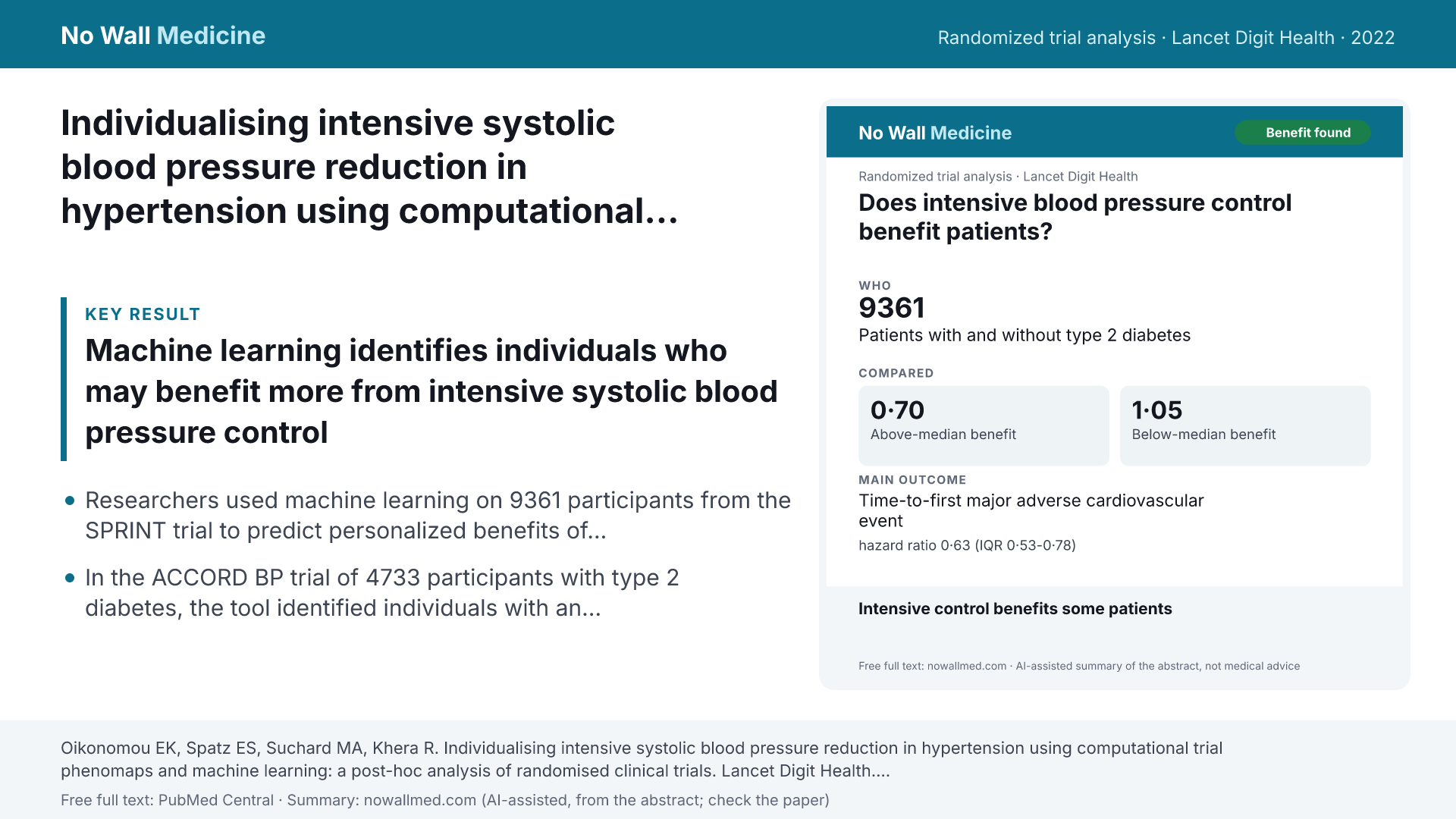
Machine learning identifies individuals who may benefit more from intensive systolic blood pressure control
Individualising intensive systolic blood pressure reduction in hypertension using computational trial phenomaps and machine learning: a post-hoc analysis of randomised clinical trials
Randomized trial analysisBenefit found
Does intensive blood pressure control benefit patients?
Who
9361
Patients with and without type 2 diabetes
Compared
0·70Above-median benefit (95% CI 0·55-0·90)
1·05Below-median benefit (95% CI 0·84-1·32)
Main outcome
Time-to-first major adverse cardiovascular event
Result: hazard ratio 0·63 (IQR 0·53-0·78)
Bottom line: Intensive control benefits some patients
Funded by: National Heart, Lung, and Blood Institute
Lancet Digit Health · 2022-10-28 · Save PNG
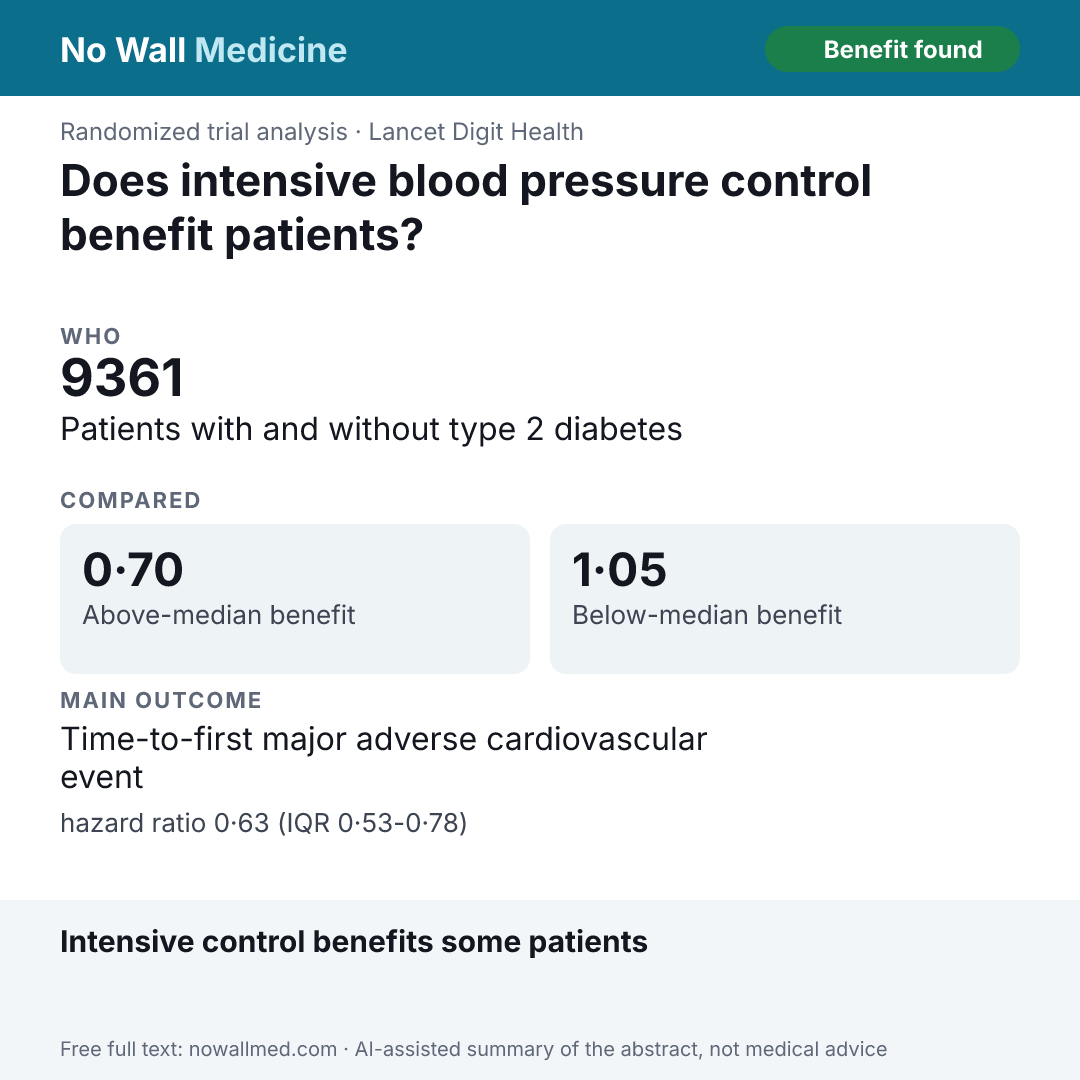
Clinical question: Does intensive blood pressure control benefit patients?
Why it matters: The cardiovascular benefits of intensive systolic blood pressure control vary across different clinical populations, making it unclear which specific patients benefit most.
Key points
- Researchers used machine learning on 9361 participants from the SPRINT trial to predict personalized benefits of intensive systolic blood pressure control for major adverse cardiovascular events.
- In the ACCORD BP trial of 4733 participants with type 2 diabetes, the tool identified individuals with an adjusted hazard ratio of 0.70 for major adverse cardiovascular events compared to 1.05 for those with below-median predicted benefit.
- Subgroup analyses for age, sex, cardiovascular disease, and smoking did not identify groups with different treatment effects.
Headline and key points written with AI from the paper’s abstract, with every number checked against it. Read the paper before relying on them.
Was this summary helpful?
Abstract
Background
The cardiovascular benefits of intensive systolic blood pressure control vary across clinical populations tested in large randomised clinical trials. We aimed to evaluate the application of machine learning to clinical trials of patients without and with type 2 diabetes to define the personalised cardiovascular benefit of intensive control of systolic blood pressure. Methods
In SPRINT, a trial of intensive (systolic blood pressure <120 mm Hg) versus standard (systolic blood pressure <140 mm Hg) systolic blood pressure control in patients without type 2 diabetes, we defined a phenotypic representation of the study population using 59 baseline variables. We extracted personalised treatment effect estimates for the primary outcome, time-to-first major adverse cardiovascular event (MACE; cardiovascular death, myocardial infarction or acute coronary syndrome, stroke, and acute decompensated heart failure), through iterative Cox regression analyses providing average hazard ratio (HR) estimates weighted for the phenotypic distance of each participant from the index patient of each iteration. Next, we trained an extreme gradient boosting algorithm (known as XGBoost) to predict the personalised effect of intensive systolic blood pressure control using features most consistently linked to increased personalised benefit, before evaluating its performance in the ACCORD BP trial of patients with type 2 diabetes randomly assigned to receive intensive versus standard systolic blood pressure control. We stratified patients based on their predicted treatment effect, and key demographic groups (age, sex, cardiovascular disease, and smoking). We assessed the presence of heterogeneity with an interaction test, and assessed the performance of the algorithm in a simulation analysis of SPRINT in the presence or absence of an artificially introduced heterogeneous treatment effect. Findings
From SPRINT, we included all 9361 study participants (mean age 67·9 years [SD 9·4], 3332 [35·6%] female) who underwent randomisation to either intensive (n=4678) or standard (n=4683) treatment. The median individualised HR for MACE was 0·63 (IQR 0·53-0·78). An eight-feature tool built for this analysis to predict personalised benefit in SPRINT was externally tested in ACCORD BP (4733 participants (mean age 62·7 years [SD 6·7], 2258 [47·7%] female), wherein it successfully identified individuals with differential benefit from intensive versus standard systolic blood pressure control (adjusted HR for MACE of 0·70 [95% CI 0·55-0·90] in individuals with above-median MACE benefit versus 1·05 [95% CI 0·84-1·32] for below-median predicted benefit; pinteraction=0·0184). Subgroup analysis based on age (<65 years: HR 0·89 [95% CI 0·71-1·12]; ≥65 years: 0·85 [0·67-1·09]), sex (male: 0·89 [0·72-1·10]; female: 0·85 [0·65-1·10]), established cardiovascular disease (no: 0·89 [0·70-1·14]; yes: 0·84 [0·67-1·06]), or active smoking (no: 0·85 [0·71-1·02]; yes: 1·01 [0·64-1·60]) did not identify groups with heterogeneity of treatment effect. In a simulation analysis of SPRINT, the proposed algorithm detected groups with heterogeneous treatment effects in the presence, but not absence, of simulated subgroup differences. Interpretation
By use of machine learning to define an individual's personalised benefit through phenotypic representations of clinical trials, we created a practical tool for individualising the selection of intensive versus standard systolic blood pressure control in patients without and with type 2 diabetes. Funding
National Heart, Lung, and Blood Institute of the US National Institutes of Health.
Abstract reproduced under the article’s CC BY NC ND licence.
Subject terms
Headline, design, result, key points, caveat and citation as plain text.
Cite this article
Oikonomou EK, Spatz ES, Suchard MA, Khera R. Individualising intensive systolic blood pressure reduction in hypertension using computational trial phenomaps and machine learning: a post-hoc analysis of randomised clinical trials. Lancet Digit Health. 2022;4(11):e796-e805. doi:10.1016/S2589-7500(22)00170-4
Spotted a mistake? Suggest a correction