Flow-controlled ventilation did not reduce interleukin 8 levels after cardiac surgery with cardiopulmonary bypass
Individualized Flow-controlled versus Pressure-controlled Ventilation in Cardiac Surgery: A Randomized Controlled Trial
Randomized controlled trialNo clear difference
Does flow-controlled ventilation reduce inflammatory stimulus compared to pressure-controlled ventilation in cardiac surgery?
Who
140
Adult patients undergoing cardiac surgery with cardiopulmonary bypass · Single-center
Compared
Flow-controlled ventilation: 3.08 pg/ml
Pressure-controlled ventilation: 3.60 pg/ml
Main outcome
Postoperative plasmatic interleukin 8 levels 6 hours after cardiopulmonary bypass
Result: β, 0.08 pg/ml; 95% CI, -0.17 to 0.33
Bottom line: Flow-controlled ventilation did not reduce plasmatic interleukin 8 levels compared to pressure-controlled ventilation in cardiac surgery patients.
Limitation: Secondary outcomes including pulmonary and extrapulmonary complications were explorative.
Anesthesiology · 2025-11-17Download image
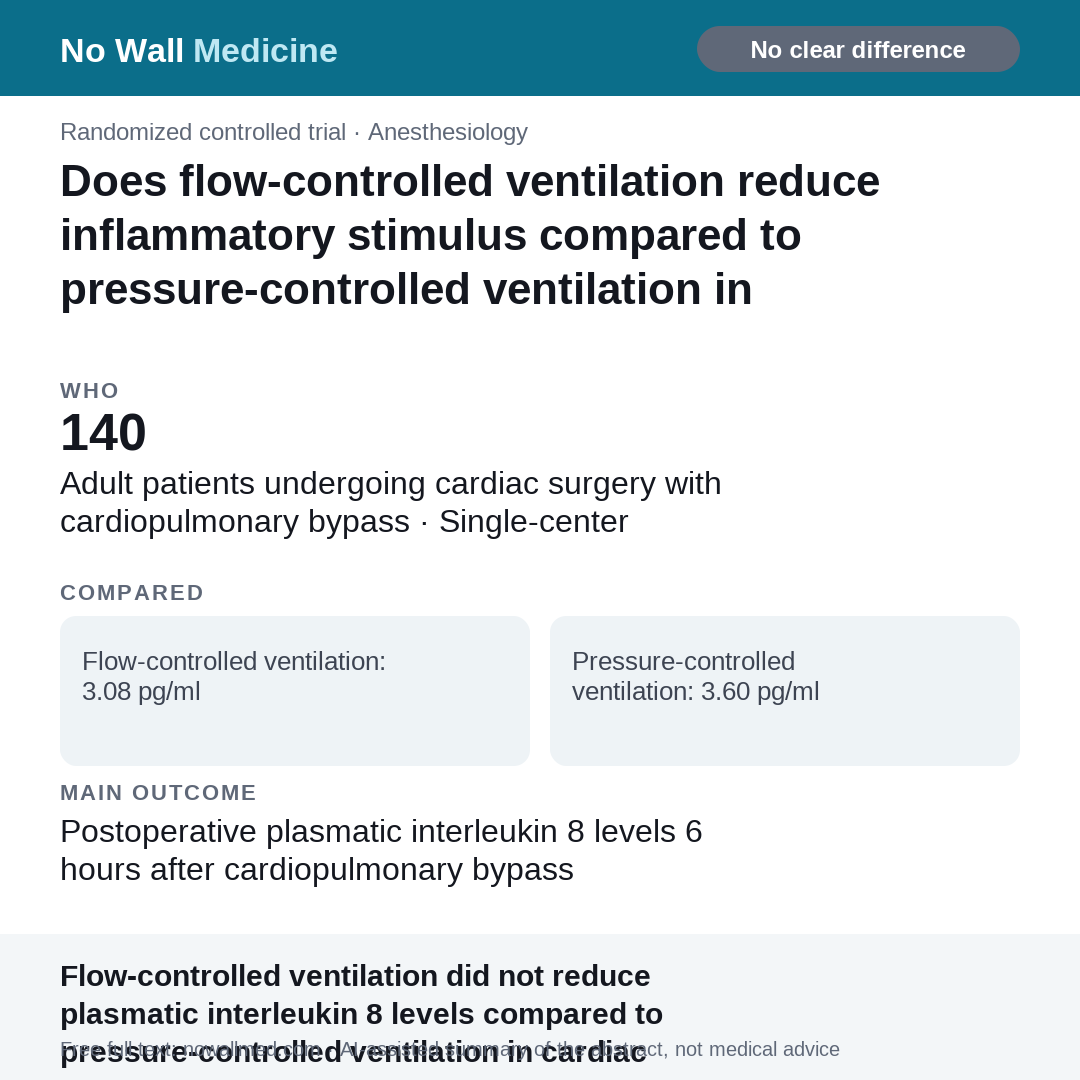
Clinical question: Does flow-controlled ventilation reduce inflammatory stimulus compared to pressure-controlled ventilation in cardiac surgery?
Why it matters: It is unknown if flow-controlled ventilation reduces the inflammatory stimulus compared to conventional pressure-controlled ventilation in patients undergoing cardiac surgery with cardiopulmonary bypass.
Key points
- Researchers conducted a randomized trial with 140 adult patients undergoing cardiac surgery using a heart-lung machine to compare flow-controlled ventilation and pressure-controlled ventilation.
- Median postoperative interleukin 8 levels at 6 h after cardiopulmonary bypass did not differ significantly between the flow-controlled group (3.08 pg/ml) and the pressure-controlled group (3.60 pg/ml).
- The flow-controlled approach reduced perioperative mechanical power by 55% and was associated with lower pulmonary complications and shorter hospital stays in this exploratory analysis.
Limitation the authors note: The secondary outcomes regarding pulmonary complications, extrapulmonary complications, and hospital length of stay were explorative.
Headline and key points written with AI from the paper’s abstract, with every number checked against it. Read the paper before relying on them.
Topics
Cite this article
Becker S, Kurz CT, Schnitzler R, Geppert J, Wichelhaus LM, Denz R. Individualized Flow-controlled versus Pressure-controlled Ventilation in Cardiac Surgery: A Randomized Controlled Trial. Anesthesiology. 2025. doi:10.1097/ALN.0000000000005851
Spotted a mistake? Suggest a correction