Ketamine and etomidate show similar mortality rates for emergency intubation in critically ill adults
Induction agents for emergency tracheal intubation in critically ill adults: a systematic review and network meta-analysis
Network meta-analysis of nine randomized controlled trialsMixed results
Which induction agent is preferable for emergency tracheal intubation in critically ill adults?
Who
4,672
Critically ill adults undergoing emergency or rapid sequence intubation
Compared
Ketamine
Etomidate
Propofol
Ketofol
Main outcome
Short-term mortality
Result: OR 0.96 (95% CI 0.80-1.16) for ketamine vs etomidate
Bottom line: Etomidate and ketamine show similar mortality, but ketamine may cause more peri-intubation hemodynamic instability.
Crit Care · 2026-05-12Download image
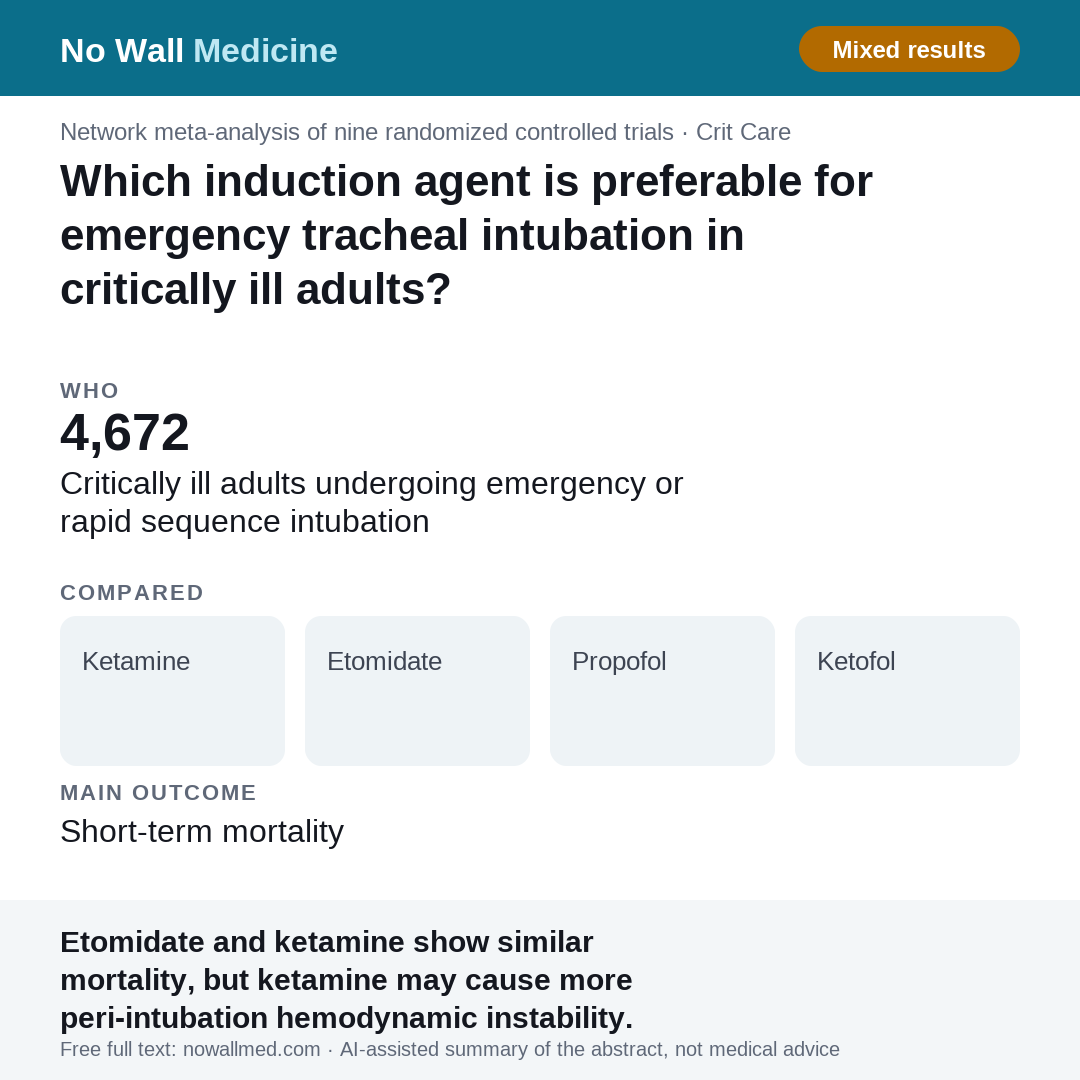
Clinical question: Which induction agent is preferable for emergency tracheal intubation in critically ill adults?
Why it matters: It remains uncertain which induction agent is preferable for emergency tracheal intubation in critically ill adults.
Key points
- Researchers analyzed nine trials involving 4,672 patients to compare etomidate, ketamine, propofol, and a ketamine-propofol combination for emergency tracheal intubation.
- Ketamine and etomidate resulted in similar mortality (OR 0.96, 95% CI 0.80-1.16), though ketamine was associated with higher rates of cardiovascular collapse (OR 1.44, 1.20-1.71).
- Ketamine was also linked to increased post-induction hypotension (OR 1.34, 1.07-1.68) and higher use of vasopressors (OR 1.45, 1.21-1.74) compared to etomidate.
Limitation the authors note: Beyond one trial, no randomized evidence exists for propofol in emergency intubation of critically ill adults.
Headline and key points written with AI from the paper’s abstract, with every number checked against it. Read the paper before relying on them.
Topics
Spotted a mistake? Suggest a correction