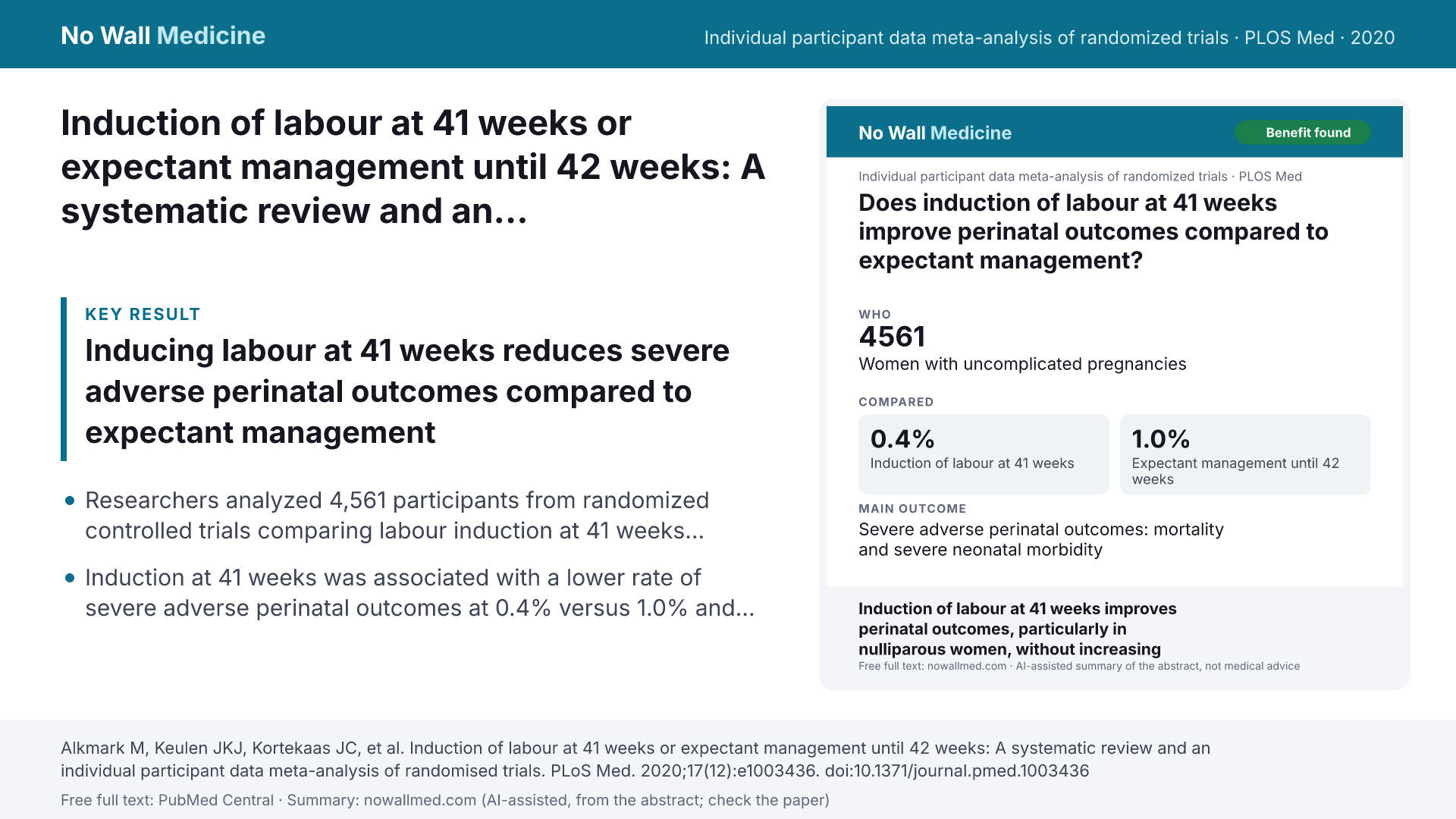
Inducing labour at 41 weeks reduces severe adverse perinatal outcomes compared to expectant management
Induction of labour at 41 weeks or expectant management until 42 weeks: A systematic review and an individual participant data meta-analysis of randomised trials
Individual participant data meta-analysis of randomized trialsBenefit found
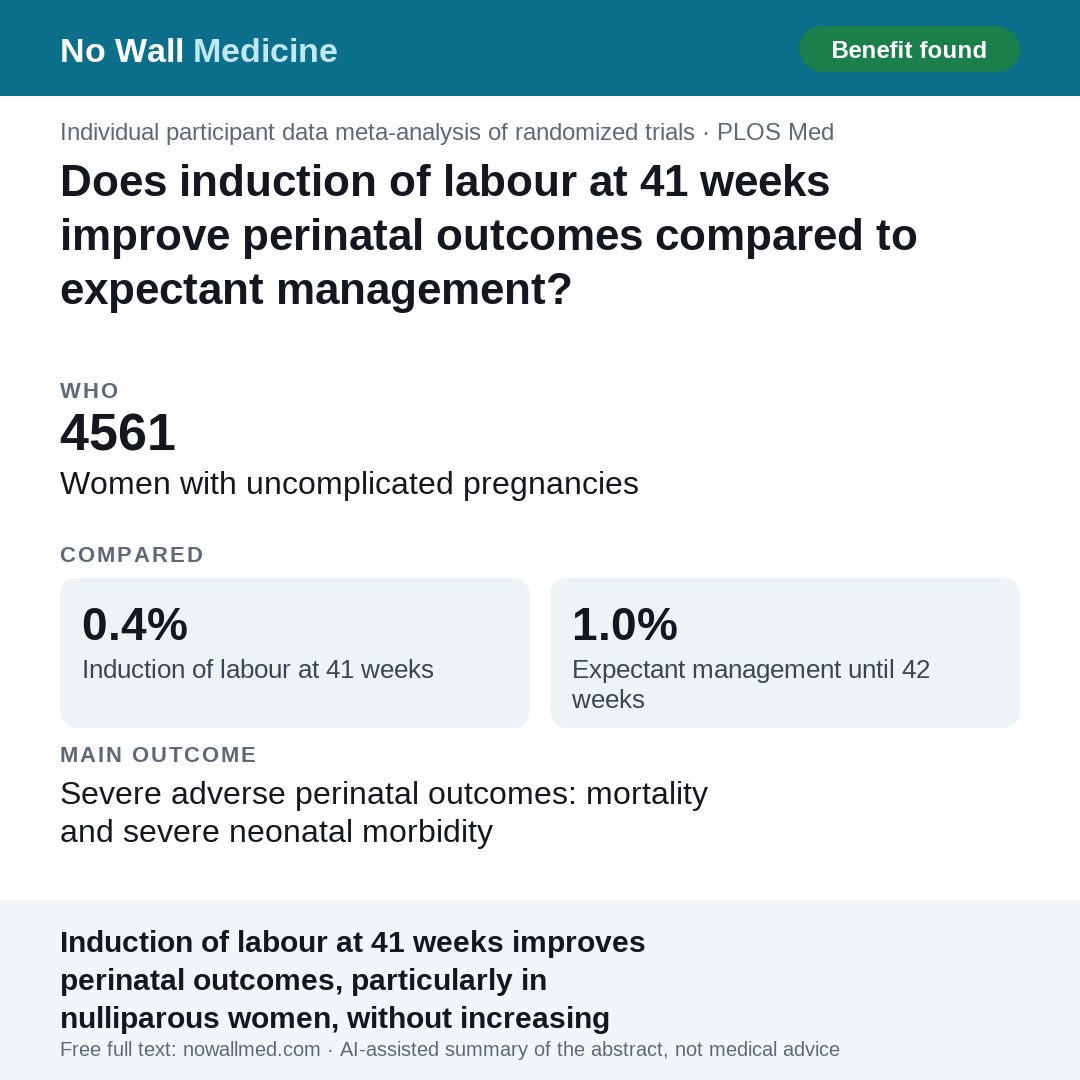
Does induction of labour at 41 weeks improve perinatal outcomes compared to expectant management?
Who
4561
Women with uncomplicated pregnancies
Compared
0.4%Induction of labour at 41 weeks (10/2,281)
1.0%Expectant management until 42 weeks (23/2,280)
Main outcome
Severe adverse perinatal outcomes: mortality and severe neonatal morbidity
Result: relative risk 0.43 (95% CI 0.21 to 0.91)
Bottom line: Induction of labour at 41 weeks improves perinatal outcomes, particularly in nulliparous women, without increasing cesarean delivery rates.
Limitation: Risk of overestimating effect on perinatal mortality due to early stopping of the largest trial for safety.
PLOS Med · 2020-12-08Download image
Clinical question: Does induction of labour at 41 weeks improve perinatal outcomes compared to expectant management?
Why it matters: It is unknown if inducing labour at 41 weeks improves perinatal outcomes compared to waiting until 42 weeks in uncomplicated pregnancies.
Key points
- Researchers analyzed 4,561 participants from randomized controlled trials comparing labour induction at 41 weeks to waiting until 42 weeks in uncomplicated pregnancies.
- Induction at 41 weeks was associated with a lower rate of severe adverse perinatal outcomes at 0.4% versus 1.0% and lower perinatal deaths at <0.1% versus 0.4%.
- The benefit for severe adverse outcomes was seen in women who had not given birth before, but not in women who had previously given birth.
Limitation the authors note: The authors stated there was a risk of overestimating the effect on perinatal mortality because the largest trial stopped early for safety reasons.
Headline and key points written with AI from the paper’s abstract, with every number checked against it. Read the paper before relying on them.
Was this summary helpful?
Subject terms
Cite this article
Alkmark M, Keulen JKJ, Kortekaas JC, et al. Induction of labour at 41 weeks or expectant management until 42 weeks: A systematic review and an individual participant data meta-analysis of randomised trials. PLOS Med. 2020. doi:10.1371/journal.pmed.1003436
Spotted a mistake? Suggest a correction