Representative credentials and data limitation disclosures influence how clinicians perceive drugs at medical conferences
Industry Interactions at Medical Conferences: Representatives' Credentials and the Disclosure of Data Limitations Influence Clinician Perceptions
2 × 2 factorial experimental studyMixed results
How do representative credentials and data limitation disclosures influence clinician perceptions and prescribing intentions?
Who
430
health care providers · 1 of 12 United States medical conferences
Compared
Master of Business Administration and no disclosure
Master of Business Administration and disclosure present
Doctor of Medicine and no disclosure
Doctor of Medicine and disclosure present
Main outcome
perceived efficacy, perceived risk, drug attitudes, and prescribing intentions
Bottom line: Representative credentials do not influence perceptions, but disclosing data limitations reduces perceived drug efficacy and drug attitudes.
J Am Board Fam Med · 2025-11-24Download image
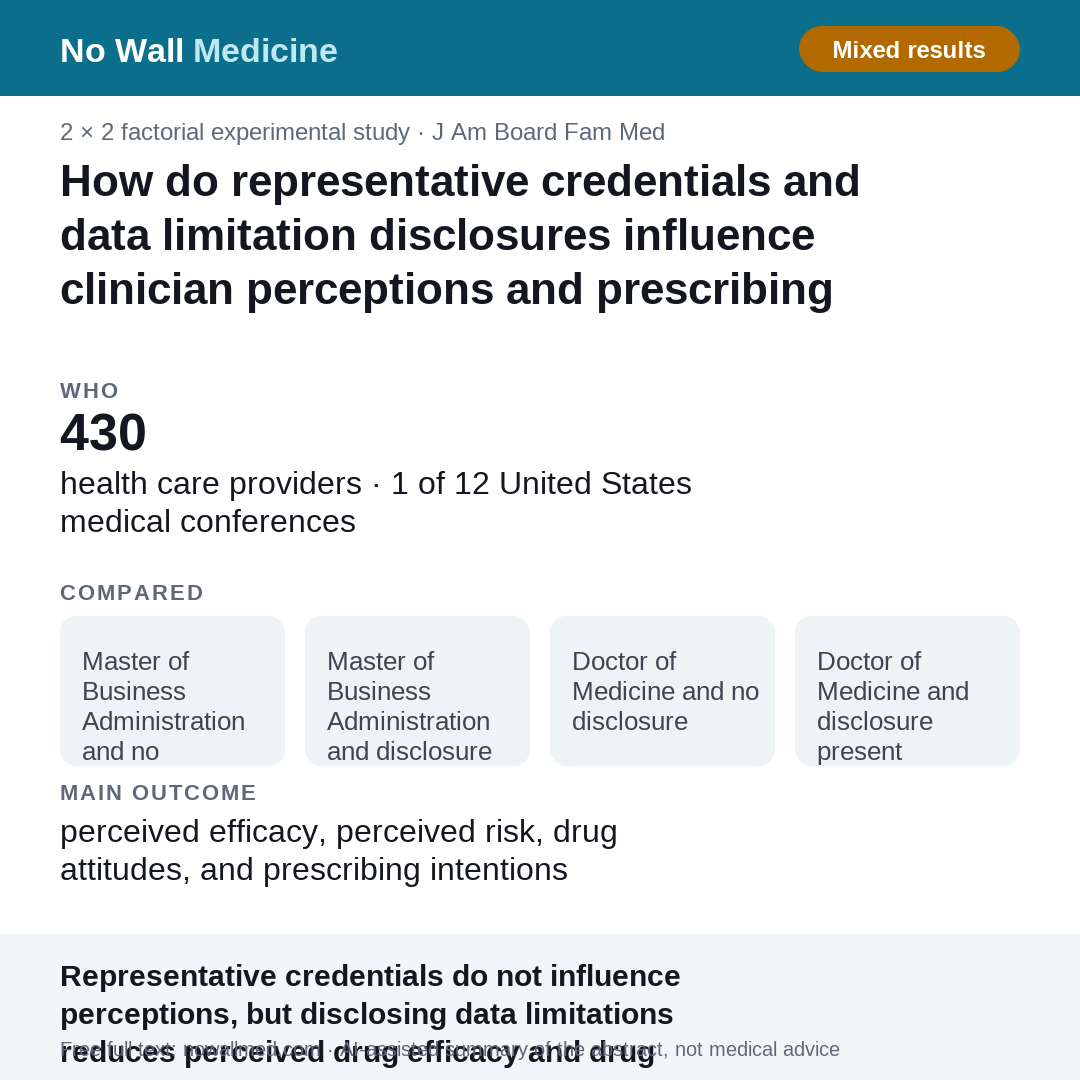
Clinical question: How do representative credentials and data limitation disclosures influence clinician perceptions and prescribing intentions?
Why it matters: It is unclear how the educational background of industry representatives and the disclosure of trial limitations affect how clinicians view promoted medications.
Key points
- Researchers conducted an experimental study with 430 health care providers who viewed videos of industry representatives discussing a fictitious drug.
- The credentials of the representative had no influence on perceptions or prescribing intentions, though those with medical degrees were rated as having slightly more medical knowledge.
- Disclosing clinical trial data limitations significantly reduced perceptions of drug efficacy and led to less positive drug attitudes.
Headline and key points written with AI from the paper’s abstract, with every number checked against it. Read the paper before relying on them.
Topics
Cite this article
O'Donoghue AC, Aikin KJ, Amoozegar JB, Johnson M, Adewumi I, Rupert DJ. Industry Interactions at Medical Conferences: Representatives' Credentials and the Disclosure of Data Limitations Influence Clinician Perceptions. J Am Board Fam Med. 2025. doi:10.3122/jabfm.2024.240368R1
Spotted a mistake? Suggest a correction