Hydrolyzed infant formulas show varying effects on allergic diseases compared to cow's milk or breast milk
Infant Formulas With Partially or Extensively Hydrolyzed Milk Proteins for the Prevention of Allergic Diseases: A Systematic Review and Meta-Analysis of Clinical Trials
Systematic review and meta-analysis of 24 trialsMixed results
Do hydrolyzed milk protein formulas prevent allergic diseases compared to cow's milk or breast milk?
Who
10,950
Infants in clinical trials
Compared
Hydrolyzed formulas (PHF or EHF)
Cow's milk formula or breast milk
Main outcome
Risk of allergic diseases
Bottom line: Hydrolyzed formulas may reduce cow's milk allergy, eczema, and wheeze compared to cow's milk formula, but may increase wheeze risk versus breast milk.
Limitation: Most trials included only high-risk infants, so more research on non-high-risk infants is warranted.
Adv Nutr · 2024-04-04Download image
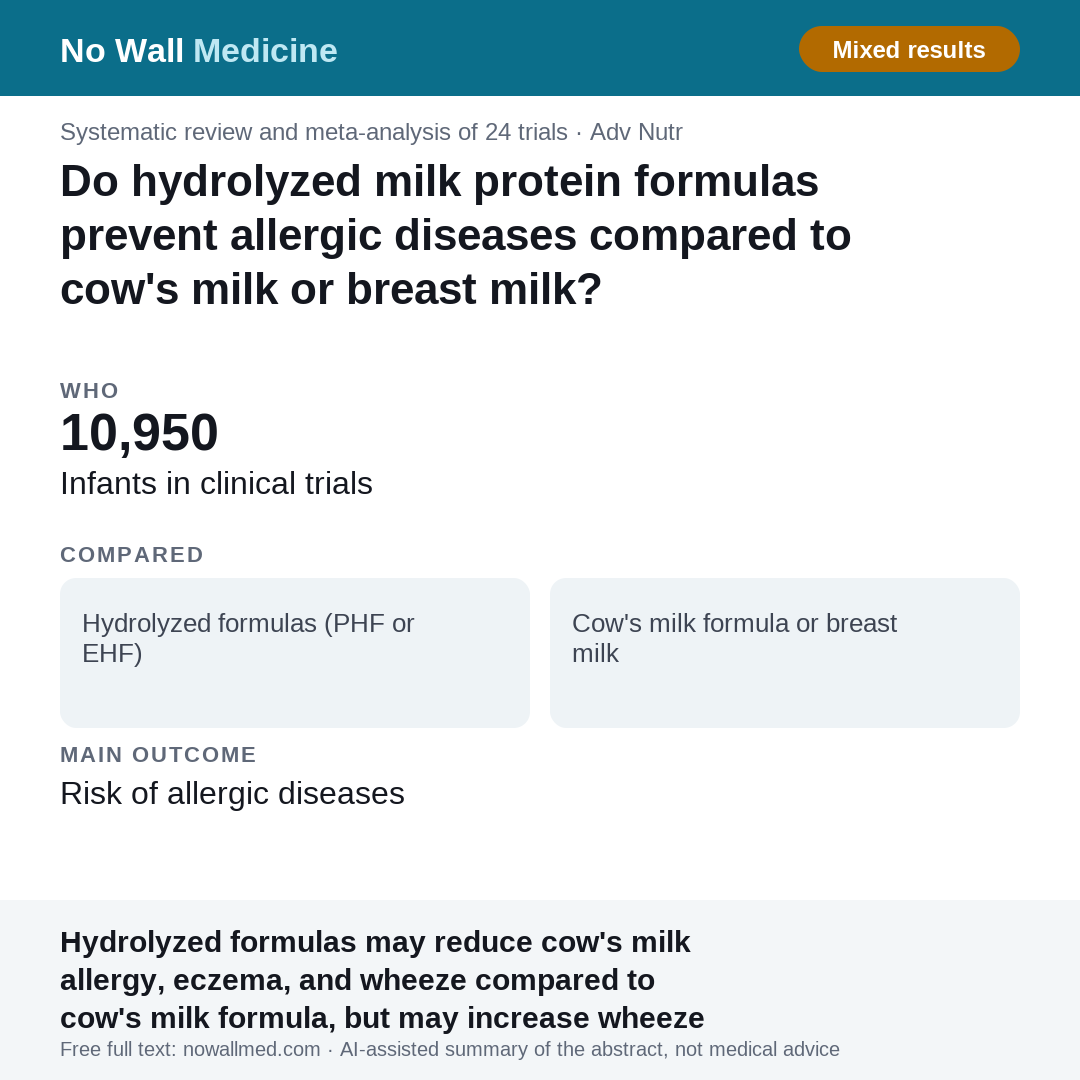
Clinical question: Do hydrolyzed milk protein formulas prevent allergic diseases compared to cow's milk or breast milk?
Why it matters: Clinical studies have been inconclusive regarding whether partially or extensively hydrolyzed milk protein formulas are effective at preventing allergic diseases compared to cow's milk formula or breast milk.
Key points
- Researchers analyzed 24 clinical trials involving 10,950 infants to compare partially or extensively hydrolyzed formulas with cow's milk formula or breast milk.
- Compared to cow's milk formula, extensively hydrolyzed formula was linked to a lower risk of cow's milk allergy (RR: 0.62) and eczema (RR: 0.79).
- Compared to breast milk, both partially and extensively hydrolyzed formulas were linked to an increased risk of wheeze (RR: 1.61 and RR: 1.64).
Limitation the authors note: Most included trials only included high-risk infants, meaning more research on non-high-risk infants is needed before generalizing results.
Headline and key points written with AI from the paper’s abstract, with every number checked against it. Read the paper before relying on them.
Was this summary helpful?
Subject terms
Cite this article
Li X, He T, Duan S, Liang J, Feng G, Li F. Infant Formulas With Partially or Extensively Hydrolyzed Milk Proteins for the Prevention of Allergic Diseases: A Systematic Review and Meta-Analysis of Clinical Trials. Adv Nutr. 2024. doi:10.1016/j.advnut.2024.100217
Spotted a mistake? Suggest a correction
Top studies every Monday
The week’s key trials and guidelines in your specialties, plus any topics you follow. By email, free.
Get the weekly digest