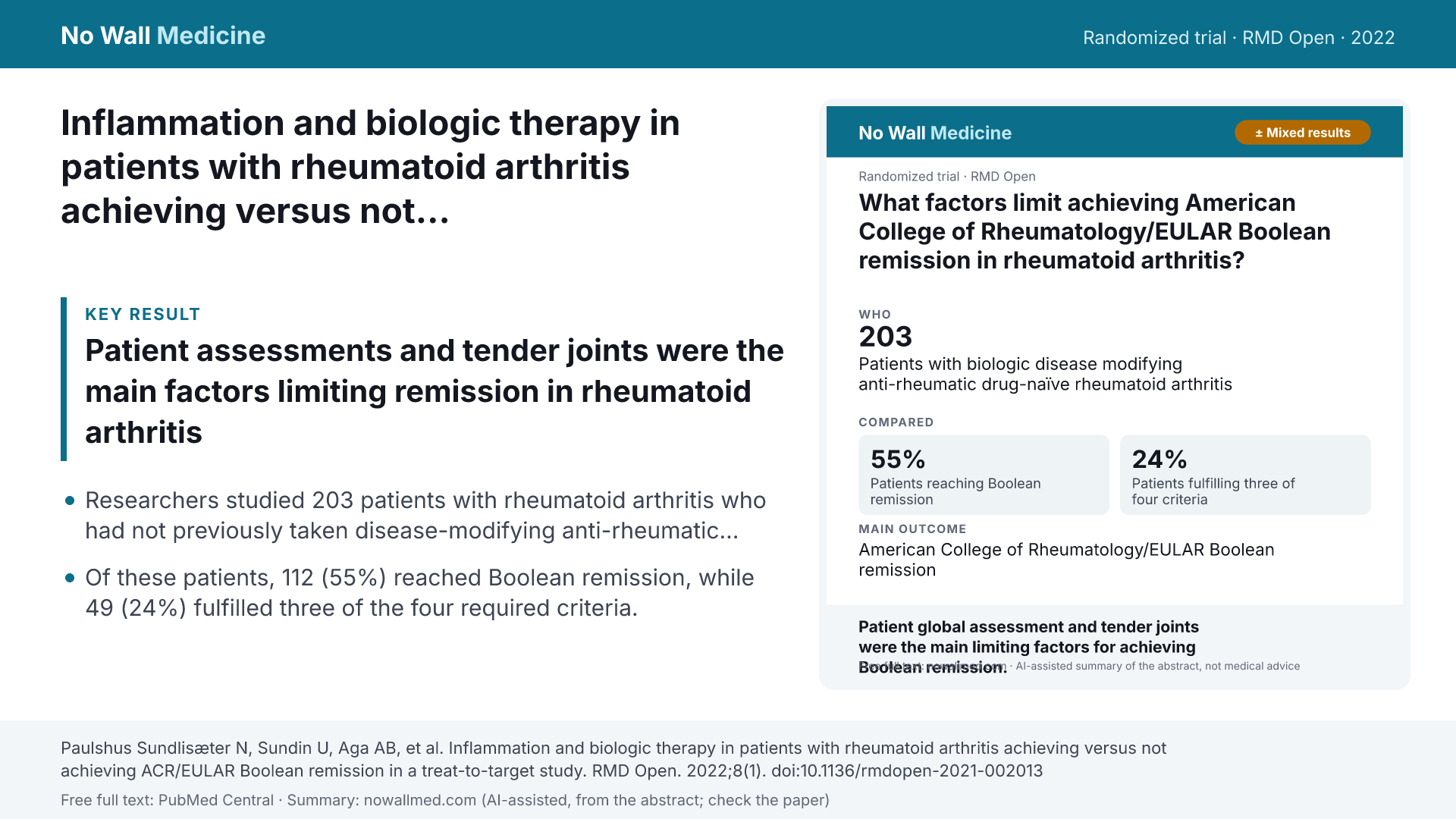
Patient assessments and tender joints were the main factors limiting remission in rheumatoid arthritis
Inflammation and biologic therapy in patients with rheumatoid arthritis achieving versus not achieving ACR/EULAR Boolean remission in a treat-to-target study
Randomized trialMixed results
What factors limit achieving American College of Rheumatology/EULAR Boolean remission in rheumatoid arthritis?
Who
203
Patients with biologic disease modifying anti-rheumatic drug-naïve rheumatoid arthritis
Compared
55%Patients reaching Boolean remission
24%Patients fulfilling three of four criteria
Main outcome
American College of Rheumatology/EULAR Boolean remission
Result: odds ratio 3.63 (95% CI 1.73 to 7.61)
Bottom line: Patient global assessment and tender joints were the main limiting factors for achieving Boolean remission.
RMD Open · 2022-01-29 · Save PNG
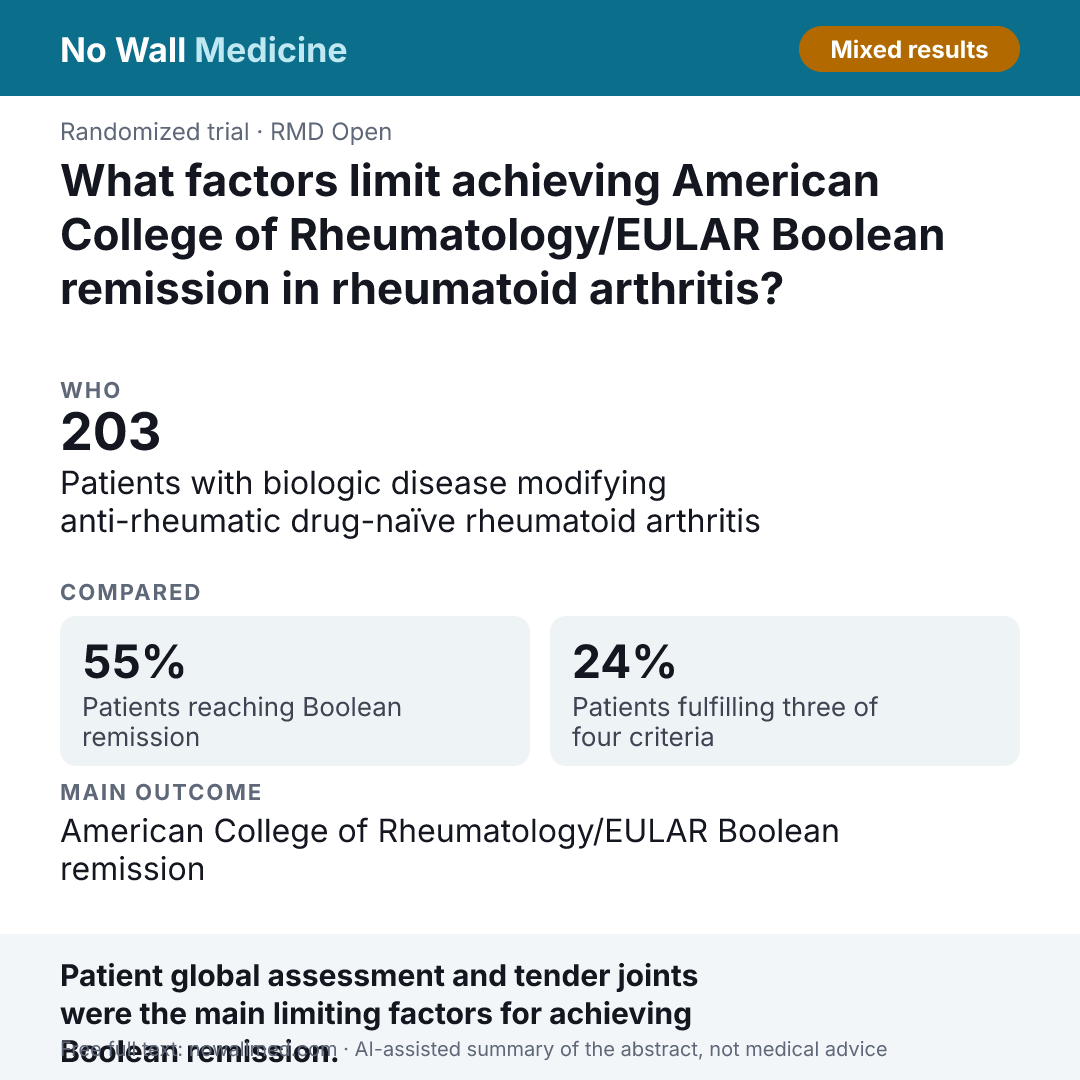
Clinical question: What factors limit achieving American College of Rheumatology/EULAR Boolean remission in rheumatoid arthritis?
Key points
- Researchers studied 203 patients with rheumatoid arthritis who had not previously taken disease-modifying anti-rheumatic drugs (DMARDs).
- Of these patients, 112 (55%) reached Boolean remission, while 49 (24%) fulfilled three of the four required criteria.
- Patient global assessment (59%) and tender joints (22%) were the primary factors preventing full remission, though imaging inflammation showed no significant difference.
Headline and key points written with AI from the paper’s abstract, with every number checked against it. Read the paper before relying on them.
Was this summary helpful?
Abstract
Objective
To investigate limiting factors of American College of Rheumatology (ACR)/EULAR Boolean remission in rheumatoid arthritis (RA), and compare patients who fulfil the criteria to patients who only partly fulfil the criteria, with respect to imaging inflammation and biologic disease modifying anti-rheumatic drug (DMARD) usage. Methods
Patients with DMARD-naïve RA were treated according to current recommendations in the the ARCTIC trial (Aiming for Remission in rheumatoid arthritis: a randomised trial examining the benefit of ultrasound in a Clinical TIght Control regimen). Limiting factors of reaching ACR/EULAR Boolean remission at 2 years were assessed. Imaging inflammation (ultrasound and MRI) in patients in remission was compared with patients failing to fulfil different components of the criteria. The OR of biologic therapy was calculated using logistic regression. Results
Of 203 patients, 112 (55%) reached ACR/EULAR Boolean remission; 49 (24%) fulfilled three of four criteria. The main limiting factors were patient global assessment (PGA) (59%) and tender joints (22%). Imaging inflammation was not significantly different for patients in remission and patients not fulfilling the criteria due to elevated PGA and/or tender joints, but higher odds of using biologics (OR 3.63, 95% CI 1.73 to 7.61) were observed. Conclusions
PGA and tender joints were the factors most often limiting achievement of ACR/EULAR Boolean remission. The level of imaging inflammation was not elevated in these patients compared with patients in remission, but the odds of using biologic DMARDs were higher.
Abstract reproduced under the article’s CC BY NC licence.
Subject terms
Headline, design, result, key points, caveat and citation as plain text.
Cite this article
Paulshus Sundlisæter N, Sundin U, Aga AB, et al. Inflammation and biologic therapy in patients with rheumatoid arthritis achieving versus not achieving ACR/EULAR Boolean remission in a treat-to-target study. RMD Open. 2022;8(1). doi:10.1136/rmdopen-2021-002013
Spotted a mistake? Suggest a correction