Urinary conversion factors affect accuracy of self-reported diet estimates
Influence of Conversion Factors on 24-Hour Urine-Derived Estimates Compared with Self-Reported Protein, Sodium, or Potassium Intake in Adults: A Systematic Review and Meta-analysis
Systematic review and meta-analysisMixed results
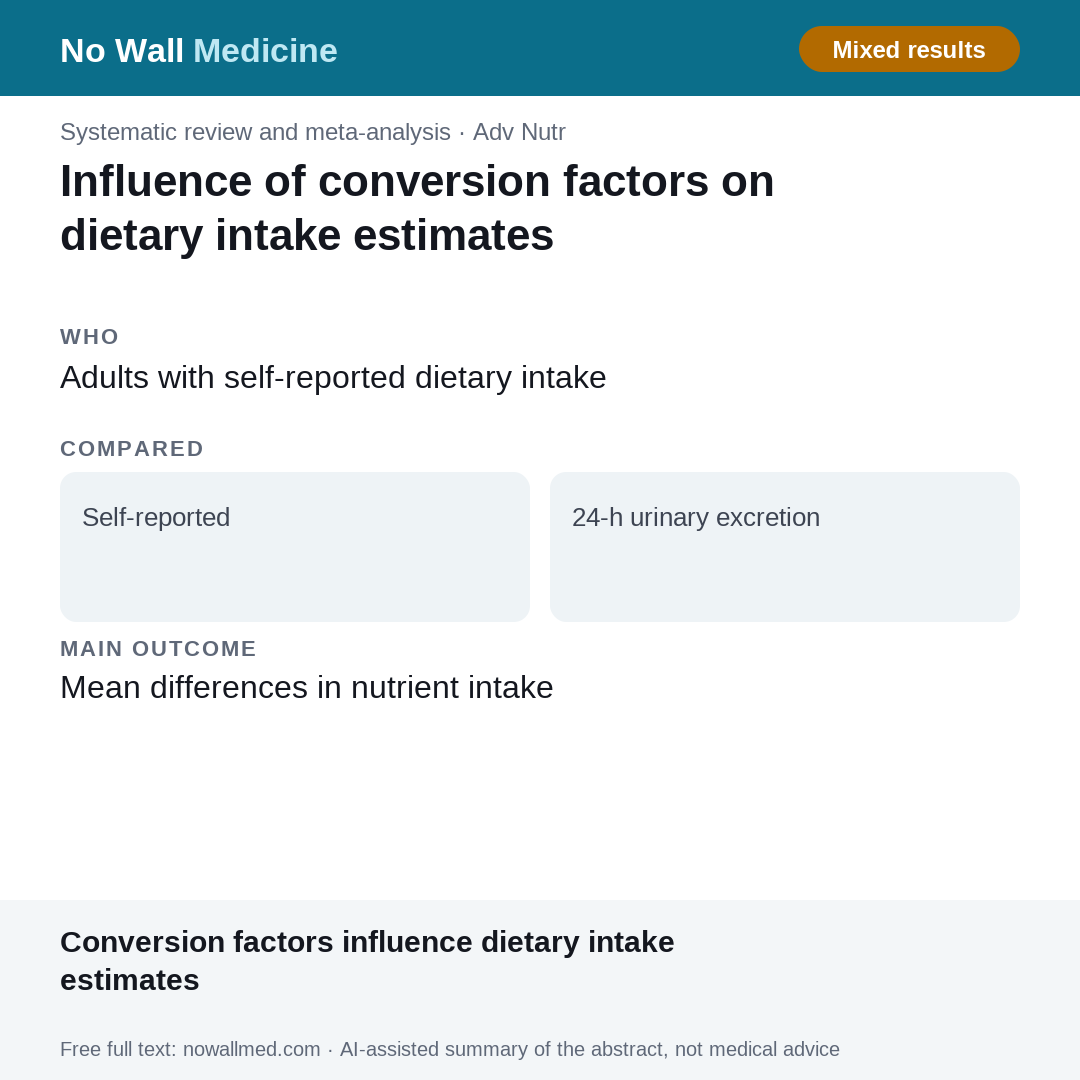
Influence of conversion factors on dietary intake estimates
Who
Adults with self-reported dietary intake
Compared
Self-reported
24-h urinary excretion
Main outcome
Mean differences in nutrient intake
Bottom line: Conversion factors influence dietary intake estimates
Limitation: Need for more accurate conversion equations
Adv Nutr · 2026-11-05Download image
Why it matters: Doctors need accurate dietary assessment methods to quantify nutrient intake
Key points
- Researchers compared self-reported diet and 24-hour urine collection in 176 studies of adults.
- Protein intake was misreported by -5.6% to +2.3%, sodium by -35.1% to -14.8%.
- Conversion factors influenced misreporting interpretations, especially for protein and potassium.
Limitation the authors note: The study relied on existing literature and did not collect new data
Headline and key points written with AI from the paper’s abstract, with every number checked against it. Read the paper before relying on them.
Cite this article
Takaoka T, Yaegashi A, Watanabe D. Influence of Conversion Factors on 24-Hour Urine-Derived Estimates Compared with Self-Reported Protein, Sodium, or Potassium Intake in Adults: A Systematic Review and Meta-analysis. Adv Nutr. 2026. doi:10.1016/j.advnut.2026.100761
Spotted a mistake? Suggest a correction