Adding electrical muscle stimulation to exoskeleton walking increased cardiorespiratory demand in people with spinal cord injury
Influence of gait-synchronized functional electrical stimulation during exoskeleton-assisted ambulation on cardiorespiratory outcomes in individuals with incomplete spinal cord injury
Randomized crossover studyBenefit found
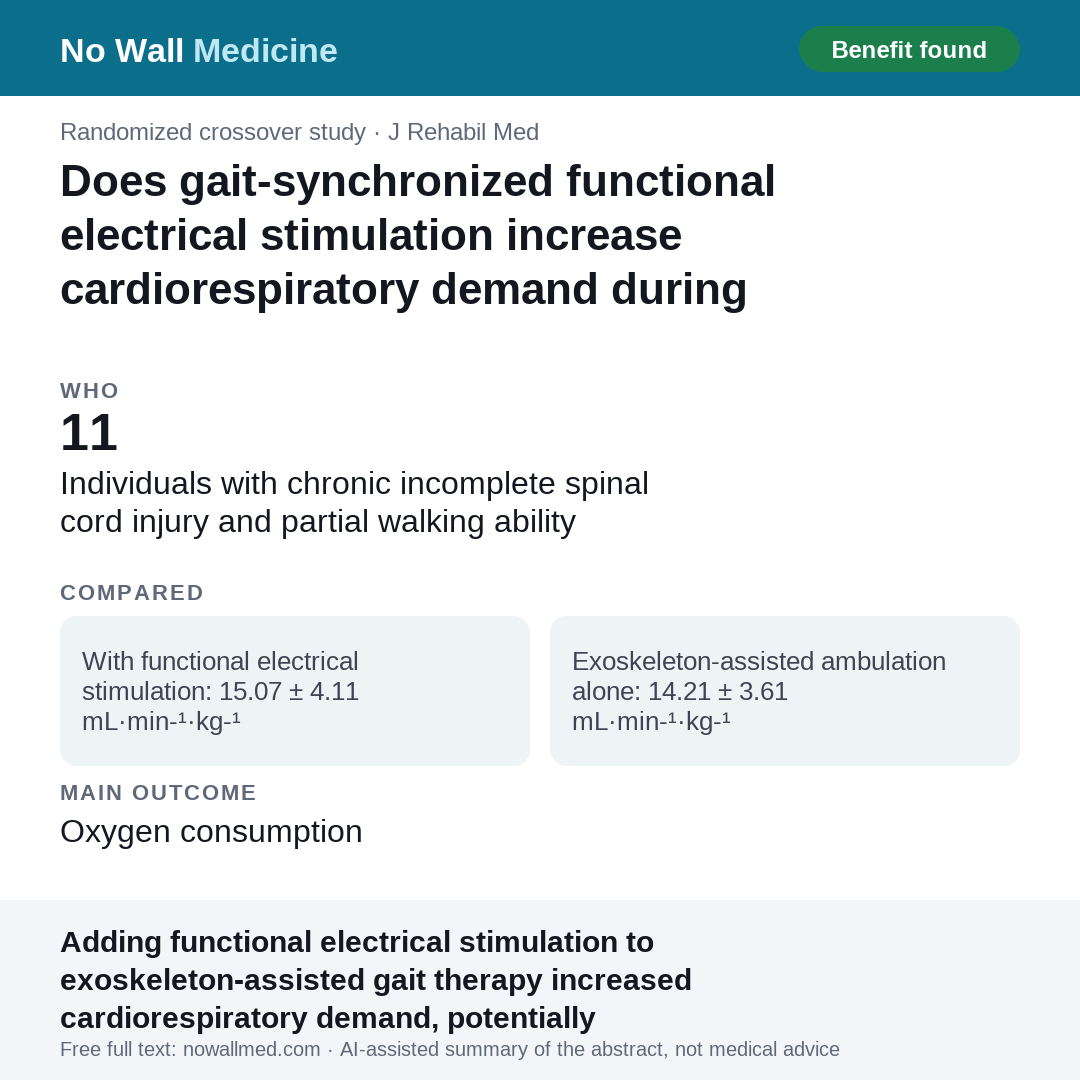
Does gait-synchronized functional electrical stimulation increase cardiorespiratory demand during exoskeleton-assisted walking?
Who
11
Individuals with chronic incomplete spinal cord injury and partial walking ability
Compared
With functional electrical stimulation: 15.07 ± 4.11 mL·min-¹·kg-¹
Exoskeleton-assisted ambulation alone: 14.21 ± 3.61 mL·min-¹·kg-¹
Main outcome
Oxygen consumption
Bottom line: Adding functional electrical stimulation to exoskeleton-assisted gait therapy increased cardiorespiratory demand, potentially enhancing training intensity.
J Rehabil Med · 2025-11-02Download image
Clinical question: Does gait-synchronized functional electrical stimulation increase cardiorespiratory demand during exoskeleton-assisted walking?
Why it matters: It is unclear how adding gait-synchronized functional electrical stimulation to exoskeleton-assisted walking affects the cardiorespiratory demand for people with incomplete spinal cord injury.
Key points
- The study looked at 11 individuals with chronic incomplete spinal cord injury and partial walking ability using a randomized crossover design.
- Oxygen consumption increased by 6% with gait-synchronized functional electrical stimulation compared to exoskeleton-assisted walking alone (15.07 ± 4.11 vs 14.21 ± 3.61 mL·min⁻¹·kg⁻¹).
- Heart rate, ventilation, and energy expenditure were also elevated, while distance and perceived exertion remained unchanged.
Headline and key points written with AI from the paper’s abstract, with every number checked against it. Read the paper before relying on them.
Topics
Cite this article
Voicu R, Kuchen DB, Perret C, Bersch I, Widmer M. Influence of gait-synchronized functional electrical stimulation during exoskeleton-assisted ambulation on cardiorespiratory outcomes in individuals with incomplete spinal cord injury. J Rehabil Med. 2025. doi:10.2340/jrm.v57.43423
Spotted a mistake? Suggest a correction